
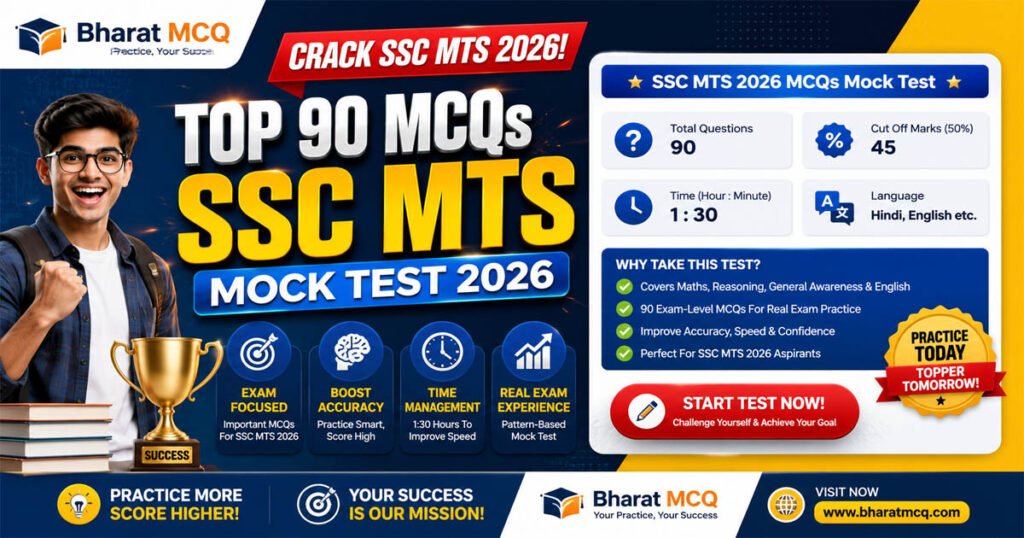
Practice SSC MTS mock test with 90 exam-level MCQs covering maths, reasoning, general awareness and English for better accuracy.
Table of Contents
SSC MTS Mock Test: Complete Practice for Serious Exam Preparation
SSC MTS is one of the most popular competitive exams for candidates who want a central government job after matriculation. The exam may look simple from a distance, but the actual competition is very high because lakhs of candidates apply every year. A candidate cannot depend only on basic knowledge or last-minute revision. To score well, regular MCQ practice, time management and accuracy are essential.
The official SSC examination system follows a computer-based format, and the SSC calendar lists Multi-Tasking Staff and Havaldar examination activity under the Commission’s scheduled examinations. This makes online-style mock practice very important. A mock test helps candidates understand how questions are framed, how options are designed and how quickly they can solve a full paper under pressure.
This SSC MTS mock test is prepared in an exam-oriented manner. It includes Numerical and Mathematical Ability, Reasoning Ability and Problem Solving, General Awareness, and English Language. These are the areas where candidates need both conceptual clarity and regular practice.
Importance of These Subjects in SSC MTS and Other Competitive Exams
Numerical and Mathematical Ability
Maths is a scoring subject if the candidate knows shortcuts, formulas and basic application. In SSC MTS, questions usually come from arithmetic, percentage, ratio, average, profit and loss, time and work, simple interest, compound interest, mensuration and data interpretation. These topics are not difficult, but they require speed.
A candidate who spends too much time on one calculation may lose marks in other sections. That is why the focus should be on quick calculation, approximation and choosing the right method. Regular practice of mixed arithmetic questions helps in improving both speed and confidence.
Reasoning Ability and Problem Solving
Reasoning checks the candidate’s ability to think logically. It does not require memorisation like general awareness, but it needs pattern recognition and careful reading. Questions may be based on series, analogy, classification, coding-decoding, direction sense, blood relation, syllogism, seating arrangement and statement-conclusion.
Many candidates make mistakes in reasoning because they hurry through the question. A single word such as “not”, “only”, “immediately” or “second to the left” can change the answer. Therefore, reasoning preparation should include both easy and moderate-level questions.
General Awareness
General Awareness plays a major role in SSC MTS because it saves time. If a candidate knows the answer, the question can be solved in a few seconds. The section generally includes Indian Polity, History, Geography, Economy, Science, Environment, Static GK, current government schemes and important facts related to India.
For this section, candidates should avoid random reading. Instead, they should prepare topic-wise notes. Constitution articles, amendments, national parks, rivers, soils, awards, books, sports and science basics should be revised regularly. Current facts should be checked from reliable and updated sources.
English Language and Comprehension
English is important for understanding instructions, solving grammar questions and improving overall score. SSC MTS English questions usually cover synonyms, antonyms, idioms, spelling, one-word substitution, error spotting, sentence improvement, fill in the blanks, voice, narration and basic comprehension.
Many candidates ignore English because they think it is difficult. However, this section can be improved with daily practice. Reading short passages, learning common words and revising grammar rules can bring steady improvement.
Types of Questions Asked in Real Exams
SSC-style exams do not ask only direct memory-based questions. They include a mix of direct, conceptual and application-based questions. For example, in maths, a question on percentage may be linked with profit and loss. In reasoning, a coding question may look simple but may involve a reverse pattern. In English, an error spotting question may test subject-verb agreement, article usage or preposition.
General Awareness also includes both static and current relevance. A candidate may be asked about constitutional provisions, government institutions, scientific facts, environmental issues or important cultural topics. This is why preparation should be broad but focused.
A real exam paper also contains gradual difficulty. Some questions are easy and can be solved quickly. Some require calculation or elimination. A few questions are designed to test the candidate’s attention. The best strategy is to attempt easy questions first, then return to time-consuming ones.
Practical Preparation Strategy for SSC MTS
Build a Topic-Wise Study Plan
Do not study randomly. Divide the syllabus into small topics. For maths, prepare percentage, ratio, average, profit and loss, time and work, speed, interest and mensuration separately. For reasoning, practise one topic at a time and then solve mixed sets.
Practise Daily MCQs
Daily MCQ practice is more useful than reading theory repeatedly. Solve at least one mixed practice set every day. After solving, check wrong answers carefully. The purpose of practice is not only to count marks but to identify weak areas.
Maintain an Error Notebook
Write down mistakes in a notebook. Divide them into calculation mistakes, concept mistakes, reading mistakes and guesswork mistakes. Before every mock test, revise this notebook. This simple habit can improve accuracy significantly.
Revise General Awareness Regularly
General Awareness cannot be mastered in one day. Revise static GK, science and polity every week. Make short notes for important articles, amendments, rivers, soils, vitamins, diseases, books and awards. For current information, use updated official or reliable sources.
Improve Calculation Speed
Learn multiplication tables, squares, cubes, percentage conversions and fraction values. These small tools save time in the exam. Avoid using long methods for every arithmetic question. Practise mental calculation wherever possible.
Take Full-Length Mock Tests
Sectional practice is useful, but full-length mock tests are necessary. A full mock test teaches time management, question selection and pressure handling. After every mock, analyse the paper. Check which section consumed more time and which type of question caused mistakes.
Common Mistakes Students Make
One common mistake is attempting questions in a fixed order even when some questions are time-consuming. In a competitive exam, smart selection is important. Candidates should first solve questions they are confident about.
Another mistake is over-guessing. Random guessing may reduce accuracy and confidence. Even when negative marking is not present in a specific section, blind guessing creates a false sense of performance during practice.
Many candidates also ignore English and General Awareness until the last stage. These subjects need continuous revision. English improves through repeated exposure, and General Awareness improves through planned revision.
In maths, students often know the formula but make calculation mistakes. In reasoning, they may miss one condition in seating arrangement or direction questions. In General Awareness, they may confuse similar facts, such as amendments, articles, years and locations.
Benefits of MCQ Practice
MCQ practice improves exam readiness because it trains the mind to identify the correct answer among close options. Competitive exam options are not always obvious. Sometimes two options look similar, and the candidate must apply exact knowledge.
Regular MCQ practice also improves speed. When candidates solve repeated patterns, they learn which method works best. For example, ratio questions, average questions and profit-loss questions often follow standard structures. Recognising these structures saves time.
Mock tests also build confidence. A candidate who has already solved many full-length papers feels less nervous during the actual exam. Practice also helps in understanding personal strengths and weaknesses.
Another major benefit is revision. One good MCQ can revise an entire concept. For example, a question on Article 32 reminds the candidate about constitutional remedies. A question on pH revises acids and bases. A question on subject-verb agreement revises grammar rules.
Internal CTA: Practice Test
This SSC MTS mock test is designed to help candidates practise in a real exam format. Attempt all 90 questions without taking long breaks. Set a timer, avoid using notes and treat the test seriously. After completing the paper, check your answers and analyse your mistakes.
For best results, repeat this process regularly with different mock tests. Focus on accuracy first, then speed. A disciplined practice routine can make a clear difference in SSC MTS, SSC Clerk, Police Bharti, Talati, PSI and other competitive exams.