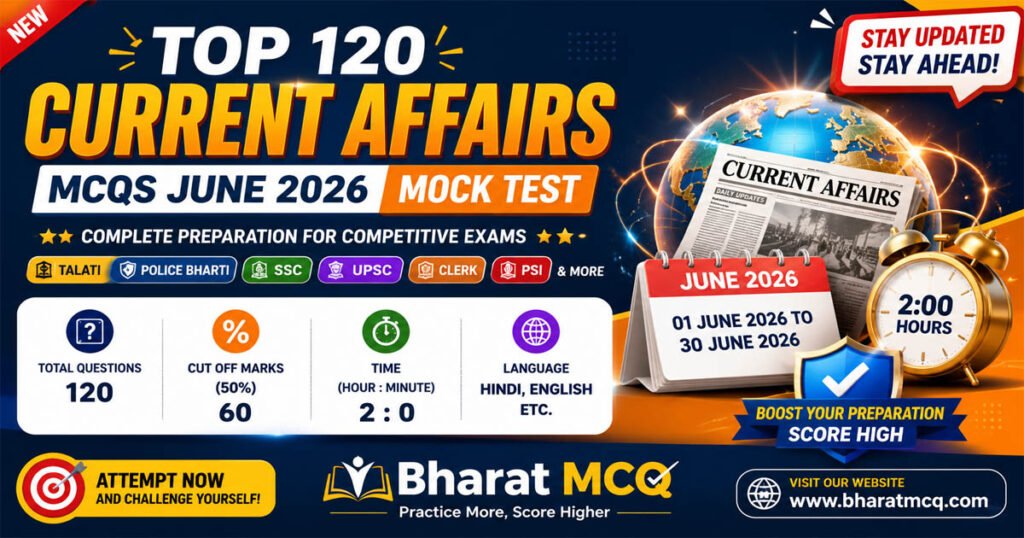
Practice Top 120 verified Current Affairs MCQs June 2026 from 01 June 2026 to 30 June 2026 for Talati, Police Bharti, SSC, UPSC, Clerk, PSI and other competitive exams.
Table of Contents
Current Affairs MCQs June 2026: 01 June 2026 to 30 June 2026
Current Affairs MCQs June 2026 is one of the most scoring sections in Indian competitive exams because it connects daily events with government policies, national development, economy, science, sports and international relations. The date range from 01 June 2026 to 30 June 2026 was especially important for exam preparation because it included major updates related to International Day of Yoga, PM-KISAN, Cabinet decisions, BRICS meetings, digital governance awards, economy, appointments, sports honours and important international days.
For aspirants preparing for Talati, Police Bharti, SSC, UPSC, Clerk, PSI and other government exams, June 2026 current affairs should not be studied randomly. The right approach is to focus on verified facts from authentic sources such as PIB releases, official government portals, RBI updates, ISRO releases and recognised national newspapers. PIB’s June 2026 release archive itself listed hundreds of official releases covering President’s Secretariat, Prime Minister’s Office, ministries, Cabinet decisions and public-policy updates.
Why Current Affairs MCQs June 2026 Matters for Exams
Competitive exams usually ask direct factual questions from recent events. For example, questions may ask the theme of International Day of Yoga 2026, the venue of a national event, the ministry linked with a scheme, the amount released under PM-KISAN, or the number of awards announced under a government programme. These are easy to medium-level questions, but they decide the final merit when competition is high.
June 2026 was rich in scheme-based and governance-based news. The 23rd instalment of PM-KISAN was released from Tarakeswar, Hooghly, West Bengal on 20 June 2026, with around Rs 18,880 crore transferred to more than 9.44 crore farmers. This is exactly the type of fact that appears in one-liner current affairs, prelims-style MCQs and state-level recruitment exams.
Key Highlights For Current Affairs MCQs June 2026
International Day of Yoga 2026
The 12th International Day of Yoga was observed on 21 June 2026 with the theme “Yoga for Healthy Ageing.” The main national celebration was held in Kolkata, West Bengal, and the Yoga Sangam Portal recorded large-scale participation across districts and organisations. PIB also reported that over 3 crore individuals participated through the Yoga Sangam Portal, making it an important current affairs topic for all exams.
Government Schemes and Cabinet Decisions
June 2026 included several exam-relevant government and Cabinet decisions. The Cabinet approved support to NCRPB for replacement of old trucks and buses in the Delhi-NCR area and also approved ATF price stabilisation support for Scheduled Indian Airlines, with budgetary support not exceeding Rs 10,000 crore. These decisions are useful for questions related to environment, transport, aviation and government policy.
The Cabinet also approved Ahmedabad Metro Rail Project Phase 2A and passed a resolution on 10 June 2026 applauding Prime Minister Narendra Modi for becoming India’s longest-serving elected Prime Minister for consecutive terms. Such items are important for polity and national current affairs sections.
Digital Governance and Awards
The National Awards for e-Governance 2026 were another high-value topic. A total of 17 projects or initiatives were selected across 7 categories, including 10 Gold Awards, 6 Silver Awards and 1 Jury Award. The e-Jagriti platform of the Department of Consumer Affairs won the Silver Award under Category I, making it a likely MCQ topic for governance, digital India and consumer affairs.
Science and Technology
Science and technology current affairs from June 2026 included strong ISRO-related updates. ISRO successfully conducted a hot test of the Semi-Cryogenic Engine Power Head Test Article at a thrust level of 175 tonnes at IPRC, Mahendragiri, Tamil Nadu. ISRO also hosted the BRICS Heads of Space Agencies 2026 meeting in Bengaluru during 23-24 June under India’s BRICS Chairship. These are important for UPSC, SSC, defence exams and state-level exams.
Economy and Finance
The economy section included RBI’s June 2026 monetary policy update, GST collection data and trade-related updates. RBI kept the repo rate unchanged at 5.25% and retained a neutral stance, while June 2026 GST collections stood at about Rs 1.95 lakh crore with 13.9% year-on-year growth. Economy-based current affairs are frequently asked in banking, SSC, UPSC and state service exams.
Sports and Honours
Sports current affairs included the inaugural Indian Athletics Awards, where Neeraj Chopra and Parul Chaudhary were honoured as Best Male and Best Female Athletes respectively. P. T. Usha and Anju Bobby George were among the legends honoured with Lifetime Achievement Awards. Sports honours are often asked as direct match-the-following or one-liner questions.
Importance of Practising Current Affairs MCQs June 2026
Reading current affairs is useful, but practising MCQs is essential. MCQs help aspirants remember dates, themes, ministries, venues, personalities and numerical data. The 120 questions above are designed in an exam-oriented style with four options and one correct answer. Aspirants should revise them multiple times, make short notes of confusing facts and connect each topic with its ministry or source.
How to Prepare This Monthly Current Affairs Set
First, revise important days and themes such as World Environment Day, World Oceans Day, International Day of Yoga, World MSME Day and National Statistics Day. Next, focus on government schemes such as PM-KISAN and major Cabinet approvals. After that, cover economy, appointments, awards, sports and science-technology updates. Finally, attempt the MCQs without looking at the answers and mark weak areas for revision.
June 2026 Current Affairs Mock Test: Important Questions with Detailed Explanations
(1) Question: Every year, World Environment Day is celebrated globally on June 5. Which international conference led to the official establishment of this day?
Answer: The Stockholm Conference on the Human Environment (1972)
Explanation: World Environment Day was established by the United Nations General Assembly in 1972 to mark the opening of the historic Stockholm Conference on the Human Environment. It serves as the primary United Nations vehicle for encouraging worldwide awareness and action for the protection of our environment.
(2) Question: The historic 2026 FIFA World Cup, which officially kicks off in the month of June 2026 across the US, Canada, and Mexico, features a major structural change. What is the total number of matches that will be played in this expanded edition?
Answer: 104 matches
Explanation: Kicking off in June 2026, the expanded 48-team tournament structure replaces the old 64-match blueprint. The teams are divided into 12 groups of 4, creating an expanded schedule of 104 matches played over 39 days.
(3) Question: The ‘Global Economic Prospects’ report, which is comprehensively updated and published every year in June, is released by which international financial institution?
Answer: The World Bank
Explanation: The World Bank releases its highly anticipated Global Economic Prospects report twice a year, in January and June. The June edition provides deep analytical insights into global economic growth trajectories, emerging market trends, and critical fiscal vulnerabilities.
(4) Question: The ‘Global Liveability Index’, which ranks cities worldwide based on stability, healthcare, culture, environment, education, and infrastructure, is published annually in June by which organization?
Answer: Economist Intelligence Unit (EIU)
Explanation: The Economist Intelligence Unit (EIU) releases its Liveability Index every June. It assesses more than 170 global cities to determine the most and least livable urban locations based on qualitative and quantitative risk scores.
(5) Question: International Day of Yoga is celebrated worldwide every year on June 21. In which year did the United Nations General Assembly (UNGA) officially pass the resolution to establish this day?
Answer: 2014
Explanation: Following an address by Prime Minister Narendra Modi in September 2014, the UNGA officially adopted a consensus resolution on December 11, 2014, establishing June 21—the summer solstice—as the International Day of Yoga, with the first global celebrations taking place in 2015.
(6) Question: The ‘SIPRI Yearbook’, which tracks international armaments, disarmament trends, and the exact state of global nuclear arsenals, is published annually in June by which independent institute?
Answer: Stockholm International Peace Research Institute (SIPRI)
Explanation: Based in Sweden, SIPRI releases its authoritative yearbook every June. It provides critical, independent data on global military expenditures, international arms transfers, and the changing deployment metrics of nuclear-armed nations.
(7) Question: India celebrates National Statistics Day every year on June 29 to commemorate the birth anniversary of which legendary scientist and statistician?
Answer: Prasanta Chandra Mahalanobis (P. C. Mahalanobis)
Explanation: National Statistics Day is celebrated on June 29 to honor the invaluable contributions of Professor P.C. Mahalanobis in the fields of economic planning and statistical development. He founded the Indian Statistical Institute (ISI) and formulated the structural blueprint for India’s Second Five-Year Plan.
(8) Question: The ‘World Competitiveness Ranking’, which analyzes and ranks economies based on how they manage their competencies to achieve long-term value creation, is published every June by which institutional entity?
Answer: International Institute for Management Development (IMD)
Explanation: The IMD World Competitiveness Center, based in Switzerland, releases its rankings every June. It evaluates countries using various criteria split into four main factors: Economic Performance, Government Efficiency, Business Efficiency, and Infrastructure.
(9) Question: The Reserve Bank of India (RBI) publishes its comprehensive ‘Financial Stability Report’ (FSR) bi-annually. In which two months of the calendar year is this statutory report regularly released?
Answer: June and December
Explanation: The RBI releases its Financial Stability Report twice a year, specifically in June and December. The report reflects the collective assessment of the Sub-Committee of the Financial Stability and Development Council (FSDC) regarding risks to financial stability and the resilience of the Indian financial ecosystem.
(10) Question: Every year, June 17 is observed globally as the World Day to Combat Desertification and Drought. Which landmark United Nations convention forms the direct organizational backing for this observance?
Answer: United Nations Convention to Combat Desertification (UNCCD)
Explanation: Declared by the UN General Assembly in 1994, this day marks the anniversary of the adoption of the UNCCD, the sole legally binding international agreement linking environment and land management to sustainable development.
(11) Question: In accordance with the fixed rotation cycle of the Group of Seven (G7), which European nation holds the rotating G7 presidency and serves as the official host for the annual summit in 2026?
Answer: France
Explanation: Following Canada’s presidency term in 2025, France assumed the official rotating presidency of the G7 for the 2026 calendar cycle, taking charge of setting the policy agenda, ministerial tracks, and hosting the 52nd G7 Leaders’ Summit.
(12) Question: The ‘Energy Transition Index’ (ETI), which benchmarks countries on the current performance of their energy systems and their readiness for a secure transition, is published periodically by which global organization?
Answer: World Economic Forum (WEF)
Explanation: The World Economic Forum, in collaboration with Accenture, publishes the Energy Transition Index. It tracks how nations balance energy security, environmental sustainability, and economic development to transition toward clean energy paths.
(13) Question: Under the Indian constitutional framework, which statutory authority is empowered to determine the structural allocation of central tax revenues between the Union government and the respective State governments?
Answer: The Finance Commission of India
Explanation: Constituted by the President under Article 280 of the Constitution, the Finance Commission serves as a quasi-judicial body tasked with making recommendations on the distribution of net tax proceeds between the Union and the States.
(14) Question: Every year, June 20 is observed globally as World Refugee Day. Which international agency under the United Nations mandate serves as the primary custodian responsible for protecting refugees worldwide?
Answer: United Nations High Commissioner for Refugees (UNHCR)
Explanation: Established in 1950, UNHCR (the UN Refugee Agency) is a global organization dedicated to saving lives, protecting rights, and building a better future for refugees, forcibly displaced communities, and stateless people around the world.
(15) Question: Which specialized regulatory body handles the formal legal registration, oversight, and dispute tracking for all Intellectual Property Rights (IPRs) related to Geographical Indications (GI Tags) in India?
Answer: Geographical Indications Registry (under the Controller General of Patents, Designs and Trade Marks)
Explanation: Based in Chennai, the Geographical Indications Registry operates under the Geographical Indications of Goods (Registration and Protection) Act, 1999. It administers GI tag certifications to protect the unique regional identity and quality of indigenous products.
(16) Question: The Shanghai Cooperation Organisation (SCO), which traditionally schedules its high-level Council of Heads of State summits around the mid-year cycle, is permanently headquartered in which capital city?
Answer: Beijing, China
Explanation: Formally established in 2001, the Shanghai Cooperation Organisation (SCO) is a major Eurasian political, economic, and security alliance. While its central administrative Secretariat is located in Beijing, its Regional Anti-Terrorist Structure (RATS) is permanently based in Tashkent, Uzbekistan.
(17) Question: What is the technical name given to the foundational sovereign network of digital public assets developed by India, which includes Aadhaar, UPI, and DigiLocker, and is globally referred to as ‘DPIs’?
Answer: Digital Public Infrastructure
Explanation: Digital Public Infrastructure (DPI) refers to blocks or platforms such as digital identity, payment infrastructure, and data exchange solutions that help countries deliver vital public services, fuel private sector innovation, and build a digital economy.
(18) Question: The Global Peace Index (GPI), which evaluates and ranks independent states and territories according to their level of peacefulness, is compiled and released annually by which international think tank?
Answer: Institute for Economics and Peace (IEP)
Explanation: Headed in Sydney, Australia, the Institute for Economics and Peace (IEP) releases the Global Peace Index report every year. It utilizes 23 qualitative and quantitative indicators to measure the state of peace across three core domains: societal safety, ongoing domestic conflict, and degree of militarization.
(19) Question: Under the standard operational guidelines of the Reserve Bank of India (RBI), what exact term is used to define the interest rate at which the central bank lends short-term money to commercial banks against government securities?
Answer: Repo Rate (Repurchase Rate)
Explanation: Repo Rate is a primary monetary policy tool used by the RBI to regulate liquidity and control inflation in the economy. When the repo rate is increased, borrowing becomes expensive for commercial banks, which helps slow down economic credit expansion.
(20) Question: The ‘Global Gender Gap Report’, which benchmarks the current state and evolution of gender parity across four core dimensions (Economic, Educational, Health, and Political), is published annually by which global entity?
Answer: World Economic Forum (WEF)
Explanation: First introduced in 2006, the Global Gender Gap Index is designed and published annually by the World Economic Forum (WEF). It tracks progress toward closing gender gaps over time, helping policy makers prioritize frameworks for gender equality.
Conclusion
The period from 01 June 2026 to 30 June 2026 offered many important exam-worthy current affairs topics. Aspirants who revise this month carefully can gain an advantage in upcoming Talati, Police Bharti, SSC, UPSC, Clerk, PSI and other competitive exams. Current affairs preparation becomes easier when facts are verified, organised and practised through MCQs. Stay consistent, revise regularly and treat every monthly current affairs set as a scoring opportunity.