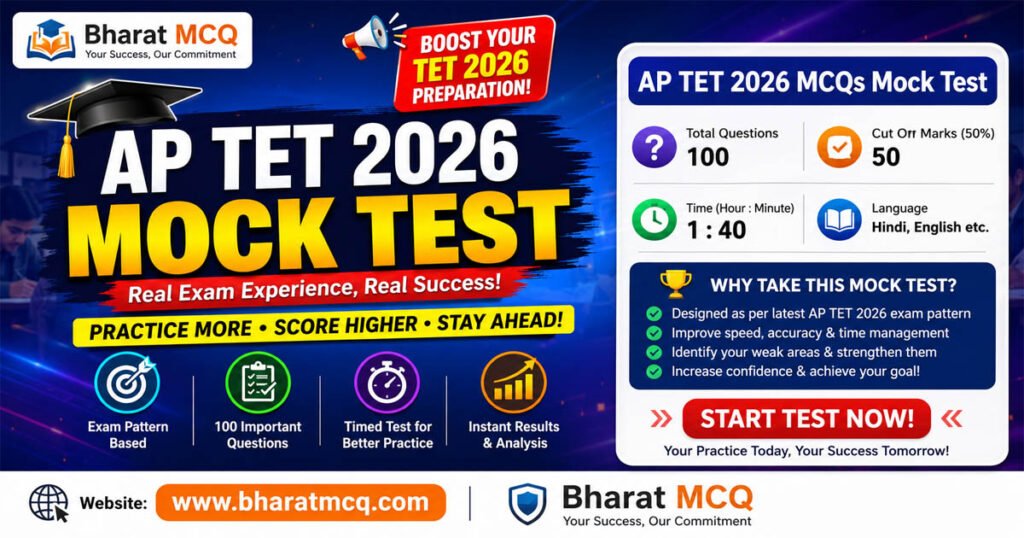
Attempt this AP TET 2026 mock test with 100 exam-level MCQs on CDP, language, English, Mathematics and EVS, plus answers and detailed explanations.
Table of Contents
AP TET 2026 Mock Test: 100 Practice Questions for Paper 1A Preparation
The Andhra Pradesh Teacher Eligibility Test is designed to assess whether a candidate possesses the subject knowledge, language competence, pedagogical understanding and analytical ability expected from a teacher. The official AP TET June 2026 Information Bulletin specifies that Paper 1A for Classes I to V contains 150 multiple-choice questions carrying 150 marks, with 30 questions each from Child Development and Pedagogy, Language I, compulsory English as Language II, Mathematics and Environmental Studies. The examination duration is two hours and thirty minutes, and there is no negative marking.
This practice set contains 100 questions and therefore functions as a proportionately condensed Paper-1A-style mock rather than a replacement for the official 150-question paper. Twenty questions are provided for each major area so that candidates can practice balanced time management and subject switching.
The official Paper 1A requires candidates to choose an eligible Language I such as Telugu, Urdu, Hindi, Kannada, Tamil or Odiya, while English is compulsory as Language II. Since this mock was requested entirely in English and no specific optional Language I was supplied, its Language-I practice questions concentrate on language structure, comprehension and pedagogy in a language-neutral manner. Candidates should additionally practice the grammar, literature and usage of their actual chosen Language I.
Importance of the AP TET Paper 1A Subjects
Child Development and Pedagogy
CDP is not simply a collection of definitions from educational psychology. Questions frequently require candidates to identify the most educationally appropriate action in a classroom situation. Preparation should cover development, learning theories, individual differences, assessment, inclusive education, motivation, mental health, guidance and learner-centred pedagogy.
Candidates should be able to distinguish closely related concepts. Reliability is different from validity, reinforcement is different from punishment, and formative assessment serves a different purpose from summative assessment. Application questions become much easier when these conceptual boundaries are clear.
Language and English
Language preparation should combine proficiency with pedagogy. The official Paper-1A framework allocates both content and pedagogy within the language components, with the bulletin indicating 24 content questions and six pedagogy questions in each 30-question language section.
Candidates should therefore study grammar, vocabulary, comprehension, meaning, sentence structure and communication while also understanding language acquisition, multilingual classrooms, error correction, reading development and assessment.
Mathematics
Mathematics requires conceptual clarity rather than dependence on memorized shortcuts. Important areas include arithmetic, ratio, percentage, averages, algebra, geometry, mensuration, probability and basic data interpretation.
For Paper 1A, the official framework states that Mathematics and EVS are based on topics from Classes III to VIII, while difficulty and linkages may extend to the secondary stage up to Class X. Questions may test critical, creative and analytical thinking. This makes conceptual practice particularly important.
Environmental Studies
EVS integrates science, environment, health and social understanding. Candidates should connect textbook concepts with daily-life situations involving water, biodiversity, food, human health, local government, maps, natural resources, pollution and disaster safety.
EVS pedagogy is equally significant. Field visits, observation, experimentation, projects, discussion and portfolio assessment are more consistent with meaningful EVS learning than rote memorization.
Types of Questions Asked in Realistic TET Practice
A strong preparation set should contain several types of MCQs. Direct conceptual questions check whether a candidate understands terminology. Classroom-situation questions test pedagogical judgement. Application questions require a familiar concept to be used in an unfamiliar situation. Error-analysis questions ask candidates to diagnose a learner’s misconception, while comprehension questions test interpretation rather than mere recall.
Mathematics questions may combine more than one operation or concept. CDP questions often contain several apparently reasonable options, requiring the candidate to choose the one most consistent with learner-centred teaching. Language questions similarly test whether candidates understand why a teaching technique works rather than simply recognizing its name.
Practical Preparation Strategy
Begin by dividing preparation according to the major Paper-1A components. Study one conceptual area and immediately solve MCQs from that area. Do not wait until the syllabus is completely revised before starting practice.
Maintain an error notebook with three categories: knowledge error, reasoning error and careless error. A knowledge error requires revision. A reasoning error requires comparison of concepts. A careless error requires a change in examination behaviour.
For Mathematics, write the essential step instead of solving everything mentally. For CDP, identify the underlying principle before reading the options closely. In EVS, connect textbook concepts to observable real-world examples. For English, analyse why incorrect options fail grammatically or contextually.
Timed practice should gradually become part of preparation. Because the official examination consists of 150 questions in 150 minutes, candidates effectively need disciplined pacing across the paper. Accuracy should nevertheless be developed before attempting maximum speed.
Common Mistakes Students Make
One common mistake is memorizing the names of psychologists without understanding their theories. Knowing that Vygotsky discussed the Zone of Proximal Development is less useful than being able to recognize scaffolding in a classroom situation.
Another mistake is treating pedagogy questions as opinion questions. The best answer should normally be selected according to established principles such as inclusion, active learning, diagnostic assessment and meaningful feedback.
In Mathematics, candidates often rush into calculation before identifying the relationship among quantities. Language errors frequently result from selecting an option that sounds familiar rather than checking grammar and context carefully. In EVS, rote preparation can become ineffective when a question presents the same scientific principle through a practical situation.
Benefits of Regular MCQ Practice
Good MCQ practice improves more than recall. It develops option elimination, conceptual discrimination, time management and the ability to detect misleading alternatives. It also makes weak areas visible.
After each mock, analyse every incorrect answer and every answer obtained through guessing. A guessed correct answer still represents uncertain knowledge. Revising such questions prevents false confidence and produces a more realistic picture of examination readiness.
20 Sample Questions with Detailed Explanations
Sample Question 1
Question: A child understands that the quantity of water remains unchanged when it is poured from a short, wide glass into a tall, narrow glass. According to Piaget, this ability is characteristic of which stage?
Correct Answer: Concrete operational stage.
Explanation: The child demonstrates conservation: the understanding that quantity remains constant despite a change in appearance. Piaget associated conservation with the concrete operational stage, when children begin applying logical reasoning to concrete objects and situations.
Sample Question 2
Question: Which practice is most likely to strengthen intrinsic motivation?
Correct Answer: Providing meaningful choices among appropriately challenging tasks.
Explanation: Intrinsic motivation arises from interest, competence, autonomy and satisfaction within the activity itself. Meaningful choice gives learners autonomy while an achievable challenge supports a sense of competence. External prizes may sometimes produce compliance but do not necessarily strengthen intrinsic interest.
Sample Question 3
Question: A test gives highly consistent results but fails to measure the intended ability. What is the test?
Correct Answer: Reliable but not valid.
Explanation: Reliability concerns consistency. Validity concerns whether the assessment actually measures the intended construct. Consistent measurement of the wrong construct can therefore be reliable without being valid.
Sample Question 4
Question: Which strategy helps reduce unnecessary working-memory load?
Correct Answer: Chunking information and using worked examples before gradually removing support.
Explanation: Working memory has limited capacity. Organizing information into manageable units and demonstrating complete solutions initially allows learners to concentrate on essential relationships. Support can then be faded as expertise develops.
Sample Question 5
Question: Compared with educational guidance, counselling is best described as what?
Correct Answer: A more individualized helping process addressing personal, educational or decision-related concerns.
Explanation: Guidance is often broader and may involve information or general assistance. Counselling normally involves more individualized interaction aimed at helping a learner understand difficulties, evaluate alternatives and make appropriate decisions.
Sample Question 6
Question: When a word produces emotional associations beyond its dictionary meaning, what is this called?
Correct Answer: Connotation.
Explanation: Denotation is the direct or literal meaning of a word. Connotation consists of additional ideas, emotions or cultural associations connected with it. Thus, “home” can denote a residence but connote safety or belonging.
Sample Question 7
Question: In the sentence “Although the trail was arduous, the climbers continued,” what does “arduous” mean?
Correct Answer: Difficult.
Explanation: The contrast created by “although” and the fact that the climbers continued despite the condition indicate that the trail required considerable effort. Context allows the meaning to be inferred without a dictionary.
Sample Question 8
Question: During a fluency-focused speaking activity, how should a teacher normally correct errors?
Correct Answer: Note important recurring errors and provide selective delayed feedback.
Explanation: Constant interruption can damage fluency and discourage communication. During a fluency task, maintaining meaningful interaction is important. Recurring or significant errors can be discussed after the activity without ignoring accuracy altogether.
Sample Question 9
Question: What is the correct reported form of “He said, ‘I have completed the work'”?
Correct Answer: He said that he had completed the work.
Explanation: When the reporting verb is in the past, the present perfect “have completed” normally shifts to the past perfect “had completed” in reported speech, assuming no special context requires the original tense.
Sample Question 10
Question: Choose the correct structure with “no sooner.”
Correct Answer: No sooner had the train arrived than the passengers rushed out.
Explanation: The standard construction is No sooner + had + subject + past participle + than. “Than,” not “when” or “then,” completes the paired structure.
Sample Question 11
Question: What does phonemic awareness involve?
Correct Answer: Hearing and manipulating individual speech sounds in spoken words.
Explanation: Phonemic awareness is an oral-language ability. A learner may identify, blend, segment, add or remove individual phonemes without seeing written letters. It supports later decoding and spelling development.
Sample Question 12
Question: Two successive discounts of 20% and 10% are equivalent to what single discount?
Correct Answer: 28%.
Explanation: Assume a price of 100. After a 20% discount it becomes 80. A further 10% discount on 80 is 8, producing a final price of 72. The total reduction is therefore 28%.
Sample Question 13
Question: A completes a task in 12 days and B in 18 days. How long do they take together?
Correct Answer: 7.2 days.
Explanation: A’s one-day work is 1/12 and B’s is 1/18. Their combined rate is 1/12 + 1/18 = 5/36. Therefore, the required time is 36/5 days, or 7.2 days.
Sample Question 14
Question: A chord in a circle of radius 13 cm is 5 cm from the centre. What is its length?
Correct Answer: 24 cm.
Explanation: The perpendicular from the centre bisects the chord. Taking half the chord as x, a right triangle gives x2+52=132. Thus x2=144, so x=12. The full chord is 24 cm.
Sample Question 15
Question: A learner writes 1/3 + 1/4 = 2/7. What should the teacher do?
Correct Answer: Use fraction strips or area models to develop equivalent fractions and a common denominator.
Explanation: The error shows that the learner is applying whole-number addition independently to the numerator and denominator. Concrete or visual fraction models help establish why unlike fractional parts must first be expressed in equivalent units.
Sample Question 16
Question: Where is the concentration of a biomagnifying pollutant generally highest?
Correct Answer: Top-level predators.
Explanation: Persistent pollutants may accumulate in organisms and become increasingly concentrated at successive trophic levels. Organisms near the top of the food chain therefore tend to receive the greatest accumulated concentration.
Sample Question 17
Question: Which practice helps reduce soil erosion on sloping agricultural land?
Correct Answer: Contour ploughing.
Explanation: Contour ploughing follows lines of equal elevation rather than directing furrows straight downhill. This slows water runoff, increases infiltration and reduces the removal of topsoil.
Sample Question 18
Question: Who constitutes the Gram Sabha?
Correct Answer: All persons registered in the relevant electoral rolls of the village or Panchayat area.
Explanation: The Gram Sabha represents the broader body of registered electors at the village level. It should not be confused with the Gram Panchayat, which consists of elected representatives.
Sample Question 19
Question: Learners believe that the Sun moves around the Earth each day to cause day and night. What is the best instructional response?
Correct Answer: Use a lamp and globe to investigate Earth’s rotation.
Explanation: Simply telling learners that their idea is wrong may leave the misconception unchanged. A physical model allows them to observe how rotation produces alternating illuminated and dark regions and supports conceptual reconstruction.
Sample Question 20
Question: Why is a portfolio useful for EVS assessment?
Correct Answer: It documents learning and growth over time through selected work, observations, feedback and reflection.
Explanation: A portfolio provides evidence from multiple stages of learning rather than a single test sitting. It can demonstrate progress in observation, projects, written work, reflection and application of EVS concepts.
Practice Test
Use the complete 100-question AP TET 2026 mock test above under timed conditions. After completing it, review incorrect and guessed responses subject-wise. Reattempt those questions after revision and compare whether the error came from weak content knowledge, misunderstanding of pedagogy, calculation mistakes or poor option analysis.