
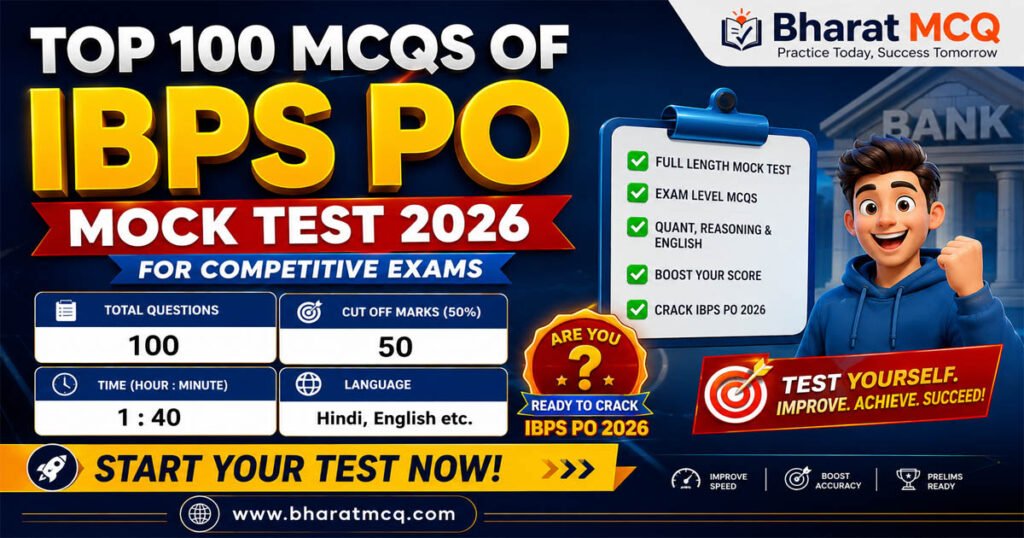
Practice a full IBPS PO mock test with 100 exam-level English, Quant and Reasoning MCQs. Improve speed, accuracy and prelims readiness.
Table of Contents
IBPS PO Mock Test: Complete Practice for Banking Exam Preparation
The IBPS PO exam is one of the most competitive banking exams in India. Every year, lakhs of candidates appear for this exam with the aim of becoming a Probationary Officer in public sector banks. The competition is high, and the exam does not test only knowledge. It tests speed, accuracy, decision-making, question selection and pressure handling.
A full-length IBPS PO mock test helps candidates understand the real exam pattern and the level of preparation required. The preliminary exam generally focuses on English Language, Quantitative Aptitude and Reasoning Ability. These sections are designed to check whether a candidate can solve banking-level questions within a limited time. Therefore, regular MCQ practice is not optional; it is a core part of serious preparation.
Importance of English, Quant and Reasoning in IBPS PO
English Language
The English section checks grammar, vocabulary, comprehension and sentence structure. Many candidates underestimate this section because they think it is less calculation-based. However, English can be a scoring section if prepared properly. Reading comprehension, error spotting, sentence improvement, fillers and para-jumbles are frequently seen in banking exams. The key requirement is clarity of language and quick elimination of wrong options.
Quantitative Aptitude
Quantitative Aptitude is one of the most important sections in IBPS PO. It includes arithmetic, simplification, approximation, number series, quadratic equations and data interpretation. This section demands both concept clarity and calculation speed. Candidates should not depend only on formulas. They must understand how to apply concepts in exam conditions.
Arithmetic topics such as profit and loss, percentage, ratio, time and work, simple interest, compound interest, probability and mixture are very important. Data interpretation questions often combine calculation with comparison, ratio, average and percentage.
Reasoning Ability
Reasoning Ability is used to test logical thinking and analytical skills. This section includes puzzles, seating arrangement, syllogism, coding-decoding, inequality, direction sense, blood relation, ranking and input-output. Reasoning can be highly scoring, but only if the candidate practices different patterns regularly.
In IBPS PO, puzzle-based questions may consume more time. Therefore, candidates must learn when to attempt a puzzle and when to skip it temporarily. Good reasoning preparation is not just about solving questions; it is about choosing the right order of attempts.
Types of Questions Asked in Real IBPS PO Exams
IBPS PO questions are generally moderate to difficult, especially when compared to basic clerical-level practice questions. The exam is designed to filter candidates who can perform under time pressure. In English, candidates may face reading comprehension based on banking, economy, technology, governance or social issues. Grammar questions may involve subject-verb agreement, tense, modifiers, parallelism and connectors.
In Quantitative Aptitude, simplification and approximation questions test calculation accuracy. Number series questions test pattern recognition. Quadratic equations check algebraic comparison. Data interpretation questions are based on tables, bar graphs, pie charts or caselets. Arithmetic questions are application-based and usually require two or more steps.
In Reasoning, seating arrangement and puzzle questions are common. These may involve linear arrangement, circular arrangement, floor-based puzzles, box puzzles or scheduling. Syllogism, inequality and coding-decoding are generally faster topics, but they still require accuracy. Input-output questions test pattern identification and sequence logic.
Practical Preparation Strategy for IBPS PO
A strong preparation plan should begin with the syllabus and exam pattern. Candidates should divide their preparation into three stages: concept building, topic-wise practice and full mock testing.
First, revise the basic concepts of each subject. In Quant, focus on percentage, ratio, average and simplification because these topics support many other chapters. In Reasoning, learn standard rules for syllogism, inequality and arrangement questions. In English, revise grammar rules and read short editorials to improve comprehension.
Second, practice topic-wise questions. Do not jump directly to full-length mocks without building accuracy. For example, solve 50 questions on quadratic equations, then 50 on number series, and then move to mixed Quant practice. Similarly, practice different types of puzzles instead of repeating only one pattern.
Third, take full-length mock tests. While taking mocks, follow exam discipline. Use a timer, avoid distractions and do not pause the test. After completing the mock, analyse it carefully. Check which questions were wrong, which questions took too much time and which questions should have been skipped.
Common Mistakes Students Make
One major mistake is attempting every question with equal priority. In IBPS PO, question selection is very important. Some questions are designed to consume time. Candidates should first solve questions that are familiar and less time-consuming.
Another common mistake is ignoring mock analysis. Taking many tests without analysis does not improve performance. Candidates must maintain a notebook of mistakes. Write down calculation errors, grammar confusion, wrong assumptions in puzzles and slow topics.
Many students also over-focus on difficult puzzles and ignore scoring topics. Syllogism, inequality, direction sense, simplification, approximation and fillers can help improve overall attempts. These topics should be revised regularly.
In English, students often answer by instinct without checking grammar logic. This leads to avoidable mistakes. In Quant, students sometimes use lengthy methods even when approximation or ratio-based solving is enough. In Reasoning, candidates may misread conditions such as immediate left, second to right, not at an end or facing north.
Benefits of MCQ Practice for IBPS PO
MCQ practice helps candidates understand how options are designed. In competitive exams, wrong options are not random. They are often based on common mistakes. Regular MCQ practice improves elimination skills and reduces confusion.
Mock tests also improve speed. When candidates repeatedly solve exam-level questions, they become faster in identifying patterns. For example, number series patterns, seating arrangement structures and grammar errors become easier to detect.
Another benefit is confidence under pressure. The real exam environment can create stress. Full-length mock practice trains the mind to stay calm and manage time. It also helps candidates decide how many questions they can realistically attempt with accuracy.
MCQ practice is also useful for revision. Instead of only reading theory, candidates can revise concepts through questions. This method is more practical for banking exams because the final score depends on solving ability, not just memory.
Practice Test for IBPS PO Aspirants
The mock test above is designed for serious IBPS PO preparation. It covers English Language, Quantitative Aptitude and Reasoning Ability in a balanced way. The questions are suitable for prelims-level practice and include conceptual as well as application-based MCQs.
Candidates should attempt the test in one sitting and then calculate their score. Do not look at the answers while solving. After the test, review every incorrect question and identify the reason behind the mistake. If the mistake is conceptual, revise the topic. If it is due to speed, practice more timed sets. If it is due to carelessness, improve reading and calculation discipline.
Use this IBPS PO mock test as a regular practice resource. Attempting one test is useful, but consistent practice is what builds exam readiness. A candidate who combines concept clarity, timed practice and proper analysis has a much better chance of performing well in the actual banking exam.