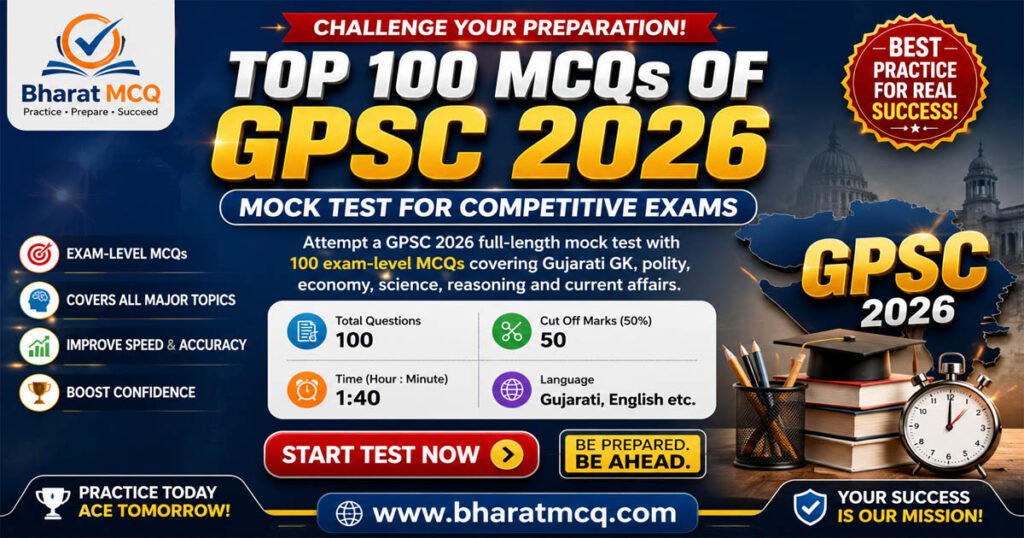
Attempt a GPSC 2026 full-length mock test with 100 exam-level MCQs covering Gujarat GK, polity, economy, science, reasoning and current affairs.
Table of Contents
GPSC 2026 Mock Test: Why Full-Length MCQ Practice Matters
The GPSC 2026 examination demands more than simple memorisation. A serious candidate must understand Gujarat-specific facts, Indian polity, economy, geography, history, science, technology, reasoning and current affairs in an integrated manner. Recent GPSC preparation patterns place strong importance on General Studies, and the syllabus broadly covers Indian history and heritage, Gujarat-related topics, Constitution, polity, economy, geography, science and current events.
A full-length mock test helps candidates experience the actual pressure of an objective competitive exam. It checks speed, accuracy, question selection and conceptual clarity. For GPSC aspirants, mock practice is useful because the exam does not ask only direct facts. Many questions are framed around application, comparison, elimination and administrative understanding.
Importance of These Subjects in Competitive Exams
GPSC is a state-level civil services examination, but its standard overlaps with several national-level competitive exams. History and culture test a candidate’s awareness of India’s civilisational background and Gujarat’s contribution to national life. Gujarat topics are especially important because candidates are expected to know the state’s geography, administration, economy, heritage and public institutions. For example, official Gujarat state data for 2024-25 lists 33 districts, 251 talukas and 17 municipal corporations, which makes such administrative facts important for state-level preparation.
Indian polity is another high-scoring area if studied systematically. Articles, constitutional bodies, federal relations, Parliament, judiciary, Panchayati Raj and governance concepts frequently appear in competitive exams. Economy questions usually test concepts such as inflation, GDP, taxation, fiscal deficit, GST, banking, agriculture and planning. Geography questions cover rivers, soils, climate, natural resources, industries and maps.
Science and technology have also become more relevant. Questions may come from health, environment, biotechnology, space technology, digital governance and cyber security. Current affairs connect all these subjects. For example, Garba of Gujarat being inscribed by UNESCO in 2023 is important for both culture and current affairs.
Types of Questions Asked in Real Exams
Real GPSC-style questions are usually not random one-line facts. They test whether the student can identify the correct statement among closely related options. Some questions are factual, such as articles of the Constitution or locations of important places. Some are conceptual, such as why GST is called a destination-based tax or why high BOD indicates water pollution.
Application-based questions are also common. A question may describe a public servant facing a conflict of interest and ask for the most ethical response. A geography question may connect soil type with crop suitability. An economy question may ask the meaning of revenue deficit rather than simply asking for a definition. Reasoning questions test series, ratios, time and work, averages, syllogism and basic quantitative aptitude.
Current affairs questions are most useful when connected with static subjects. The Digital Personal Data Protection Act, 2023 is linked with privacy, digital governance and citizen rights. COP28 is relevant not merely as an event but because its outcome referred to transitioning away from fossil fuels in energy systems.
Practical Preparation Strategy for GPSC 2026
Start with the syllabus and divide preparation into fixed blocks. Keep separate notebooks or digital files for Gujarat GK, polity, economy, geography, science, current affairs and reasoning. Study static subjects first because they give stability to preparation. Polity, geography and history should be revised multiple times because they contain many repeatable concepts.
For Gujarat-specific preparation, focus on districts, rivers, ports, cultural sites, personalities, industries, wildlife areas, administrative structure and government institutions. Do not study Gujarat GK as isolated facts. Connect Kutch with geography, ports with economy, Garba with culture, and GIFT City with financial services.
For current affairs, avoid collecting unlimited material. Prepare issues that have exam value: constitutional amendments, major laws, environment summits, government schemes, international organisations, awards, reports and Gujarat-related updates. Make short notes in question-answer format.
Reasoning and mathematics should be practised daily. Many candidates ignore aptitude and lose marks in easy areas. Solve series, percentage, ratio, average, time and work, clock, direction, coding-decoding and syllogism questions under a timer.
Common Mistakes Students Make
The first mistake is reading too many sources without revision. GPSC preparation requires repeated revision, not unlimited material. The second mistake is ignoring Gujarat-specific content. Since GPSC is conducted for Gujarat services, state-related knowledge can make a major difference.
The third mistake is treating current affairs as daily news collection. Not every news item is useful. Students should focus on exam-relevant facts and their background. The fourth mistake is not analysing mock tests. Attempting a mock test without reviewing wrong answers gives limited benefit.
Another common mistake is overconfidence in familiar subjects. A candidate may know polity theory but still make mistakes in article-based questions. Similarly, a student may know history but fail when options are framed chronologically. Accuracy must be built through practice.
Benefits of MCQ Practice
MCQ practice improves elimination skills. In real exams, candidates may not know every answer directly, but they can remove wrong options through logic. Regular practice also improves speed. A full-length mock helps students understand how much time they spend on factual questions, reasoning questions and lengthy application-based questions.
Mock tests also reveal weak areas. If a student repeatedly makes mistakes in economy, it means the concepts need revision. If errors occur in current affairs, notes may be too scattered. If reasoning consumes too much time, daily timed practice is required.
A good MCQ set also trains the mind to read carefully. Words like “primarily,” “best,” “notable,” “generally” and “most appropriate” are important in competitive exams. Many wrong answers happen because students read the question too quickly.
Practice Test
This GPSC 2026 mock test is designed to give aspirants a full-length practice experience with 100 MCQs. Attempt the test in one sitting, mark doubtful questions separately and review every incorrect answer after completion. Focus on accuracy first, then gradually improve speed. Reattempt the same test after revision to measure improvement and strengthen exam readiness.