
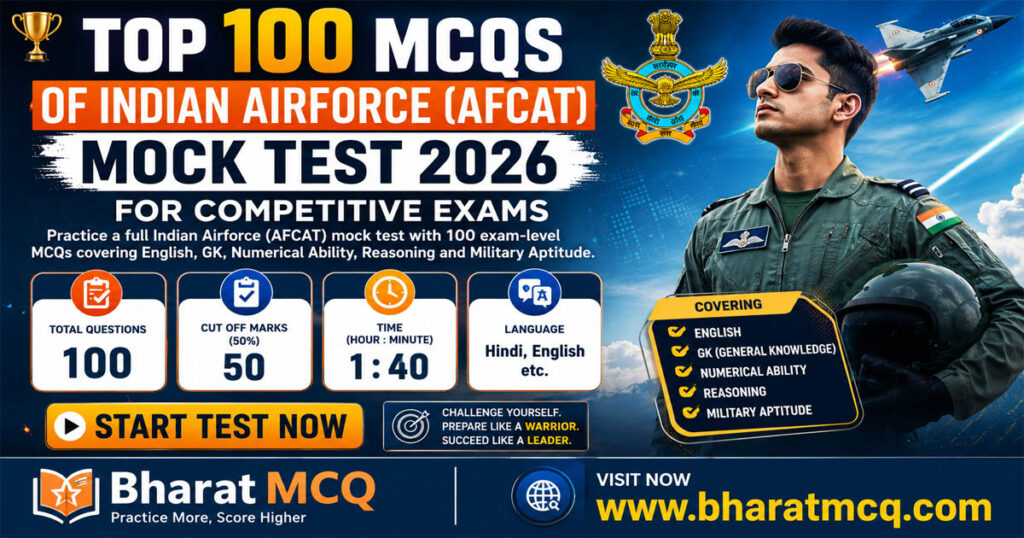
Practice a full Indian Airforce (AFCAT) mock test with 100 exam-level MCQs covering English, GK, Numerical Ability, Reasoning and Military Aptitude.
Table of Contents
Indian Airforce (AFCAT) Mock Test: Complete Practice for Indian Air Force Aspirants
The Indian Airforce Common Admission Test, commonly known as AFCAT, is one of the most important defense entrance exams for candidates who want to join the Indian Air Force as commissioned officers. The exam is designed to test not only subject knowledge but also speed, accuracy, reasoning ability, awareness and decision-making under pressure. As per the official AFCAT FAQ, the exam is an objective test of two hours with 100 questions, covering General Awareness, English, Numerical Ability, Reasoning and Military Aptitude.
A serious Indian Airforce (AFCAT) aspirant must treat mock tests as a core part of preparation, not as a final-week activity. A full-length mock test helps candidates understand the real pressure of solving mixed questions within a limited time. Since every correct answer carries marks and every wrong answer attracts negative marking, selection depends on controlled accuracy as much as knowledge. The official AFCAT syllabus document confirms that three marks are awarded for every correct answer, one mark is deducted for every incorrect answer, and no marks are given for unattempted questions.
Importance of Indian Airforce (AFCAT) Subjects in Competitive Exams
Indian Airforce (AFCAT) includes four major areas: English, General Awareness, Numerical Ability, and Reasoning with Military Aptitude. Each area has a different purpose. English checks comprehension, grammar, vocabulary and sentence clarity. This is important because officers are expected to communicate precisely in written and spoken situations.
General Awareness tests whether the candidate understands India, the world, defence affairs, polity, history, geography, economy and science. AFCAT does not expect only memorised facts; it often checks whether the candidate can connect facts with national and strategic relevance.
Numerical Ability measures basic mathematical application. The questions are not usually advanced mathematics, but they demand quick calculation, ratio handling, percentage sense, time and work logic, profit and loss clarity, and speed-distance accuracy.
Reasoning and Military Aptitude are crucial because they test the ability to think logically, recognise patterns, handle directions, analyse relationships and make quick mental decisions. These skills are highly relevant for defence services, where situational awareness and clarity of thought matter.
Types of Questions Asked in Real Indian Airforce (AFCAT) Exams
AFCAT questions are usually objective and direct, but they are not random. In English, candidates may face synonyms, antonyms, idioms, sentence correction, error detection, fill in the blanks and voice or narration-based questions. The challenge is not only knowing the rule but applying it quickly.
In General Awareness, questions may come from Indian history, freedom movement, Constitution, defence institutions, geography, awards, sports, science and current affairs. Defence-related awareness is especially useful because the exam is connected to the Indian Air Force and officer-level selection.
Numerical questions generally include percentage, average, ratio and proportion, simple and compound interest, time and work, speed and distance, mixture, probability and basic algebra. A candidate who knows formulas but lacks practice may still lose marks because AFCAT is time-bound.
Reasoning questions include analogy, coding-decoding, series, blood relation, ranking, direction sense, syllogism, seating arrangement, odd one out and spatial ability. Military Aptitude questions may also test practical orientation, observation and structured thinking.
Practical Preparation Strategy for Indian Airforce (AFCAT)
Start preparation by understanding the exam pattern and syllabus. Do not prepare only one favourite subject. AFCAT rewards balanced preparation. A candidate strong in English but weak in Reasoning may lose the advantage, while a candidate good in maths but careless in General Awareness may miss easy marks.
For English, read editorials, defence-related articles and quality newspapers. Maintain a notebook for difficult words, idioms and commonly confused grammar rules. Practise error detection daily because it improves grammar faster than passive reading.
For General Awareness, divide the syllabus into static and current portions. Static topics include Constitution, history, geography, science and defence basics. Current topics should be revised from reliable monthly compilations, but avoid memorising every small event. Focus on appointments, defence exercises, space missions, major awards, sports results and national schemes.
For Numerical Ability, build speed through repeated practice. Learn shortcuts only after understanding the basic method. Maintain a formula sheet for percentage, profit and loss, interest, time and work, and speed-distance questions. Revise it every week.
For Reasoning, solve mixed sets instead of practising only one chapter for too long. In the real exam, questions do not come chapter-wise. Mixed practice improves switching ability and reduces mental hesitation.
Common Mistakes Indian Airforce (AFCAT) Aspirants Make
One common mistake is attempting too many questions without considering negative marking. AFCAT is not only a test of knowledge; it is a test of judgement. Blind guessing can reduce the final score.
Another mistake is ignoring English. Many candidates assume English is easy and postpone it. In reality, vocabulary and grammar improve gradually, not overnight. Regular practice is essential.
Some aspirants study General Awareness without revision. Facts fade quickly if they are not revised. A better method is weekly revision with short MCQ practice.
In Numerical Ability, candidates often depend too much on lengthy calculations. AFCAT requires smart approximation, option elimination and time control. If one question takes too long, it can affect the whole paper.
In Reasoning, students sometimes solve questions mechanically without reading conditions carefully. Words like “only”, “not”, “immediate”, “all”, “some” and “either” can change the entire answer.
Benefits of MCQ Practice for Indian Airforce (AFCAT)
MCQ practice improves exam temperament. It trains the mind to read quickly, compare options and eliminate wrong answers. Full-length mocks also help candidates identify weak areas. After every mock test, spend time analysing mistakes. Check whether the mistake was due to lack of knowledge, calculation error, poor time management or misreading.
Practising MCQs also improves confidence. When candidates solve exam-level questions regularly, they become familiar with the tone of the paper. This reduces anxiety during the actual exam.
A good AFCAT mock test should include all sections in balanced proportion. It should not be too easy, because the real exam checks competitive performance. It should also avoid outdated or irrelevant questions. The purpose of a mock is to train the candidate for the actual exam environment.
Practice Test
Use the AFCAT mock test above as a full-length timed practice paper. Set a timer for two hours, attempt the questions without interruption, and then calculate your score using the official marking approach: +3 for every correct answer and -1 for every wrong answer. After scoring, revise every incorrect and doubtful question. Reattempt the same paper after a few days to check improvement in accuracy, speed and confidence.