
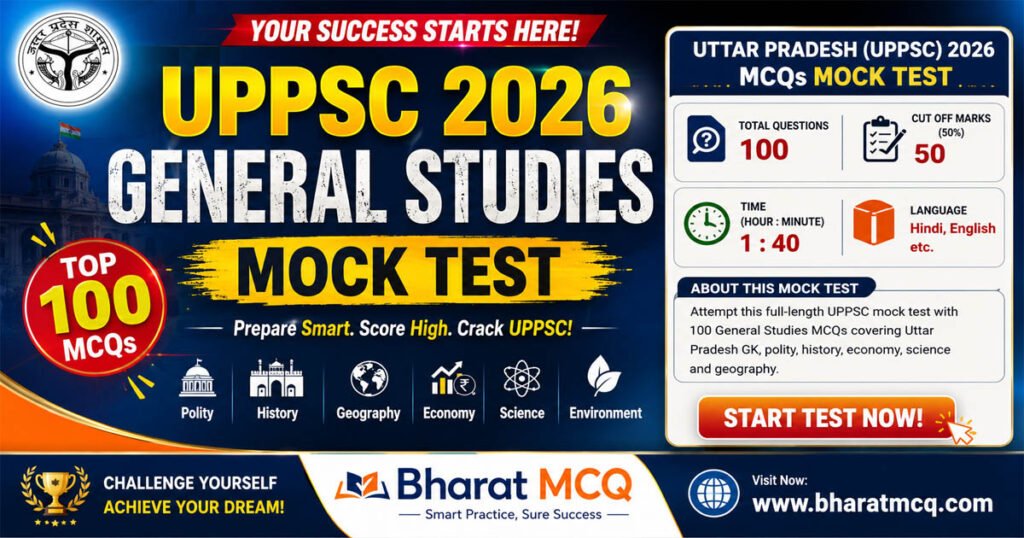
Attempt this full-length UPPSC mock test with 100 General Studies MCQs covering Uttar Pradesh GK, polity, history, economy, science and geography.
Table of Contents
UPPSC Mock Test 2026: 100 General Studies Questions
Introduction
The Uttar Pradesh Public Service Commission Combined State/Upper Subordinate Services Examination requires a broad and connected understanding of General Studies. Candidates must study national subjects such as Indian polity, history, geography, economy, environment, science and social development while also giving sufficient attention to Uttar Pradesh-specific topics.
This full-length UPPSC mock test contains 100 carefully structured multiple-choice questions. The paper begins with direct factual and conceptual questions and gradually moves towards statement-based, analytical and application-oriented problems. This pattern helps candidates assess not only what they remember but also how effectively they can apply concepts under examination conditions.
The mock test is particularly useful for UPPSC PCS Preliminary Examination preparation, revision sessions, sectional assessment and time-management practice. It covers stable concepts and important areas that regularly form the foundation of State PCS questions.
Importance of General Studies in UPPSC
General Studies is central to the UPPSC selection process. A candidate cannot depend on one or two strong subjects because the preliminary examination tests knowledge across several disciplines.
Uttar Pradesh-specific knowledge is especially important. Questions may be based on the state’s history, rivers, soils, agriculture, industries, cultural centres, wildlife areas, administrative institutions and role in the national movement. Candidates should connect state-specific facts with wider national themes. For example, the Chauri Chaura incident must be studied within the context of the Non-Cooperation Movement, while the agricultural geography of Uttar Pradesh should be connected with irrigation, soil conditions and cropping patterns.
Indian polity is another high-value area because it is conceptual and comparatively predictable. Fundamental Rights, Parliament, federalism, constitutional bodies, local government and judicial review must be understood rather than memorised mechanically.
History and culture require chronological clarity. Candidates should know major developments from ancient India, the Delhi Sultanate, the Mughal period, colonial administration and the freedom movement. In geography and environment, the examination often tests the relationship between physical processes and their practical consequences.
Economy, science and social development questions assess the candidate’s ability to interpret familiar concepts in real situations. Inflation, fiscal deficit, monetary policy, biotechnology, public health, poverty, education and financial inclusion should therefore be studied through examples.
Types of Questions Asked in Real Exams
UPPSC questions can broadly be classified into four categories.
Direct Knowledge Questions
These test accurate recall. Examples include the location of Dudhwa National Park, the constitutional Schedule containing anti-defection provisions or the site associated with the Buddha’s first sermon.
Conceptual Questions
These assess whether candidates understand the meaning of a term or process. Questions on fiscal deficit, biodiversity hotspots, social audits and demographic dividend belong to this category.
Statement-Based Questions
Such questions present two or more statements and ask candidates to identify the correct combination. They demand careful reading because one incorrect statement changes the answer.
Application-Based Questions
These describe an administrative, economic, agricultural or environmental situation. Candidates must identify the concept being applied. Questions involving groundwater depletion, direct benefit transfers, open market operations and wetland restoration follow this pattern.
Practical Preparation Strategy
Begin with the official syllabus and divide it into manageable units. Prepare separate revision sheets for Uttar Pradesh history, geography, culture, administration, industries and important locations. Maps are particularly useful for rivers, neighbouring states, wildlife reserves, industrial centres and historical sites.
For polity, read every topic with its constitutional basis. Do not learn isolated article numbers without understanding their purpose. Compare institutions such as the Finance Commission, Election Commission, Comptroller and Auditor General, Parliament and State Legislatures.
Create timelines for history. Place major dynasties, administrative reforms, movements and Congress sessions in chronological order. This reduces confusion between similar events.
In economy, focus on relationships. Understand how interest rates affect credit, how inflation changes purchasing power, why governments borrow and how monetary operations influence liquidity. Avoid treating definitions as disconnected facts.
Science preparation should concentrate on everyday applications, public health, biotechnology, space, information technology and basic scientific principles. For environment, revise ecosystems, pollution, climate processes, conventions and conservation methods.
Attempt the complete paper in one sitting. Set a fixed time limit and avoid checking answers during the test. After completing it, classify every wrong response as a knowledge error, conceptual error, reading error or guess. This analysis is more valuable than the raw score.
Common Mistakes Students Make
A frequent mistake is studying national General Studies while neglecting Uttar Pradesh-specific topics. State-related questions can significantly affect the final score.
Candidates also confuse closely related constitutional terms. A Money Bill, Finance Bill, ordinance and constitutional amendment are not interchangeable. Similarly, fiscal deficit, revenue deficit and current account deficit measure different things.
Another common error is excessive guessing in statement-based questions. Each statement should be tested independently before examining the options.
Students sometimes memorise environmental conventions without understanding their subject matter. They should know whether an agreement relates to wetlands, biodiversity, climate, hazardous waste or wildlife trade.
Ignoring maps is another major weakness. Rivers, dams, national parks, industrial centres and archaeological sites are easier to remember when studied spatially.
Finally, many aspirants attempt mock tests but do not analyse them. Repeated practice without error correction merely repeats the same weaknesses.
Benefits of Regular MCQ Practice
MCQ practice improves recall speed, option elimination and decision-making. It also reveals small conceptual gaps that may remain hidden during ordinary reading.
A properly designed mock test trains candidates to distinguish between an answer that is merely familiar and one that is factually correct. It improves the ability to identify qualifiers such as “only,” “primarily,” “most directly” and “necessarily.”
Regular testing also supports revision. When a learner retrieves information from memory, the concept becomes easier to recall later. Mixed-subject papers are particularly useful because the actual examination requires candidates to switch rapidly between polity, history, geography, science and economy.
20 Sample Questions with Detailed Explanations
1. Which ancient city was the capital of the Kosala Mahajanapada?
Correct answer: Shravasti
Shravasti was an important political and religious centre of ancient Kosala. It is also closely associated with Buddhism because the Buddha spent several rainy seasons at the Jetavana monastery near the city. Ayodhya was another major city of Kosala, but Shravasti is generally identified as its principal capital during the period of the Mahajanapadas.
2. The Rihand Dam is constructed across a tributary of which river?
Correct answer: Son
The Rihand River is a tributary of the Son River. The Rihand Dam, also known as Govind Ballabh Pant Sagar, is situated in the Sonbhadra region. The reservoir supports irrigation and power generation and is an important geographical feature of southeastern Uttar Pradesh.
3. Which archaeological site is associated with the Ochre Coloured Pottery culture and copper hoards?
Correct answer: Alamgirpur
Alamgirpur, located in western Uttar Pradesh, is also recognised as an eastern site of the Harappan cultural zone. Archaeological evidence from the region includes cultural material associated with the Ochre Coloured Pottery tradition, which is frequently linked with copper-hoard discoveries in the upper Gangetic plains.
4. Who appoints the Advocate General of Uttar Pradesh?
Correct answer: Governor of Uttar Pradesh
Under Article 165 of the Constitution, the Governor appoints the Advocate General for the State. The person must be qualified to be appointed as a judge of a High Court. The Advocate General advises the State Government on legal matters and performs other duties assigned by the Governor.
5. Which writ prevents a lower court from exceeding its jurisdiction?
Correct answer: Prohibition
The writ of prohibition is issued by a superior court to a lower court or tribunal directing it not to continue proceedings beyond its lawful jurisdiction. It is preventive in nature. Certiorari, in comparison, is generally corrective and may be used to quash an order already passed.
6. Who decides whether a bill is a Money Bill?
Correct answer: Speaker of Lok Sabha
Article 110 defines a Money Bill. When a dispute arises over whether a particular bill satisfies that definition, the decision of the Speaker of the Lok Sabha is constitutionally final. A Money Bill can be introduced only in the Lok Sabha and requires the President’s recommendation.
7. Which amendment gave constitutional status to Panchayati Raj institutions?
Correct answer: 73rd Constitutional Amendment
The 73rd Amendment inserted Part IX into the Constitution and added the Eleventh Schedule. It established a constitutional framework for rural local government, including Gram Sabhas, regular elections, reservation of seats and State Finance Commissions.
8. The Allahabad Pillar inscription praising Samudragupta was composed by whom?
Correct answer: Harisena
Harisena was a court poet and official of Samudragupta. The inscription describes the ruler’s military campaigns, political relationships and personal qualities. It is an important historical source for understanding Gupta imperial expansion.
9. What did the Iqta system involve?
Correct answer: Assignment of revenue from a territory in lieu of salary
Under the Delhi Sultanate, an Iqta was a territorial revenue assignment given to an officer. The officer collected revenue and used it to maintain troops and meet administrative obligations. It did not automatically confer absolute or permanent ownership of the land.
10. Which Congress session adopted the goal of complete independence?
Correct answer: Lahore Session of 1929
At the Lahore Session under Jawaharlal Nehru’s presidency, the Indian National Congress adopted Poorna Swaraj as its objective. It also authorised the observance of 26 January 1930 as Independence Day and prepared the political ground for the Civil Disobedience Movement.
11. Why is the Coriolis force zero at the Equator?
Correct answer: Because its deflecting effect varies with latitude and becomes zero at 0° latitude
The Coriolis force arises from Earth’s rotation and affects the direction of moving air and water. Its magnitude is proportional to the sine of latitude. Since the sine of zero degrees is zero, the Coriolis effect vanishes at the Equator and becomes strongest near the poles.
12. What is biomagnification?
Correct answer: Progressive increase in pollutant concentration at higher trophic levels
Persistent pollutants may enter a food chain in very small quantities. Because they are not readily broken down or excreted, they accumulate in organisms. Predators consume many contaminated organisms, causing the pollutant concentration to become highest among top-level consumers.
13. Why are intermediate goods excluded from national income calculations?
Correct answer: To avoid double counting
The value of an intermediate product is included in the final product’s price. Counting both would record the same economic value more than once. National income accounting therefore uses final goods and services or calculates the value added at each production stage.
14. What is the likely purpose of an increase in the repo rate?
Correct answer: To reduce inflationary demand
The repo rate is the rate at which the Reserve Bank of India lends short-term funds to eligible banks against securities. A higher repo rate can make borrowing more expensive, moderate credit growth and reduce excessive demand. It is therefore commonly used as an anti-inflationary monetary measure.
15. What is a current account deficit?
Correct answer: Current account payments exceed current account receipts
The current account records trade in goods and services, income flows and current transfers. A deficit occurs when outward payments exceed inward receipts. It may be financed through capital inflows or the use of foreign exchange reserves.
16. What is immunological memory?
Correct answer: The immune system’s ability to respond more rapidly to a previously encountered antigen
Vaccines expose the immune system to a harmless form, component or genetic instruction associated with a pathogen. This produces memory cells. If the actual pathogen is encountered later, these cells enable a faster and stronger immune response.
17. What is the purpose of CRISPR-Cas technology?
Correct answer: Targeted genome editing
CRISPR-Cas systems can be programmed to recognise specific DNA sequences. The Cas enzyme cuts DNA at the selected location, after which cellular repair mechanisms may be used to remove, alter or insert genetic material. The technology has major applications in biological research and medicine.
18. How do leguminous crops improve soil fertility?
Correct answer: Through biological nitrogen fixation
Leguminous plants commonly form a symbiotic relationship with nitrogen-fixing bacteria in root nodules. These bacteria convert atmospheric nitrogen into forms that plants can use. Including legumes in crop rotation can therefore reduce nitrogen depletion and improve soil fertility.
19. What is a social audit?
Correct answer: Public verification of programme records and implementation
A social audit enables citizens and beneficiaries to examine expenditure, attendance records, beneficiary lists and the physical quality of public works. Officials may be required to answer questions in an open forum. It strengthens transparency, participation and administrative accountability.
20. Why may a water-intensive crop create problems in a semi-arid region?
Correct answer: It can cause groundwater depletion and soil salinisation
When groundwater extraction exceeds natural recharge, the water table declines. Intensive irrigation may also raise dissolved salts toward the surface, particularly where drainage is inadequate. Sustainable alternatives include crop diversification, micro-irrigation, rainwater harvesting and soil-moisture conservation.
Practice Test
Attempt all 100 questions under timed conditions before checking the answers. Record uncertain questions separately, review the underlying concepts and retake the test after revision. Use the result to identify weak areas in Uttar Pradesh General Knowledge, polity, history, geography, economy, environment, science and social development.