
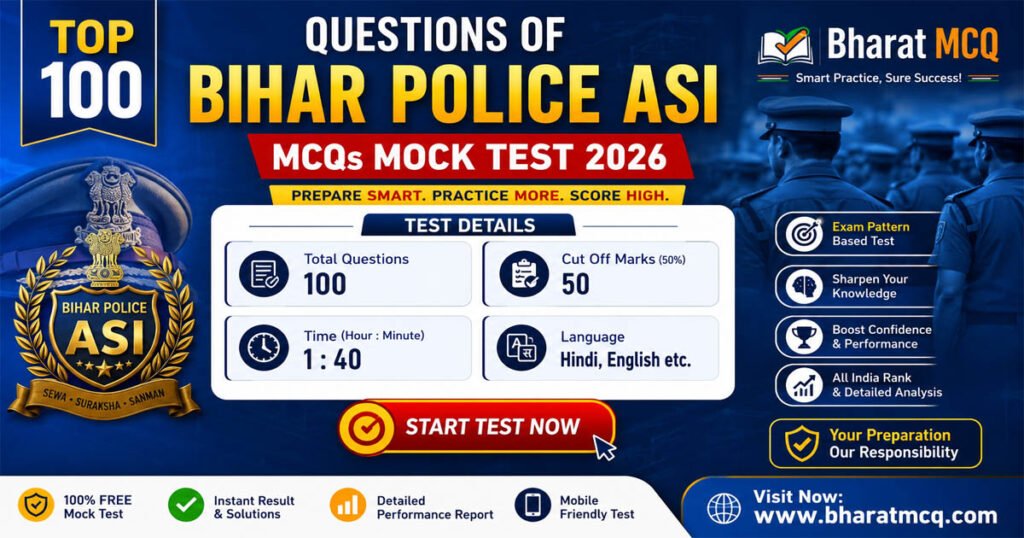
Attempt this full-length Bihar Police ASI mock test with 100 exam-level questions covering GK, Bihar, reasoning, maths, science and English.
Table of Contents
Bihar Police ASI Mock Test: 100 Exam-Level Questions
Introduction
The Bihar Police Assistant Sub-Inspector examination requires a balanced understanding of general studies, Bihar-specific knowledge, reasoning, numerical ability, science and language skills. A candidate cannot depend only on memorised facts because competitive examinations increasingly test interpretation, application and accuracy under time pressure.
This Bihar Police ASI mock test contains 100 multiple-choice questions designed to reproduce the structure and difficulty expected in a serious police recruitment examination. The questions cover the Indian Constitution, history, geography, Bihar general knowledge, economics, science, logical reasoning, quantitative aptitude and English language usage.
The test should be attempted in one sitting under timed conditions. Candidates should avoid checking answers while solving the paper. After completing the test, they should analyse incorrect answers and identify whether each error resulted from a knowledge gap, calculation mistake, misunderstanding or poor time management.
Importance of the Subjects in the Bihar Police ASI Examination
General studies evaluates whether a candidate understands the constitutional, historical, geographical and economic environment in which public administration and policing operate. Questions on Fundamental Rights, parliamentary institutions, constitutional authorities and governance are particularly relevant because police personnel exercise public authority within a legal framework.
Bihar-specific history and geography are equally important. Candidates should know the significance of Champaran, Nalanda, Vikramshila, ancient Magadha, major rivers, wetlands, protected areas and prominent personalities associated with the state.
Reasoning and numerical ability measure analytical discipline. Police work frequently requires the interpretation of sequences, relationships, directions, statements, records and numerical information. These sections therefore test more than calculation speed; they assess structured thinking.
Science questions examine practical awareness of human biology, electricity, optics, chemistry, environmental processes and everyday scientific phenomena. English evaluates grammar, vocabulary, comprehension of formal expressions and the ability to communicate accurately.
Types of Questions Asked in Competitive Police Exams
A Bihar Police ASI-level paper generally includes direct factual questions as well as questions requiring conceptual application. In polity, a candidate may be asked to identify a constitutional Article, writ, Schedule or parliamentary procedure. History questions may connect an event with its location, leader or consequence.
Reasoning questions commonly involve syllogisms, coding-decoding, directions, family relationships, arrangements, clocks, calendars and number series. These questions should be solved by applying a definite rule rather than relying on intuition.
Quantitative aptitude generally covers percentages, profit and loss, averages, ratio, time and work, speed, compound interest, mensuration and basic algebra. Science questions often test the application of principles such as refraction, resistance, oxidation, respiration and ecological pollution.
English questions focus on subject-verb agreement, articles, prepositions, voice, narration, vocabulary, idioms and sentence correction.
Practical Preparation Strategy
Begin by dividing the syllabus into manageable units. Study one major subject and one practice-oriented subject each day. For example, combine polity with reasoning or Bihar history with quantitative aptitude. This prevents monotony and ensures regular numerical practice.
Create concise revision notes for constitutional Articles, historical events, rivers, protected areas, economic terms and scientific concepts. Notes should contain only information that can be revised quickly.
For mathematics, maintain a formula sheet covering percentages, compound interest, averages, speed, work, area and probability. However, formulas are useful only when candidates understand when and how to apply them.
Reasoning questions should be solved with diagrams, tables or symbols wherever possible. Family relations, seating arrangements and directions become easier when represented visually.
Attempt full-length mock tests regularly. After every test, classify errors into four categories: lack of knowledge, conceptual misunderstanding, calculation error and careless reading. The next study session should address the category responsible for the largest number of mistakes.
Common Mistakes Students Make
One common mistake is spending excessive time on a difficult question while leaving easier questions unanswered. Candidates should mark lengthy questions for review and move forward.
Another mistake is reading only part of a question. Words such as “not,” “only,” “incorrect,” “immediate” and “most appropriate” can completely change the required answer.
In numerical questions, candidates often apply a correct formula to incorrect data. Units must be converted carefully, especially in speed, distance and mensuration problems.
In reasoning, candidates sometimes assume information not contained in the statements. Syllogisms must be solved only from the given premises.
In English, many candidates choose an option because it sounds familiar. Grammar questions should instead be answered through rules relating to subject-verb agreement, tense, articles, prepositions and sentence structure.
Benefits of Regular MCQ Practice
MCQ practice improves recall, decision-making speed and option elimination. It also helps candidates distinguish between closely related concepts, such as fiscal deficit and revenue deficit, oxidation and reduction, or habeas corpus and quo warranto.
A full-length mock test reveals whether a candidate can maintain concentration across multiple subjects. It also identifies sections in which accuracy falls when the candidate works under pressure.
Repeated practice develops the habit of checking conditions before solving a question. Over time, candidates learn when to calculate fully, when to eliminate options and when to leave a doubtful question for review.
20 Sample Questions with Detailed Explanations
1. Which Article empowers the Supreme Court to issue writs for Fundamental Rights?
Correct Answer: Article 32
Article 32 allows an individual to approach the Supreme Court for the enforcement of Fundamental Rights. The Court may issue writs such as habeas corpus, mandamus, prohibition, certiorari and quo warranto. Article 226 gives similar but wider writ jurisdiction to High Courts.
2. Who decides whether a Bill is a Money Bill?
Correct Answer: Speaker of the Lok Sabha
Under the Constitution, the Speaker of the Lok Sabha certifies whether a Bill qualifies as a Money Bill. The Speaker’s endorsement is placed on the Bill when it is transmitted to the Rajya Sabha and presented to the President.
3. What is the purpose of the writ of quo warranto?
Correct Answer: To question a person’s authority to hold a public office
Quo warranto literally asks “by what authority.” A court may issue this writ when a person is alleged to be occupying a substantive public office without satisfying the legal qualifications or appointment requirements.
4. Why was the Battle of Buxar historically important?
Correct Answer: It strengthened the East India Company’s political position in eastern India
The Battle of Buxar was fought in 1764. The Company’s victory over the combined forces of Mir Qasim, Shuja-ud-Daula and the Mughal emperor Shah Alam II paved the way for its acquisition of Diwani rights in Bengal, Bihar and Odisha.
5. What was the main issue in the Champaran Satyagraha?
Correct Answer: Exploitation of indigo cultivators
European planters compelled cultivators to grow indigo under oppressive arrangements. Gandhi investigated their grievances in 1917 and organised a peaceful campaign. Champaran became his first major satyagraha in India.
6. Who founded Vikramshila University?
Correct Answer: Dharmapala
Vikramshila was established by the Pala ruler Dharmapala. It became an important centre of Buddhist learning and was particularly associated with advanced Buddhist philosophy and scholarship.
7. Why is the Kosi called the “Sorrow of Bihar”?
Correct Answer: Because of its frequent course changes and floods
The Kosi carries a heavy sediment load from the Himalayan region. Deposition of sediment raises the riverbed and contributes to channel shifting, embankment pressure and destructive flooding across the plains of north Bihar.
8. Which river is a right-bank tributary of the Ganga in Bihar?
Correct Answer: Son
A right-bank tributary enters a river from the right side when viewed in the direction of flow. The Ganga flows generally eastward in Bihar, and the Son approaches it from the south, making it a right-bank tributary.
9. What usually happens when the RBI raises the repo rate?
Correct Answer: Inflationary pressure may reduce
The repo rate is the rate at which the Reserve Bank lends short-term funds to commercial banks against securities. A higher rate can make borrowing more expensive, moderate credit growth and reduce excess demand in the economy.
10. What does fiscal deficit measure?
Correct Answer: Total expenditure minus total receipts excluding borrowings
Fiscal deficit indicates the amount the government must borrow to meet its expenditure. Borrowings are excluded from receipts in this calculation because they finance the deficit rather than reduce the government’s liabilities.
11. Why are antibiotics ineffective against most viral infections?
Correct Answer: Viruses lack the independent cellular machinery targeted by antibiotics
Antibiotics generally target bacterial structures or processes such as cell-wall synthesis, ribosomes or bacterial metabolic pathways. Viruses replicate by using the machinery of host cells and do not possess these bacterial targets.
12. What is biomagnification?
Correct Answer: Increasing concentration of persistent pollutants along a food chain
Certain pollutants are not easily broken down or eliminated. Their concentration increases as contaminated organisms are consumed at successively higher trophic levels. Top predators therefore accumulate the highest concentrations.
13. Why does a body moving in a circle have acceleration even at constant speed?
Correct Answer: Its velocity changes direction continuously
Velocity is a vector quantity containing both magnitude and direction. During circular motion, the speed may remain constant, but the direction changes at every point. This produces centripetal acceleration towards the centre.
14. What happens to the frequency of light when it enters glass from air?
Correct Answer: It remains unchanged
The speed and wavelength of light change when light passes from one medium to another. Its frequency remains fixed because it is determined by the source and must remain continuous across the boundary.
15. Find the next number: 3, 8, 18, 38, 78, ?
Correct Answer: 158
Each term is obtained by multiplying the previous term by two and adding two. Thus, 3 × 2 + 2 = 8, 8 × 2 + 2 = 18 and 78 × 2 + 2 = 158.
16. What is the angle between the hands of a clock at 4:20?
Correct Answer: 10°
At 20 minutes, the minute hand is at 120°. The hour hand moves 0.5° per minute and is therefore at 4 × 30° + 20 × 0.5° = 130°. The difference is 10°.
17. A train covers its own length of 180 metres in 12 seconds. What is its speed?
Correct Answer: 54 km/h
Speed equals distance divided by time: 180 ÷ 12 = 15 metres per second. To convert metres per second into kilometres per hour, multiply by 18/5. Therefore, 15 × 18/5 = 54 km/h.
18. An article is marked 25% above cost and sold at a 10% discount. What is the profit?
Correct Answer: 12.5%
Assume the cost price is ₹100. The marked price becomes ₹125. After a 10% discount, the selling price is ₹112.50. The profit is ₹12.50 on a cost of ₹100, or 12.5%.
19. What is the meaning of “vigilant”?
Correct Answer: Watchful
A vigilant person remains alert to possible danger, error or suspicious activity. In policing and security contexts, vigilance implies careful observation and readiness to respond.
20. What does “corroborate” mean?
Correct Answer: To support a statement with additional evidence
Corroboration occurs when independent evidence strengthens or confirms an assertion. For example, a witness’s statement may be corroborated by CCTV footage, documents, forensic evidence or another reliable witness.
Practice the Full Bihar Police ASI Test
Attempt all 100 questions under examination conditions and record the time taken. After completing the test, calculate subject-wise accuracy rather than reviewing only the total score. Revise every incorrectly answered concept and attempt the paper again after a suitable interval.