
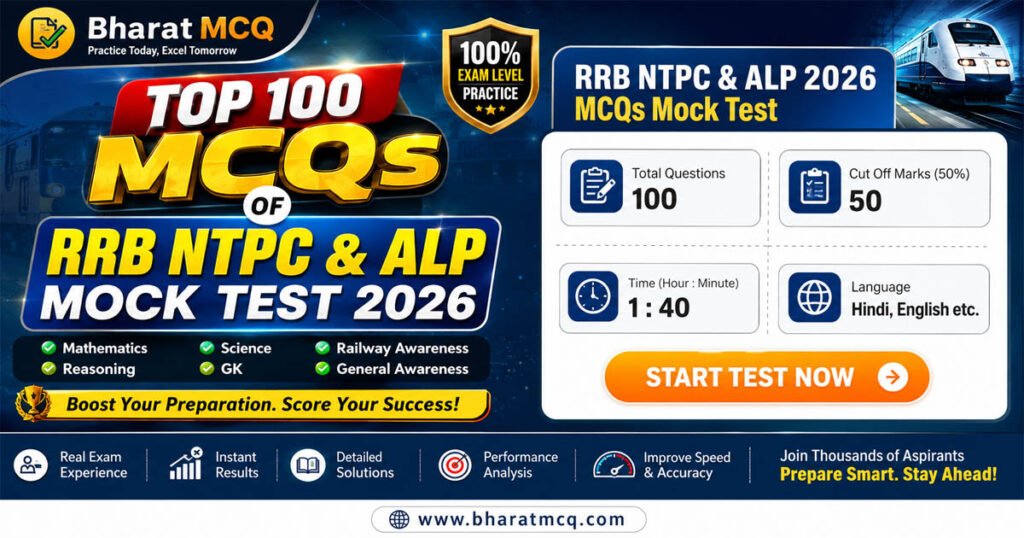
Practice RRB NTPC & ALP mock test with 100 exam-level MCQs covering maths, reasoning, science, GK and railway awareness.
Table of Contents
RRB NTPC & ALP Mock Test: Complete Practice for Railway Exam Aspirants
Railway Recruitment Board exams are among the most competitive government recruitment examinations in India. RRB NTPC and RRB ALP attract lakhs of candidates every recruitment cycle because they offer stable government jobs, structured career growth and opportunities across different railway zones. To perform well in these exams, students need more than basic subject knowledge. They need speed, accuracy, question selection skills and regular practice with exam-level MCQs.
This full-length RRB NTPC and ALP mock test is designed to give candidates a real exam-like experience. The paper includes questions from Mathematics, Reasoning, General Science, General Awareness, Computer Awareness and Railway-related knowledge. These areas are repeatedly tested in Railway exams and require consistent preparation.
A good mock test should not feel like a random collection of questions. It should reflect the actual pattern of competitive exams, where easy, moderate and difficult questions appear together. Candidates must learn how to manage time, avoid negative marking mistakes and identify scoring questions quickly.
Importance of Subjects in RRB NTPC & ALP Exams
RRB NTPC and ALP exams test a candidate’s overall aptitude. Mathematics checks calculation ability, numerical understanding and problem-solving speed. Topics such as percentage, profit and loss, time and work, speed and distance, averages, ratio, simple interest and compound interest are highly important. These chapters are scoring, but they require regular practice.
Reasoning is another major scoring section. It tests logical thinking, pattern recognition and decision-making ability. Series, coding-decoding, blood relation, direction sense, syllogism, analogy, ranking, calendar and statement-conclusion questions are commonly seen in Railway exams. Candidates who practice reasoning daily can improve accuracy within a short time.
General Science plays a special role in RRB ALP because the post is technical in nature. Physics, Chemistry and Biology basics are frequently asked, but the questions are usually application-based. Concepts related to electricity, force, motion, machines, human body, vitamins, diseases, acids, bases, metals and energy sources are important.
General Awareness is equally important for both NTPC and ALP. This section includes Indian history, geography, polity, economy, culture and railway awareness. Questions from the Constitution, freedom movement, rivers, soils, national institutions, railway zones and important facts are common. A strong General Awareness base helps candidates score quickly because these questions take less time than calculation-based questions.
Types of Questions Asked in Real Railway Exams
In RRB NTPC and ALP exams, questions are usually direct but not always simple. The examiner often checks whether the candidate understands the concept rather than memorising a formula. For example, a profit and loss question may include marked price and discount together. A time and work question may involve two workers with partial completion. A train question may combine length, platform and relative speed.
Reasoning questions are designed to test observation. A number series may follow multiplication, addition or square-based patterns. Coding-decoding may use alphabet shifts, reverse coding or symbol substitution. Direction questions may appear simple, but one wrong turn can change the answer.
Science questions in Railway exams are generally based on practical knowledge. Instead of asking only definitions, the paper may ask about the working of a transformer, fuse, diesel engine, generator or braking system. Biology questions may focus on deficiency diseases, blood groups, vitamins and plant processes.
General Awareness questions usually cover high-frequency facts. Candidates should prepare the Indian Constitution, important amendments, historical events, freedom struggle, Indian geography, economic terms and cultural heritage. Railway-specific facts such as railway zones, gauges, museums and safety systems are also useful.
Preparation Strategy for RRB NTPC & ALP
A practical preparation strategy starts with understanding the syllabus. Candidates should divide the syllabus into daily targets instead of studying randomly. Mathematics and Reasoning should be practised every day because both sections improve with repetition. General Science and General Awareness should be revised through short notes.
For Mathematics, candidates should first learn formulas and standard methods. After that, they should solve mixed questions. Railway exams do not ask chapters separately in the final paper, so mixed practice is essential. Candidates should focus on calculation speed, approximation and shortcut methods where applicable.
For Reasoning, daily practice of 25 to 30 questions is useful. Candidates should not memorise reasoning questions. They should understand the logic behind each type. After solving a question, they should check whether there is a faster method.
For General Science, NCERT-level clarity is enough for most questions, but candidates should connect concepts with real applications. For example, electricity chapters should be studied with practical devices such as fuse, generator, motor and transformer. Biology should be prepared with tables for vitamins, diseases, glands and body systems.
For General Awareness, revision is more important than one-time reading. Candidates should prepare short notes on history, polity, geography and economy. Static GK should be revised repeatedly because many questions are fact-based.
Common Mistakes Students Make
One common mistake is spending too much time on difficult questions. In a competitive exam, every question carries value, but time is limited. Candidates should skip lengthy questions in the first round and return to them later.
Another mistake is ignoring General Science. Many students focus only on Maths and Reasoning, especially for NTPC, but Science can provide quick marks. For ALP candidates, ignoring Science is even more risky.
Some candidates rely only on reading and do not attempt enough mock tests. Reading improves knowledge, but mock tests improve performance. Exams test how well a candidate applies knowledge under time pressure.
Poor revision is another major issue. Students study many topics but forget formulas, facts and concepts because they do not revise. Weekly revision should be part of every preparation plan.
Guesswork is also dangerous. Since competitive exams often include negative marking, blind guessing can reduce the final score. Candidates should attempt only those questions where they can eliminate options logically or are reasonably confident.
Benefits of MCQ Practice
MCQ practice is the most effective way to prepare for Railway exams. It improves speed, accuracy and confidence. Regular practice helps candidates understand question patterns and repeated concepts. It also teaches time management.
Mock tests help candidates identify weak areas. For example, a student may feel confident in Mathematics but repeatedly make mistakes in average or mixture questions. By analysing mock test performance, the student can correct these weak points.
MCQs also improve exam temperament. Many candidates know the answer but make mistakes due to pressure. Practising full-length tests reduces exam fear and builds decision-making ability.
Another benefit is option-based thinking. In competitive exams, candidates do not always need to solve questions in a long method. Sometimes, options can help eliminate wrong answers faster. This skill develops only through practice.
Practice Test for RRB NTPC & ALP
This RRB NTPC and ALP mock test contains 100 exam-oriented questions covering all important areas. Candidates should attempt the test in a fixed time limit and avoid using notes while solving. After completing the test, check the answers and mark incorrect questions for revision.
Use this practice test as a serious exam attempt. Sit in a quiet place, keep a timer and solve questions with full focus. After the test, analyse which section took more time and where mistakes occurred. This process will help improve performance in the actual Railway exam.
Regular mock test practice is one of the best ways to build exam readiness. Attempt more topic-wise tests, revise important formulas and strengthen General Awareness daily. With disciplined preparation and proper analysis, candidates can improve their score in RRB NTPC, RRB ALP and other Railway recruitment exams.