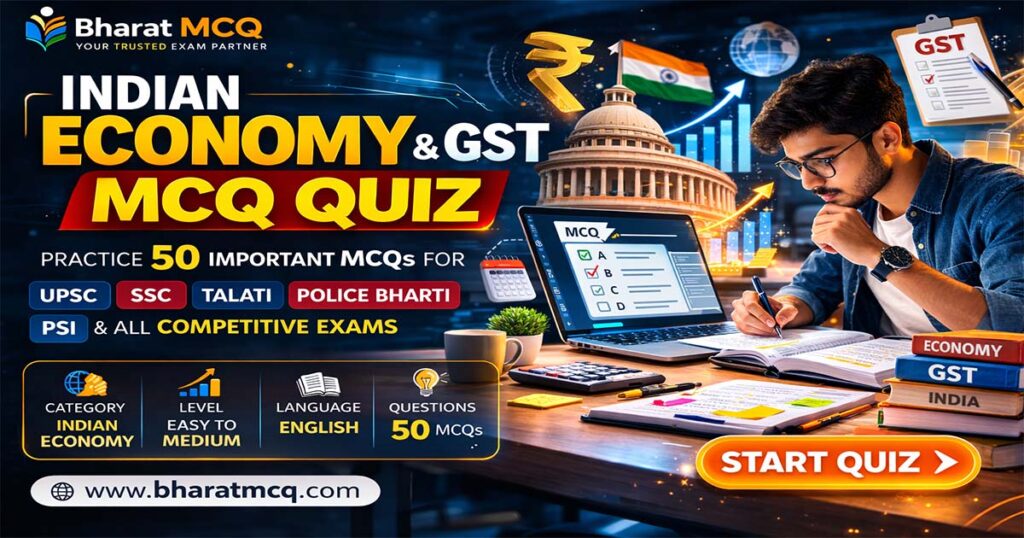
Practice 50 important MCQs on India Economy and GST MCQ for UPSC, SSC, Talati, Police Bharti, PSI and other competitive exams. Improve exam accuracy.
Indian Economy & GST MCQ Quiz
Start QuizIndia Economy and GST MCQ Quiz for Competitive Exams
India’s economic system and the Goods and Services Tax (GST) are among the most important topics in competitive examinations such as UPSC, SSC, Talati, Police Bharti, PSI, Clerk, and other state-level recruitment exams. Questions from these topics frequently appear in General Studies and Economy sections because they test a candidate’s understanding of how the Indian economy functions.
A strong conceptual understanding of GST, fiscal policy, taxation systems, and economic indicators helps aspirants solve exam questions quickly and accurately. Practicing MCQs is one of the most effective ways to strengthen this understanding.
This quiz contains 50 exam-oriented MCQs designed according to real competitive exam patterns.
Importance of Indian Economy and GST in Competitive Exams
The Indian economy is a major component of the General Studies syllabus across almost all government recruitment exams. Examiners frequently test candidates on topics such as GDP, inflation, fiscal deficit, economic reforms, taxation, and economic institutions.
GST is particularly important because it represents one of the biggest tax reforms in India. Since its implementation in 2017, questions related to GST structure, tax slabs, GST Council, input tax credit, and tax administration have appeared regularly in exams.
Candidates preparing for exams like Talati, Police Bharti, and SSC often encounter questions that combine conceptual knowledge with practical understanding of taxation systems.
For example, a question may test the difference between CGST, SGST, and IGST or the principle of destination-based taxation under GST.
Therefore, mastering these topics can significantly improve a candidate’s score in the General Knowledge section.
Types of Questions Asked in Real Exams
Competitive exams usually ask economy and GST questions in several formats. Understanding these patterns helps aspirants prepare more effectively.
Concept-based questions are the most common. These questions test basic economic understanding such as the meaning of GDP, inflation, fiscal deficit, or aggregate demand.
Another common type is policy and institution-based questions. These questions focus on organizations such as the GST Council, RBI, NITI Aayog, and the Ministry of Finance.
Exams also include taxation structure questions, particularly after GST reforms. Candidates may be asked about GST rate slabs, input tax credit, GST returns, or taxes subsumed under GST.
Some exams include application-based questions, where candidates must identify the correct tax component applied to intra-state or inter-state transactions.
Finally, current economic developments such as budget policies, reforms, and major schemes may also appear in questions.
Practicing MCQs that reflect these patterns helps aspirants become familiar with real exam difficulty levels.
Preparation Strategy for Economy and GST
Preparing for Indian economy topics does not require advanced economics knowledge, but it does require conceptual clarity.
The first step is to understand the basic structure of the Indian economy, including sectors of the economy, national income indicators, and economic growth.
Next, candidates should focus on taxation systems, particularly the structure of GST. Understanding the difference between CGST, SGST, IGST, and UTGST is essential.
It is also important to study economic institutions and policies, including the roles of RBI, GST Council, Ministry of Finance, and NITI Aayog.
Another important strategy is to regularly follow economic updates such as the Union Budget and Economic Survey, since questions often arise from these areas.
However, reading alone is not enough. The most effective way to prepare is to practice a large number of MCQs. Practice helps identify weak areas and improves speed and accuracy.
Common Mistakes Students Make
Many students lose marks in economy-related questions due to small conceptual errors.
One common mistake is confusing direct and indirect taxes. For example, some candidates incorrectly classify GST as a direct tax when it is actually an indirect tax.
Another mistake is misunderstanding the GST structure, particularly the difference between intra-state and inter-state tax components.
Students also tend to memorize facts without understanding concepts. Competitive exams often test practical understanding rather than simple definitions.
Another issue is ignoring economic terminology, such as fiscal deficit, trade balance, and inflation indicators like CPI and WPI.
Finally, many aspirants do not practice enough MCQs. Without regular practice, even well-prepared students may struggle with exam time pressure.
Avoiding these mistakes can significantly improve performance in the General Knowledge section.
Benefits of Practicing MCQs
MCQ practice plays a critical role in competitive exam preparation.
First, it helps reinforce theoretical concepts through application. When students solve questions about GST or GDP, they develop a deeper understanding of the topic.
Second, MCQ practice improves speed and accuracy, which are essential for exams with strict time limits.
Third, solving multiple questions exposes candidates to different exam patterns and difficulty levels, making them better prepared for actual exam conditions.
Finally, regular MCQ practice helps identify weak areas so students can revise those topics more effectively.
For topics like Indian economy and GST, solving a wide range of questions is often more effective than simply reading theory.
Practice the India Economy and GST Quiz
To help competitive exam aspirants strengthen their preparation, we have created a 50-question MCQ quiz on India’s Economy and GST.
These questions are designed according to the latest competitive exam standards and cover important topics such as:
- GDP and national income concepts
- GST structure and taxation system
- Economic indicators like inflation and fiscal deficit
- Government economic institutions
- Tax reforms and economic policies
Regularly practicing quizzes like this can significantly improve your understanding and exam performance.
👉 Start the quiz now and test your knowledge of India’s Economy and GST.