
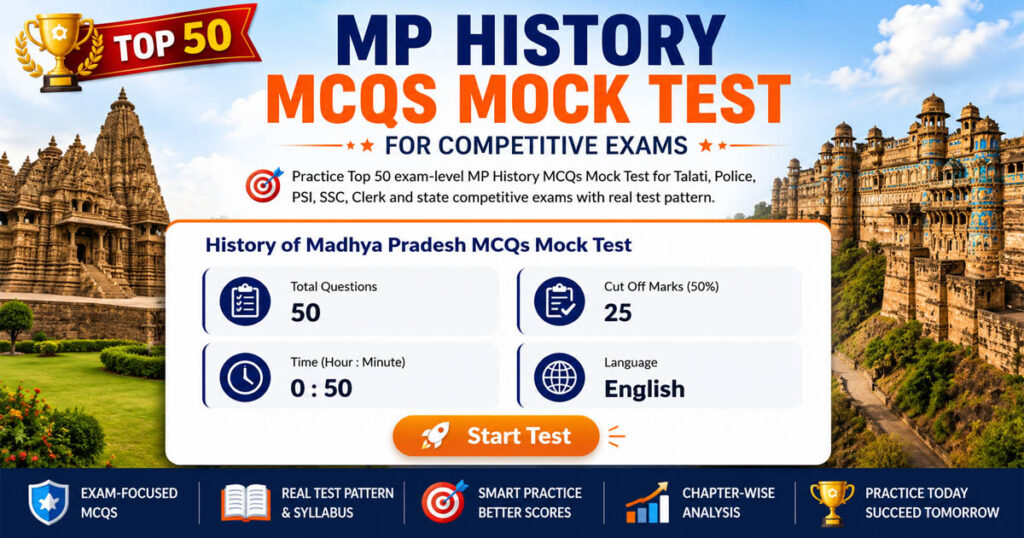
Practice Top 50 exam-level MP History MCQs Mock Test for Talati, Police, PSI, SSC, Clerk and state competitive exams with real test pattern.
Table of Contents
MP History Mock Test for Competitive Exams
History of Madhya Pradesh is an important part of General Knowledge in many Indian competitive exams. Questions from this subject are asked in state-level exams as well as in several national-level examinations where regional history, culture, dynasties, freedom movement and historical places are included in the syllabus. For exams like Police Bharti, PSI, Clerk, SSC, MPPSC-related tests and other state recruitment exams, candidates must prepare Madhya Pradesh history with factual accuracy and proper exam orientation.
This mock test is designed to help students practise real exam-type questions. It includes ancient, medieval, modern and freedom movement-based topics. Instead of asking only simple memory-based facts, the test also covers connections between rulers, places, monuments, dynasties and historical events. Such question framing is common in competitive exams because examiners often check whether a candidate can identify the correct historical association.
Importance of Madhya Pradesh History in Competitive Exams
Madhya Pradesh has a very rich historical background. From prehistoric sites like Bhimbetka to Buddhist centres like Sanchi and Bharhut, the state has played an important role in Indian history. Ancient cities such as Ujjain, Vidisha and Mahishmati were linked with trade, religion, politics and learning. These topics are frequently asked because they connect regional history with wider Indian history.
In medieval history, the Paramaras, Chandelas, Kalachuris, Tomars, Malwa Sultanate, Gond rulers and Bundelas are important for exam preparation. Questions may be based on capitals, monuments, rulers, forts, battles and architectural features. For example, Raja Bhoja, Khajuraho temples, Gwalior Fort, Mandu and Rani Durgavati are high-value topics for objective exams.
Modern history of Madhya Pradesh is equally important. The Revolt of 1857, Rani Avantibai, Tantya Bhil, Jhanda Satyagraha, Tripuri Congress session and the formation of Madhya Pradesh in 1956 are commonly relevant for competitive exams. These topics help students understand the contribution of the region to India’s freedom struggle and post-independence political development.
Types of Questions Asked in Real Exams
Competitive exams usually ask different types of questions from Madhya Pradesh history. The first type is direct factual questions. These may ask about the location of Bhimbetka, the district of Khajuraho, the ruler associated with Bhojpur or the dynasty related to Mandu. Such questions require clear memorisation.
The second type is association-based questions. In these questions, students must connect a ruler with a place, a dynasty with a monument or an event with a region. For example, Ahilyabai Holkar is associated with Maheshwar, Rani Durgavati with Garha-Katanga, and Scindia power with Gwalior. These questions are common because they test conceptual linkage rather than isolated facts.
The third type is chronology or period-based questions. The examiner may ask whether a monument belongs to the Gupta period, Shunga period, Chandela period or Mughal period. Students should prepare broad time periods of major dynasties and monuments.
The fourth type is freedom movement-based questions. These include local leaders, tribal resistance, revolutionary events and Congress sessions. Students should not ignore regional participation in the national movement, as state-level exams frequently include such questions.
Practical Preparation Strategy
To prepare Madhya Pradesh history effectively, begin with a proper division of the syllabus. Divide the subject into ancient, medieval, modern and post-independence sections. This makes revision easier and reduces confusion between dynasties and events.
For ancient history, focus on Bhimbetka, Sanchi, Bharhut, Ujjain, Vidisha, Eran, Udayagiri and Mahishmati. Learn their locations, historical importance and associated periods. Questions from these topics are often direct but can be tricky if district names or dynastic links are confused.
For medieval history, prepare dynasty-wise notes. Make separate short notes on Paramaras, Chandelas, Kalachuris, Tomars, Gond rulers, Bundelas, Holkars and Scindias. Under each dynasty, write the important rulers, capitals, monuments and battles. This method is more useful than reading long paragraphs repeatedly.
For modern history, focus on the Revolt of 1857 in Madhya Pradesh, tribal movements, local freedom fighters and major political events. Rani Avantibai, Tantya Bhil, Tatya Tope, Jabalpur, Neemuch, Mhow and Tripuri should be revised carefully.
Map-based preparation is also useful. Many historical questions become easy when students know the location of important places. Mark Sanchi, Bhimbetka, Khajuraho, Mandu, Gwalior, Maheshwar, Burhanpur, Jabalpur, Vidisha and Ujjain on a map. This helps in remembering districts and regions.
Common Mistakes Students Make
One common mistake is preparing only famous monuments and ignoring historical regions. For example, many students know Khajuraho but do not revise Bundelkhand, Chandela rulers or the Nagara style of architecture. Competitive exams often frame questions by linking these facts.
Another mistake is confusing rulers and dynasties. Students sometimes mix up Paramaras with Chandelas, Holkars with Scindias, or Gond rulers with Bundela rulers. To avoid this, prepare comparison tables. Write the dynasty in one column, region in the second column, ruler in the third column and important contribution in the fourth column.
Students also ignore the modern history of Madhya Pradesh. Freedom movement questions may look simple, but they require accurate knowledge of places and personalities. Rani Avantibai, Tantya Bhil and the Tripuri Congress session are examples of topics that should be revised seriously.
A further mistake is depending only on reading without MCQ practice. Reading gives knowledge, but MCQ practice teaches elimination, speed and accuracy. In competitive exams, knowing the answer is not enough; candidates must identify it quickly under time pressure.
Benefits of MCQ Practice
MCQ practice is one of the most effective ways to prepare for Madhya Pradesh history. It helps students understand the pattern of questions asked in real exams. When candidates practise regularly, they begin to notice repeated themes such as dynasties, monuments, capitals, forts, districts and freedom fighters.
MCQs also improve memory retention. When a student repeatedly solves questions on Sanchi, Bhimbetka, Ujjain, Mandu or Gwalior, these facts become easier to recall. This is especially useful for General Knowledge, where quick recall is essential.
Practice tests also help in identifying weak areas. A student may feel confident while reading history, but mistakes in MCQs reveal gaps in preparation. For example, if a candidate repeatedly confuses the location of Eran, Bharhut or Udayagiri, that topic needs revision.
Another benefit is improvement in elimination skills. In many exams, options are closely framed. A student who has practised enough can eliminate incorrect options even when the question appears difficult. This improves overall score and reduces negative marking risk where applicable.
Practice Test for Better Exam Readiness
This MP History Mock Test is useful for candidates preparing for state-level and national-level competitive exams. It covers important facts, historical associations, dynasties, monuments, freedom movement topics and administrative history. Students should solve the test in a timed manner and then revise the questions they answered incorrectly.
For best results, attempt this practice test more than once. In the first attempt, focus on accuracy. In the second attempt, focus on speed. After completing the test, prepare short revision notes from wrong answers. This method will help you build strong command over Madhya Pradesh history and improve performance in competitive exams.