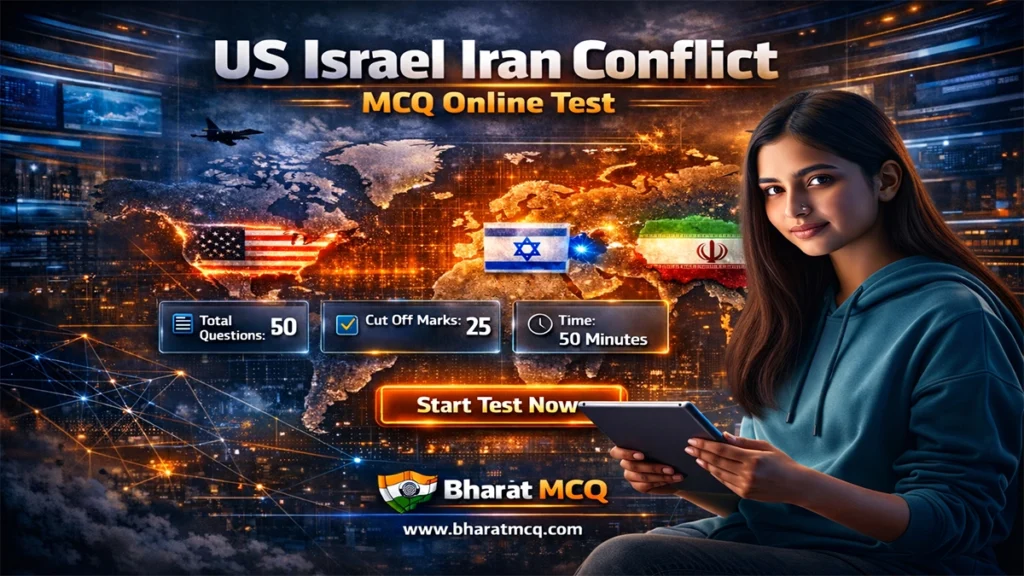
Practice 50 MCQs on US–Israel–Iran geopolitical conflict. Ideal for UPSC, Talati, Police, SSC and other competitive exam preparation.
Table of Contents
US–Israel–Iran Conflict MCQ Online Test for Competitive Exams
International relations and global conflicts have become a crucial part of modern competitive examinations. Topics related to the Middle East, especially the geopolitical tensions between the United States, Israel, and Iran, are frequently included in exams such as UPSC, GPSC, SSC, Talati, Police Bharti, Clerk, and other state-level recruitment tests.
Understanding this geopolitical triangle is essential for aspirants preparing for government examinations. The region plays a significant role in global politics, energy security, military alliances, and international diplomacy. This mock test is designed to help aspirants assess their knowledge and improve their understanding of this important topic.
Importance of Middle East Geopolitics in Competitive Exams
The Middle East is one of the most strategically important regions in the world. Several factors make it highly relevant for competitive exams:
Global Energy Security
Countries like Iran hold massive oil and natural gas reserves. The Persian Gulf and the Strait of Hormuz are crucial routes for global oil transportation. Any instability in this region can affect global energy prices and international trade.
Strategic Military Alliances
The United States maintains strong defense and intelligence partnerships with Israel. This relationship plays a major role in shaping the geopolitical landscape of the Middle East.
Nuclear Non-Proliferation Issues
Iran’s nuclear program has been one of the most debated international issues in recent decades. International agreements such as the Joint Comprehensive Plan of Action (JCPOA) and global monitoring by the International Atomic Energy Agency (IAEA) are key topics often asked in exams.
Regional Proxy Conflicts
Several conflicts in the Middle East involve indirect confrontations between regional and global powers. Groups and alliances operating in Lebanon, Syria, Iraq, and Yemen often appear in current affairs questions.
Because of these reasons, questions related to the US–Israel–Iran relationship frequently appear in competitive examinations.
Types of Questions Asked in Real Competitive Exams
Competitive exam questions on international conflicts generally test conceptual understanding rather than simple memorization.
Some common question formats include:
Geography-Based Questions
Exams often ask about strategic locations such as:
- Strait of Hormuz
- Persian Gulf
- Mediterranean Sea
- Red Sea
Understanding these geographical locations helps candidates answer questions related to trade routes and military strategy.
Organization-Based Questions
Many questions focus on international organizations involved in conflict resolution and monitoring.
Examples include:
- United Nations Security Council
- International Atomic Energy Agency (IAEA)
- OPEC
Students must know the role and functions of these institutions.
Political Leadership and Governance
Examinations may test knowledge about political systems and leadership structures, such as Iran’s Supreme Leader or Israel’s political institutions.
Defense and Military Systems
Another common area is defense technology and military strategy. Questions may involve systems like Israel’s missile defense mechanisms or the structure of military alliances.
Preparation Strategy for This Topic
Preparing international relations topics requires a systematic approach.
Follow Reliable Current Affairs Sources
Students should regularly read reputable newspapers and international affairs magazines. Focus on developments related to diplomacy, sanctions, and global negotiations.
Understand the Background of Conflicts
Instead of memorizing isolated facts, aspirants should understand the historical and political background behind the tensions between these countries.
Study Strategic Geography
Map-based learning is extremely useful for understanding conflict zones, naval routes, and regional borders.
Practice MCQs Regularly
Solving MCQs helps students become familiar with the types of questions asked in exams. Regular practice improves accuracy and speed.
Focus on Conceptual Clarity
Competitive exams increasingly emphasize analytical understanding. Candidates should focus on concepts such as nuclear treaties, military alliances, and geopolitical strategy.
Common Mistakes Students Make
Many aspirants lose marks in international relations questions due to avoidable mistakes.
Ignoring Map Knowledge
Students often overlook geographical understanding, which is essential for topics involving straits, seas, and strategic corridors.
Confusing Organizations
A common mistake is mixing up the roles of organizations like the United Nations, IAEA, and OPEC.
Overlooking Current Affairs Context
Static knowledge alone is not enough. Students must connect historical background with recent developments.
Memorizing Without Understanding
Memorizing facts without understanding the geopolitical context often leads to confusion in analytical questions.
Avoiding these mistakes can significantly improve performance in competitive exams.
Benefits of Practicing MCQ-Based Mock Tests
Mock tests play a vital role in exam preparation.
Improves Exam Speed
Practicing MCQs helps candidates solve questions quickly during the actual exam.
Identifies Weak Areas
Mock tests reveal gaps in knowledge, allowing aspirants to focus on weaker topics.
Builds Conceptual Clarity
Repeated practice strengthens understanding of international relations and global politics.
Enhances Confidence
Regular testing helps students become comfortable with exam patterns and reduces anxiety during real examinations.
US-Israel-Iran Conflict Mock Test: Important Questions with Detailed Explanations
(1) Question: What is the official name of the landmark 2015 diplomatic agreement commonly referred to as the “Iran Nuclear Deal”?
Answer: Joint Comprehensive Plan of Action (JCPOA)
Explanation: The JCPOA was reached in July 2015 between Iran and the P5+1 nations (the US, UK, France, China, Russia, and Germany) plus the European Union. It aimed to significantly limit Iran’s nuclear enrichment capabilities in exchange for lifting crushing economic sanctions.
(2) Question: Which sophisticated cyberweapon, widely believed to be a joint US-Israeli intelligence project, was uncovered in 2010 after sabotaging centrifuges at Iran’s Natanz nuclear facility?
Answer: Stuxnet
Explanation: Stuxnet was a highly complex malicious computer worm specifically designed to target Supervisory Control and Data Acquisition (SCADA) systems. It physically destroyed roughly a fifth of Iran’s nuclear centrifuges by causing them to spin out of control, marking a milestone in state-sponsored cyber warfare.
(3) Question: What is the name of the series of US-brokered normalization agreements signed in 2020 that established diplomatic relations between Israel and several Arab nations, fundamentally altering Middle Eastern alliances against Iran?
Answer: The Abraham Accords
Explanation: Brokered by the United States, the Abraham Accords initially enabled the normalization of diplomatic relations between Israel, the United Arab Emirates (UAE), and Bahrain, later expanding to include Morocco and Sudan. This strategically united Israel and Sunni Arab states to counter Iranian regional influence.
(4) Question: In January 2020, a targeted US drone strike near Baghdad International Airport assassinated which powerful commander of Iran’s Islamic Revolutionary Guard Corps (IRGC) Quds Force?
Answer: Major General Qasem Soleimani
Explanation: Qasem Soleimani was the mastermind behind Iran’s external military operations and asymmetrical proxy network across the Middle East (including Hezbollah, Hamas, and Houthi rebels). His assassination by US forces caused a massive spike in direct geopolitical tensions.
(5) Question: What is the name of Israel’s highly effective short-range air defense system, which intercepts incoming rockets and artillery and receives significant financial and technical backing from the United States?
Answer: Iron Dome
Explanation: The Iron Dome is a combat-proven, all-weather mobile air defense system developed by Rafael Advanced Defense Systems and Israel Aerospace Industries. The United States has provided billions of dollars in funding for its development, production, and missile replenishment cycles.
(6) Question: Which vital maritime choke point, bounded by Iran to the north, handles nearly a fifth of the world’s total petroleum consumption and frequently serves as a naval flashpoint between the US and Iran?
Answer: Strait of Hormuz
Explanation: The Strait of Hormuz connects the Persian Gulf with the Gulf of Oman and the Arabian Sea. Because it is the only sea lane from the oil-rich Persian Gulf to the open ocean, Iran frequently threatens to close the strait during intense geopolitical standoffs with Western powers.
(7) Question: What political and military term is used to describe the loose anti-Western and anti-Israeli alliance led by Tehran, which coordinates state and non-state actors across Lebanon, Syria, Iraq, and Yemen?
Answer: The Axis of Resistance
Explanation: The “Axis of Resistance” is an informal alliance anchored by Iran. It includes the Syrian government, Lebanese Hezbollah, Palestinian militant groups like Hamas and Islamic Jihad, Iraqi Shiite militias, and the Houthi movement in Yemen, all cooperating to oppose US and Israeli presence in the region.
(8) Question: Which advanced exo-atmospheric anti-ballistic missile defense system, jointly funded and developed by Israel and the United States, is engineered to intercept long-range ballistic missiles outside Earth’s atmosphere?
Answer: Arrow 3
Explanation: Co-developed by Israel Aerospace Industries and US aerospace giant Boeing, the Arrow 3 forms the top tier of Israel’s multi-layered defense shield. It is specifically designed to neutralize incoming long-range ballistic missiles, such as those possessed by Iran, while they are still in space.
(9) Question: In April 2019, the United States took the unprecedented step of designating which official branch of a foreign state’s military forces as a Foreign Terrorist Organization (FTO)?
Answer: The Islamic Revolutionary Guard Corps (IRGC)
Explanation: Under the Trump administration, the US formally designated Iran’s IRGC as an FTO. This marked the first time Washington officially labeled a component of another sovereign government’s military as a terrorist entity, escalating economic and legal sanctions.
(10) Question: Which historic event in 1979 led to the complete and permanent rupture of formal diplomatic relations between the United States and Iran?
Answer: The Iran Hostage Crisis
Explanation: Following the 1979 Iranian Islamic Revolution that ousted the US-backed Shah, Iranian student militants stormed the US Embassy in Tehran. They held 52 American diplomats and citizens hostage for 444 days, permanently ending formal diplomatic ties between the two nations.
(11) Question: Which powerful Shia Islamist political party and militant group based in Lebanon acts as Iran’s most formidable and heavily armed regional proxy bordering northern Israel?
Answer: Hezbollah
Explanation: Founded in the early 1980s with direct funding, training, and ideological guidance from Iran’s IRGC, Hezbollah has grown into a powerful state-within-a-state in Lebanon. It possesses a massive arsenal of precision-guided rockets aimed directly at Israel.
(12) Question: Which prominent Iranian nuclear scientist, widely regarded as the historical mastermind behind Iran’s covert military nuclear program, was assassinated in November 2020 in a sophisticated operation attributed to Israel’s Mossad?
Answer: Mohsen Fakhrizadeh
Explanation: Mohsen Fakhrizadeh was a high-ranking military officer in the IRGC and the academic head of Iran’s secret nuclear weapons research program (AMAD Project). He was killed in a highly planned ambush utilizing a remote-controlled satellite-assisted machine gun near Tehran.
(13) Question: What strategic term describes the US statutory foreign policy commitment to ensure that Israel maintains a decisive military advantage over any potential combination of regional adversaries?
Answer: Qualitative Military Edge (QME)
Explanation: QME is a concept in US foreign policy where the US guarantees to maintain Israel’s technological and tactical military superiority over other nations in the region. This commitment was officially written into US statutory law by Congress in 2008.
(14) Question: The heavily fortified underground facilities at Natanz and Fordow are central to the international standoff involving the US, Israel, and Iran due to their role in what specific activity?
Answer: Uranium Enrichment
Explanation: Natanz and Fordow house thousands of advanced gas centrifuges used to enrich uranium gas. Because highly enriched uranium is the core material required to manufacture a nuclear weapon, these heavily guarded facilities are the primary targets of international sanctions and covert operations.
(15) Question: What was the name of the aggressive geopolitical and economic strategy launched by the United States in 2018 aimed at forcing Iran back to the negotiating table by completely cutting off its global oil exports?
Answer: The “Maximum Pressure” Campaign
Explanation: After unilaterally withdrawing the US from the JCPOA nuclear deal in 2018, the Trump administration initiated the “Maximum Pressure” campaign. It re-imposed sweeping secondary sanctions on any global entity trading with Iran, severely disabling the Iranian economy.
(16) Question: Which major naval confrontation in April 1988 between the US Navy and Iranian forces in the Persian Gulf stands as the largest US surface clash since World War II?
Answer: Operation Praying Mantis
Explanation: Launched during the Iran-Iraq “Tanker War,” Operation Praying Mantis was a retaliatory strike by the US after an American warship (USS Samuel B. Roberts) hit an Iranian naval mine. The US Navy successfully destroyed multiple Iranian oil platforms and warships during the one-day battle.
(17) Question: Which Yemeni rebel group, heavily armed by Iran with anti-ship ballistic missiles, has disrupted global Red Sea maritime trade routes under the banner of supporting Gaza against Israel?
Answer: The Houthi Movement (Ansar Allah)
Explanation: The Houthis are a Shia Islamist political and military organization that seized power in northern Yemen. Backed by Iranian technology, they have launched drone and missile attacks against commercial ships in the Bab-el-Mandeb Strait, drawing direct military counter-strikes from a US-led naval coalition.
(18) Question: At the 2012 UN General Assembly, which Israeli Prime Minister drew widespread global media attention by holding up a literal cartoon graphic of a bomb to illustrate a “red line” for Iran’s nuclear enrichment?
Answer: Benjamin Netanyahu
Explanation: Benjamin Netanyahu used the cartoon bomb diagram to visually explain that the international community must draw a strict “red line” before Iran completed its medium-enrichment phase (20% purity), arguing that letting them pass it would leave them just months away from a bomb.
(19) Question: What intermediate-range air defense system, jointly developed by Israel’s Rafael and the US defense firm Raytheon, fills the middle tier of Israel’s defense shield to intercept heavy artillery rockets and cruise missiles?
Answer: David’s Sling
Explanation: David’s Sling (formerly known as Magic Wand) is designed to bridge the operational gap between the short-range Iron Dome system and the long-range, high-altitude Arrow missile defense systems, intercepting tactical ballistic missiles and long-range drones.
(20) Question: Legally enacted by the US Congress in 2017, what sweeping federal sanctions law punishes foreign entities for engaging with Iran’s ballistic missile programs, alongside measures targeting Russia and North Korea?
Answer: CAATSA (Countering America’s Adversaries Through Sanctions Act)
Explanation: CAATSA is a powerful US federal law that imposes stringent secondary sanctions on individuals and entities contributing to Iran’s ballistic missile capabilities, conventional weapons trade, and the financial operations of the IRGC.
Practice the Full Mock Test Now
To strengthen your preparation, attempt the US–Israel–Iran Conflict MCQ Online Test above. This test contains 50 carefully designed questions that simulate the difficulty level of real competitive exams.
Practicing such tests regularly will help you stay updated with international affairs and improve your performance in exams like UPSC, GPSC, Talati, Police Bharti, SSC, and other government recruitment examinations.
Start practicing now and evaluate your understanding of one of the most important geopolitical topics in modern competitive exam preparation.