
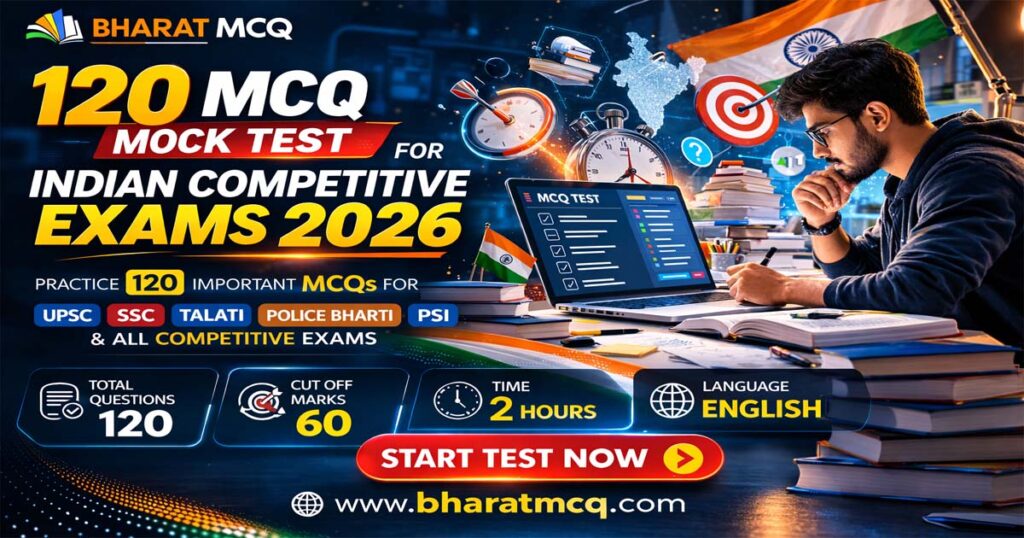
Practice 120 high-quality MCQs for UPSC, SSC, Talati, Police Bharti and other competitive exams. Improve accuracy with this full-length mock test.
Introduction: 120 MCQ for Indian Competitive Exam Mock Test 2026
Securing a government job in India is a dream for millions, but it requires more than just reading textbooks; it requires strategic preparation. Whether you are aiming for UPSC, State PSCs, SSC, Police Bharti, or Talati exams, the competition is fierce. One universal truth unites all these exams: they test your knowledge, speed, and accuracy through Multiple Choice Questions (MCQs).
To help you gauge your preparation level and refine your strategy, taking a full-length, comprehensive mock test is arguably the most critical step you can take. Simulated testing environments don’t just test your knowledge; they build your exam temperament.
Importance of Core Subjects in Competitive Exams
Competitive exams are designed to assess a candidate’s holistic understanding of the world around them. Here is why the core subjects are heavily weighted:
- Indian Polity & Constitution: As future administrators and government officials, a deep understanding of the rules governing the nation is non-negotiable. Questions on Fundamental Rights, Parliament, and Constitutional Amendments are staples.
- History & Culture: You cannot shape the future without understanding the past. Modern Indian History, particularly the freedom struggle, carries maximum weight.
- Geography & Environment: Environmental issues are global priorities. Knowledge of India’s physical geography, river systems, and ecological conservation is essential for administrative awareness.
- Economy: Understanding inflation, monetary policy, and taxation is vital for comprehending how state policies impact the common citizen.
- General Science: Basic scientific literacy reflects a rational mindset, which is crucial for modern governance.
- Reasoning & Aptitude: These sections do not test rote learning. Instead, they evaluate your logical thinking, problem-solving speed, and analytical capabilities.
Decoding the Types of Questions Asked
Real competitive exams have moved far beyond straightforward, fact-based questions. Today, examiners design questions to test conceptual clarity and application.
- Direct Factual Questions: These test your memory. (e.g., “Who founded the Ramakrishna Mission?”)
- Concept-Based Questions: These test your understanding of a process or definition. (e.g., “What causes Stagflation?”)
- Application-Based Questions: These evaluate your analytical skills, prominently seen in the reasoning and quantitative aptitude sections.
- Elimination-Style Questions: In harder exams, the options are designed to confuse you. Only a clear understanding of the subject allows you to eliminate the wrong choices confidently.
Proven Preparation Strategy for Success
Clearing a competitive exam is a marathon, not a sprint. Here is a strategy utilized by top rankers:
1. Master the Syllabus and Previous Year Questions (PYQs)
Before you read a single book, memorize your syllabus. Follow this up by analyzing PYQs from the last five years. This tells you what to study and, more importantly, what to skip.
2. Standard Resources Only
Avoid the trap of collecting too many study materials. Stick to standard books (like NCERTs for foundational knowledge, Laxmikanth for Polity, Spectrum for History) and revise them multiple times.
3. Current Affairs Integration
Static subjects are often linked to current events. If the President of India is in the news, expect a static question on the election of the President in your exam. Make reading a reliable newspaper a daily habit.
4. Time Management Strategies
Divide your study hours rationally across subjects. Dedicate the first half of your day to heavy subjects like Polity or History, and use the post-lunch slump for practicing Math and Reasoning.
Common Mistakes Aspirants Must Avoid
Even hardworking students sometimes fail to make the cut. Often, it comes down to a few critical errors:
- Ignoring Mock Tests: Reading without testing is an illusion of knowledge. Many students wait until they “finish the syllabus” to take a test. The syllabus is never truly finished. Start testing early.
- Over-Attempting Questions: In exams with negative marking, guessing wildly is suicidal. Learn the art of intelligent guessing and know when to leave a question blank.
- Neglecting Revision: Our brains forget information rapidly. A 10-hour study day is useless if you don’t dedicate at least 2 hours to revising what you studied yesterday.
- Losing Momentum: Consistency beats intensity. Studying 6 hours daily for six months is far more effective than studying 15 hours a day for one month.
The Tangible Benefits of MCQ Practice
Practicing a structured, 120-question mock test offers several benefits that plain reading simply cannot match:
- Identifies Weak Areas: A mock test acts as a diagnostic tool. If you consistently get Economy questions wrong, you know exactly where to focus your revision.
- Improves Speed and Accuracy: Solving 120 questions within a strict time limit trains your brain to process information faster without sacrificing accuracy.
- Builds Confidence: Familiarity breeds confidence. The more mock tests you attempt, the less anxiety you will face on the actual exam day.
- Teaches the Art of Elimination: Sometimes you won’t know the exact answer, but regular MCQ practice helps you develop the instinct to eliminate obviously incorrect options, increasing your probability of a correct guess.
Take the Ultimate Practice Test Now
Preparation is meaningless without execution. It is time to put your knowledge to the test.
We have designed a complete, professional-grade 120 MCQ Mock Test that mirrors the exact difficulty, tone, and distribution of real Indian competitive exams. Dive into the test, stick to the time limit, and analyze your performance honestly.
Are you ready to evaluate your standing and take a solid step toward your dream career? Start practicing today and track your progress!