
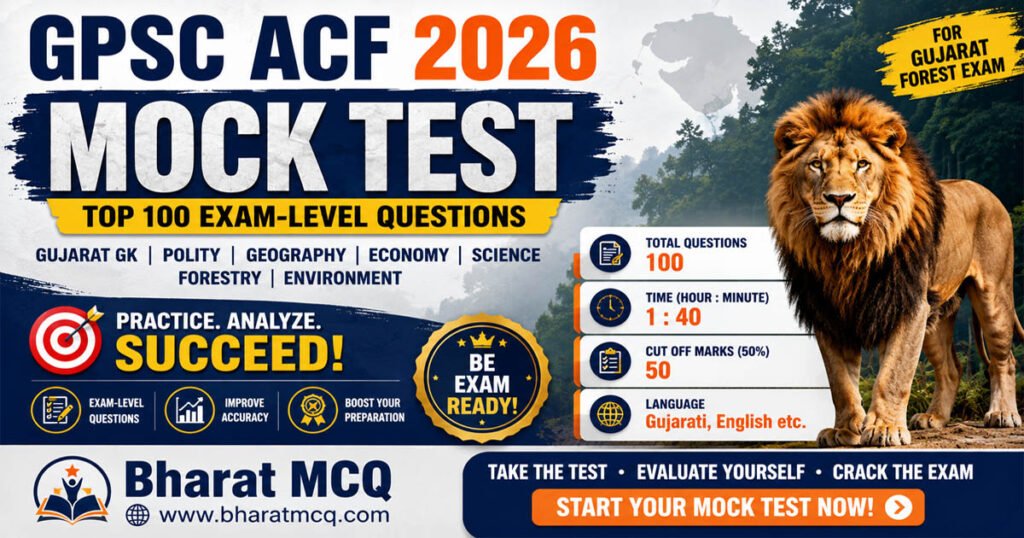
Attempt this GPSC ACF 2026 mock test with 100 exam-level questions on Gujarat GK, polity, geography, economy, science, forestry and environment.
Table of Contents
GPSC ACF 2026 Mock Test with 100 Exam-Level Questions
Introduction
The GPSC Assistant Conservator of Forest examination requires a combination of general studies knowledge, analytical ability, Gujarat-specific awareness and a strong understanding of environmental issues. Candidates must prepare beyond isolated facts because GPSC questions increasingly test conceptual clarity, relationships between topics and the practical application of knowledge.
The official GPSC preliminary structure for Assistant Conservator of Forest and Range Forest Officer contains General Studies Paper I and General Studies Paper II, each carrying 200 marks with a duration of 180 minutes. The prescribed syllabus covers history, Gujarat culture, the Constitution, governance, reasoning, economy, geography, science, technology, environment, forests, wildlife and current events.
This 100-question GPSC ACF 2026 mock test is designed as a balanced practice paper. It includes factual, conceptual, numerical, analytical and application-oriented questions suitable for serious GPSC preparation.
Importance of the Subjects in the GPSC ACF Examination
History and culture questions assess a candidate’s understanding of India’s development and Gujarat’s distinctive political, literary and architectural heritage. Important areas include the Harappan sites of Gujarat, the Solanki period, social and religious movements, the freedom struggle and major cultural monuments.
Indian polity is essential because an Assistant Conservator of Forest works within a constitutional and administrative framework. Knowledge of Fundamental Rights, constitutional bodies, Centre-State relations, Scheduled Areas, local governance, environmental institutions and judicial principles is directly relevant to public administration.
Geography helps candidates understand drainage systems, soils, climate, forests, grasslands, coastal processes and natural hazards. Gujarat-specific locations such as Gir, Banni, the Gulf of Khambhat, the Narmada Valley and the Rann of Kachchh are especially important.
Economy questions test public finance, taxation, agriculture, development, employment and environmental economics. Concepts such as externalities, Green GDP, fiscal deficit and sustainable development are highly relevant to natural-resource governance.
Science and technology now play an important role in forest management. Remote sensing, GIS, LiDAR, environmental DNA, satellite imagery, artificial intelligence and radar systems are used for mapping, wildlife estimation, fire detection and habitat monitoring.
Types of Questions Asked in Real Exams
GPSC questions are rarely limited to direct definitions. A candidate may be asked to identify the constitutional provision governing a body, distinguish between closely related ecological concepts or apply a mathematical principle to a field-based situation.
Statement-based questions test whether candidates understand the limitations of a conclusion. For example, knowing that all mangroves are wetlands does not prove that every mangrove is a protected area.
Application questions may present a forest fire, plantation survey, wildlife-monitoring method or policy situation. The candidate must select the administratively and scientifically appropriate response.
Numerical questions generally involve percentages, averages, ratios, work and time, probability, data interpretation and weighted values. They are usually manageable, but careless calculation can lead to negative marking.
Practical Preparation Strategy
Build preparation around the official syllabus
Divide the syllabus into manageable sections rather than studying from random sources. A practical division is Gujarat history and culture, polity, economy, geography, reasoning, science and technology, environment, forestry and current affairs.
Create a syllabus tracker and mark every topic as not started, in progress, revised once or revised multiple times. This prevents excessive attention to favourite subjects while weaker sections remain incomplete.
Connect static subjects with current developments
Environmental current affairs should be linked with fundamental concepts. When studying a new Ramsar recognition, revise the Ramsar Convention, wetland wise use and wetland ecosystem services. When reading about a wildlife-estimation report, study sampling, habitat requirements, conservation status and applicable legislation.
Use maps and visual revision
Mark Gujarat’s national parks, sanctuaries, wetlands, rivers, grasslands, mountain systems, coastal features and tribal regions on blank maps. Map-based learning improves retention and helps answer location-based elimination questions.
Practise calculations without a calculator
Candidates should be comfortable with fractions, ratios, percentage change, averages, weighted averages and inverse proportion. Write the formula first, substitute values carefully and check whether the final answer is logically possible.
Maintain an error register
After every test, classify incorrect answers into four categories: knowledge gap, conceptual confusion, calculation error and careless reading. The same error should not be repeated in the next mock test.
Revise through active recall
Reading the same notes repeatedly creates familiarity but not necessarily recall. Close the book and write what you remember about a topic. Then compare it with the source and add the missing points.
Common Mistakes Students Make
One frequent mistake is memorising current affairs without understanding the related institution or convention. Such preparation fails when GPSC changes a direct fact into a conceptual question.
Candidates also confuse similar environmental terms such as in situ and ex situ conservation, succession and restoration, weather and climate, afforestation and reforestation, or fiscal deficit and primary deficit.
Another error is ignoring Gujarat-specific details. National-level preparation alone is insufficient because Gujarat’s history, geography, economy, forests, protected areas and cultural heritage form an important part of the syllabus.
Some candidates attempt every question without evaluating uncertainty. A better approach is to answer high-confidence questions first, reconsider questions where two options can be eliminated and avoid unsupported guessing where negative marking applies.
Benefits of Regular MCQ Practice
MCQ practice develops retrieval speed, option elimination and time management. It also reveals whether a student can apply knowledge under examination pressure.
A balanced mock test identifies weak sections that may remain hidden during ordinary reading. For example, a candidate may understand ecology well but lose marks in constitutional provisions or data interpretation.
Repeated practice also improves judgement. Candidates learn to identify absolute words, incomplete conclusions, technically inaccurate statements and options that are broadly true but do not answer the exact question.
20 Sample Questions with Detailed Explanations
1. Which feature most clearly demonstrates the advanced urban planning of Dholavira?
Correct Answer: Integrated reservoirs and water channels
Explanation: Dholavira was located in an arid environment where reliable water management was essential. Its planners created reservoirs, channels, drains and water-harvesting structures connected with the settlement. This system demonstrates adaptation to local geography and a high level of municipal planning.
2. The doctrine of the Basic Structure was laid down in which case?
Correct Answer: Kesavananda Bharati v. State of Kerala
Explanation: In the 1973 Kesavananda Bharati judgment, the Supreme Court held that Parliament possesses wide constitutional-amendment powers but cannot destroy the Constitution’s basic structure. Features such as constitutional supremacy, judicial review, federalism and democracy are generally associated with this doctrine.
3. The Comptroller and Auditor General can be removed in the same manner as whom?
Correct Answer: A Judge of the Supreme Court
Explanation: The CAG requires institutional independence because the office audits government expenditure. The Constitution therefore provides strong security of tenure. Removal requires the same rigorous parliamentary process and grounds applicable to a Supreme Court judge.
4. What does the Public Trust Doctrine imply?
Correct Answer: The State holds certain natural resources in trust for the public.
Explanation: Resources such as rivers, forests, lakes and seashores have significant public value. The doctrine limits the government’s ability to transfer or permit the destruction of such resources merely for private benefit. The State must protect them for present and future generations.
5. Twelve guards complete a survey in 18 days. How long will eight guards take?
Correct Answer: 27 days
Explanation: The total work equals 12 × 18, or 216 guard-days. With eight guards, the required time is 216 ÷ 8, which equals 27 days. The number of workers and time are inversely proportional when efficiency remains constant.
6. What should be the first operational priority during a forest fire near a settlement?
Correct Answer: Protect human life, activate the response system and assess immediate fire behaviour.
Explanation: Emergency management follows the priority of life safety, incident stabilisation and property or environmental protection. During strong winds, fire behaviour may change rapidly. Evacuation, communication, command activation and assessment therefore come before estimating ecological or economic damage.
7. What is fiscal deficit?
Correct Answer: Total expenditure minus revenue receipts and non-debt capital receipts
Explanation: Fiscal deficit represents the government’s total borrowing requirement. Debt receipts are excluded because including borrowed money would hide the financing gap. A persistently high deficit may increase public debt and interest obligations.
8. What is a Pigouvian tax?
Correct Answer: A tax imposed to make a polluter bear the marginal external cost of pollution
Explanation: Pollution imposes costs on people who may not participate in the economic transaction. A Pigouvian tax attempts to internalise this negative externality by increasing the polluter’s private cost to reflect the broader social cost.
9. Where are the Banni grasslands located?
Correct Answer: Kachchh district
Explanation: Banni is a large grassland ecosystem situated along the southern edge of the Great Rann of Kachchh. It supports pastoral livelihoods and specialised dryland biodiversity. Its ecology is influenced by salinity, seasonal water availability and invasive vegetation.
10. How can El Niño affect the Indian monsoon?
Correct Answer: It can weaken the Walker circulation and often suppress the monsoon.
Explanation: El Niño involves abnormal warming in the central and eastern equatorial Pacific. This warming can alter tropical atmospheric circulation and reduce conditions favourable for the Indian summer monsoon. The relationship is strong but not mechanically identical in every year.
11. What is the formula for NDVI?
Correct Answer: (Near-Infrared − Red) ÷ (Near-Infrared + Red)
Explanation: Healthy vegetation absorbs much of the visible red light used in photosynthesis and strongly reflects near-infrared radiation. NDVI uses this contrast to estimate vegetation greenness, density and condition from remotely sensed data.
12. What technology did the SpaDeX mission demonstrate?
Correct Answer: Space rendezvous, docking and undocking
Explanation: ISRO’s SpaDeX satellites successfully demonstrated docking in January 2025 and undocking in March 2025. Such capability is important for future space-station operations, satellite servicing, sample-return missions and missions involving multiple spacecraft modules.
13. Where does primary ecological succession begin?
Correct Answer: On a surface where soil is initially absent
Explanation: Primary succession starts on newly exposed surfaces such as fresh lava or bare rock. Pioneer organisms help weather the substrate and contribute organic matter. Secondary succession begins where a previous community has been disturbed but soil remains.
14. What are the three zones of a biosphere reserve?
Correct Answer: Core, buffer and transition zones
Explanation: The core zone receives the highest protection. The buffer supports compatible research, education and limited activities. The transition zone permits settlements and sustainable economic activity. The system integrates biodiversity conservation with human development.
15. What are the three objectives of the Convention on Biological Diversity?
Correct Answer: Conservation, sustainable use and fair and equitable benefit sharing
Explanation: The CBD does not focus only on protecting species. It also promotes sustainable use of biodiversity and equitable sharing of benefits obtained from genetic resources, including issues connected with traditional knowledge and access arrangements.
16. When is Central Government approval required under the forest-conservation law?
Correct Answer: Before using forest land for a non-forest purpose
Explanation: Diversion of forest land can fragment habitats and reduce ecosystem services. Prior Central approval creates an additional scrutiny mechanism before State governments or authorities permit non-forest use of covered forest land.
17. What population was reported in India’s first riverine dolphin estimation?
Correct Answer: 6,327 dolphins
Explanation: The report released in 2025 estimated 6,327 riverine dolphins after surveys covering 28 rivers across eight states. Uttar Pradesh recorded the highest estimated number, followed by Bihar, West Bengal and Assam.
18. Which were India’s first Ramsar Wetland Cities?
Correct Answer: Indore and Udaipur
Explanation: Indore and Udaipur received recognition as India’s first Ramsar Wetland Cities in 2025. The recognition highlights cities that demonstrate positive relationships with nearby wetlands through planning, conservation, awareness and sustainable management.
19. What were India’s positions in FAO’s Global Forest Resources Assessment 2025?
Correct Answer: Ninth in total forest area and third in annual forest gain
Explanation: The reported rankings distinguish total existing forest area from the annual increase in forest area. India was placed ninth globally in total forest area and third in annual forest gain, according to the official 2025 environmental review.
20. Which India-led resolution was adopted at Ramsar COP15?
Correct Answer: Promoting Sustainable Lifestyles for the Wise Use of Wetlands
Explanation: The resolution linked wetland conservation with sustainable lifestyles and the Ramsar principle of wise use. It was adopted at Ramsar COP15 in Victoria Falls in 2025 and was aligned with India’s Mission LiFE approach.
Practice the Complete GPSC ACF Mock Test
Attempt all 100 questions under timed conditions before checking the answer indexes. Record incorrect and uncertain responses separately. Revise the related concept, solve the same question again after several days and then attempt another mixed mock test. This method converts each mistake into a specific revision task and produces measurable improvement across the GPSC ACF syllabus.