
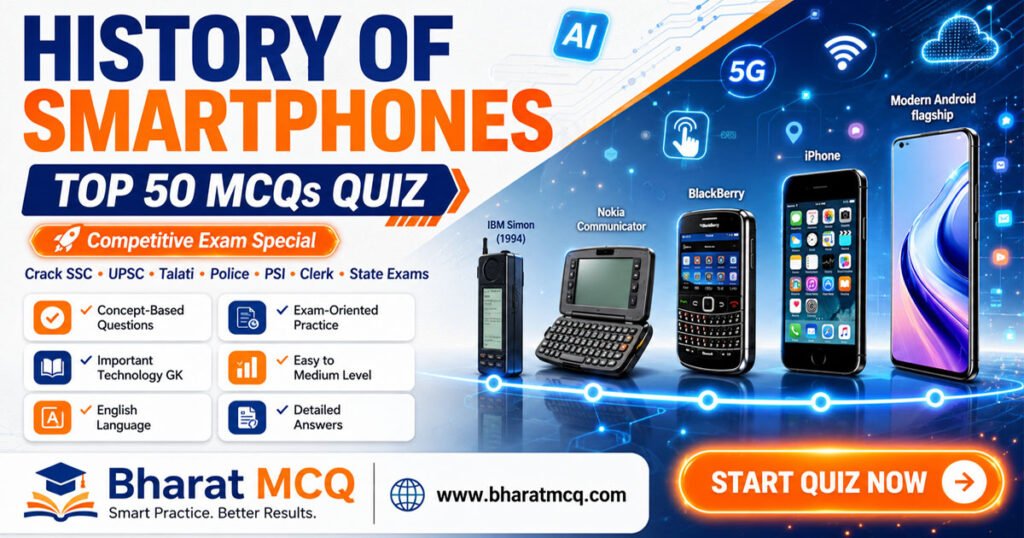
Study the History of Smartphones through 50 exam-level MCQs with answers for SSC, UPSC, Police, Talati, Clerk and state competitive exams in India.
History of Smartphones MCQs Quiz
Start QuizTable of Contents
History of Smartphones MCQ Questions with Answers
Introduction
The history of smartphones is an important part of computer awareness and information technology. Questions related to mobile generations, early smartphones, operating systems, touchscreen technology, wireless communication and application stores may appear in SSC, banking, railway, police, clerk, Talati, PSI and other government examinations.
The smartphone did not emerge from a single invention. It developed through the convergence of cellular telephones, personal digital assistants, computers, digital cameras, music players, navigation systems and internet technologies. Motorola’s handheld cellular prototype, the IBM Simon, Nokia Communicator devices, BlackBerry phones, Apple’s iPhone and Google’s Android platform represent major stages in this development.
Importance History of Smartphones in Competitive Exams
Competitive examinations generally do not ask only direct questions such as the name of the first smartphone. They may test chronological order, the difference between mobile generations, identification of technological features or the historical importance of a device.
Candidates should understand the relationship between hardware, software and communication networks. For example, the development of 3G made richer mobile data services possible, while application stores created an organized system for distributing smartphone software.
Types of Questions Commonly Asked
Questions from this topic generally include:
- Identification of the first handheld cellular phone and first smartphone
- Chronological arrangement of important mobile devices
- Features of 1G, 2G, 3G, 4G and 5G networks
- Development of Android, iOS, Symbian and BlackBerry
- Differences between resistive and capacitive touchscreens
- Importance of sensors, GPS, Bluetooth and Wi-Fi
- Role of application stores in smartphone development
Top 20 Important Practice Questions
1. Which company demonstrated the first working handheld cellular phone prototype in 1973?
A. IBM
B. Motorola
C. Nokia
D. Apple
Correct Answer: B. Motorola
Explanation: Motorola publicly demonstrated its DynaTAC handheld cellular prototype in New York City on 3 April 1973. The demonstration proved that cellular communication could be provided through a portable handheld device instead of only through vehicle-mounted equipment.
2. Which principle is fundamental to the operation of a cellular network?
A. One transmitter for the entire country
B. Frequency reuse across small geographical cells
C. Direct satellite connection for every call
D. Use of fixed telephone cables only
Correct Answer: B. Frequency reuse across small geographical cells
Explanation: A cellular network divides a service area into smaller geographical regions called cells. Low-powered base stations allow the same frequencies to be reused in sufficiently separated cells. This increases network capacity and permits more users to communicate through limited radio spectrum.
3. Which mobile generation primarily used analog voice transmission?
A. 1G
B. 2G
C. 3G
D. 4G
Correct Answer: A. 1G
Explanation: First-generation mobile networks were primarily analog systems designed for voice communication. They offered limited capacity, weak security and little support for data services. Second-generation systems introduced digital transmission, which improved voice quality, capacity and security.
4. IMT-2000 is associated with which mobile generation?
A. 1G
B. 2G
C. 3G
D. 5G
Correct Answer: C. 3G
Explanation: IMT-2000 is the International Telecommunication Union’s framework for third-generation mobile systems. It was developed to support higher data rates, multimedia services and global compatibility beyond the capabilities of earlier 2G networks.
5. What was the most important effect of 4G LTE on smartphone usage?
A. Return to analog voice
B. High-speed packet-based mobile broadband
C. Removal of internet services
D. Replacement of mobile towers with landlines
Correct Answer: B. High-speed packet-based mobile broadband
Explanation: Fourth-generation networks made high-speed mobile internet a central smartphone function. Video streaming, cloud applications, video conferencing, online gaming and real-time navigation became considerably more practical because of improved speed, capacity and reduced delay.
6. Which device is widely regarded as the first smartphone?
A. Nokia 9000 Communicator
B. IBM Simon Personal Communicator
C. Apple iPhone
D. T-Mobile G1
Correct Answer: B. IBM Simon Personal Communicator
Explanation: The IBM Simon combined a cellular telephone with personal-organizer functions, fax, pager capabilities and a touchscreen. Although it was large, expensive and commercially unsuccessful, the Computer History Museum identifies it as the first smartphone because it merged communication and computing functions in one handheld device.
7. The IBM Simon was commercially released in which year?
A. 1983
B. 1990
C. 1994
D. 1998
Correct Answer: C. 1994
Explanation: IBM and BellSouth introduced the Simon to consumers in 1994. Its release came approximately eleven years after the commercial introduction of Motorola’s DynaTAC 8000X and thirteen years before Apple’s first iPhone announcement.
8. Which feature distinguished the Nokia 9000 Communicator from ordinary mobile phones of its period?
A. A full QWERTY keyboard with email and web functions
B. A fingerprint scanner
C. A flexible OLED display
D. A 5G modem
Correct Answer: A. A full QWERTY keyboard with email and web functions
Explanation: Introduced in 1996, the Nokia 9000 Communicator opened like a small computer and provided a large display, QWERTY keyboard, email, fax, web access and business applications. It represented an important stage in the convergence of mobile phones and portable computers.
9. Which sequence correctly arranges the devices from earliest to latest?
A. IBM Simon, DynaTAC, iPhone, Nokia 9000
B. DynaTAC, IBM Simon, Nokia 9000, iPhone
C. Nokia 9000, DynaTAC, IBM Simon, iPhone
D. DynaTAC, Nokia 9000, IBM Simon, iPhone
Correct Answer: B. DynaTAC, IBM Simon, Nokia 9000, iPhone
Explanation: Motorola demonstrated the DynaTAC prototype in 1973 and commercially introduced the DynaTAC 8000X in 1983. IBM Simon followed in 1994, the Nokia 9000 Communicator appeared in 1996 and Apple announced the original iPhone in 2007.
10. Why did BlackBerry become popular among business users?
A. It offered satellite television
B. It emphasized secure mobile email
C. It introduced foldable displays
D. It functioned only as a gaming device
Correct Answer: B. It emphasized secure mobile email
Explanation: BlackBerry devices combined mobile email, messaging, organizer functions and physical QWERTY keyboards. Their secure and continuously connected email services made them particularly popular among corporate executives, professionals and government organizations.
11. What was the role of personal digital assistants in smartphone history?
A. They introduced cellular base stations
B. Their computing and organizer functions were merged with phones
C. They were designed only for voice calling
D. They eliminated the need for software
Correct Answer: B. Their computing and organizer functions were merged with phones
Explanation: Personal digital assistants provided calendars, contacts, notes, document tools and other computing functions. Smartphone development accelerated when manufacturers combined these capabilities with cellular calling, messaging and internet connectivity.
12. When did Apple officially introduce the original iPhone?
A. 9 January 2007
B. 11 July 2008
C. 22 October 2008
D. 3 April 1973
Correct Answer: A. 9 January 2007
Explanation: Apple introduced the original iPhone at Macworld on 9 January 2007. The company described it as a combination of a mobile phone, a widescreen iPod with touch controls and an internet communications device.
13. Which network technology was absent from the original 2007 iPhone?
A. Wi-Fi
B. EDGE
C. GSM
D. 3G
Correct Answer: D. 3G
Explanation: The original iPhone supported GSM, EDGE, Wi-Fi and Bluetooth, but it did not include 3G mobile networking. Apple added 3G connectivity with the iPhone 3G in 2008.
14. Why was the original iPhone’s multi-touch interface historically important?
A. It required a mechanical keyboard
B. It allowed direct finger-based gestures on the display
C. It removed graphical applications
D. It worked only with an external mouse
Correct Answer: B. It allowed direct finger-based gestures on the display
Explanation: Earlier touchscreen devices frequently depended on a stylus and pressure-sensitive resistive displays. The iPhone popularized a capacitive multi-touch interface that supported tapping, swiping, scrolling and pinching with fingers, making smartphone interaction more direct and intuitive.
15. Which important features were introduced with the iPhone 3G?
A. 3G networking and built-in GPS
B. Fax printing and infrared keyboard
C. Analog television and pager support
D. Satellite calling and a physical keyboard
Correct Answer: A. 3G networking and built-in GPS
Explanation: The iPhone 3G added faster 3G mobile networking and built-in GPS for location-based services. It also used iPhone 2.0 software, which supported third-party applications distributed through Apple’s App Store.
16. In which year did Apple’s App Store launch?
A. 2006
B. 2007
C. 2008
D. 2010
Correct Answer: C. 2008
Explanation: Apple’s App Store became available in July 2008. More than 500 native applications were available around the launch of the iPhone 3G, allowing users to install software wirelessly from an organized digital marketplace.
17. Which was the first commercially released Android-powered smartphone?
A. BlackBerry 5810
B. Nokia N95
C. T-Mobile G1
D. Apple iPhone 3G
Correct Answer: C. T-Mobile G1
Explanation: The T-Mobile G1, also known as the HTC Dream, became the first commercially available phone based on Android in October 2008. Google described its release as the result of more than three years of work involving members of the Open Handset Alliance.
18. What was Android Market?
A. A mobile network standard
B. The original Android application store
C. A smartphone processor
D. A touchscreen technology
Correct Answer: B. The original Android application store
Explanation: Android Market launched with the first Android-powered phone in October 2008. It allowed users to download applications and provide ratings and comments. The service was later developed into the Google Play ecosystem.
19. Bluetooth was originally designed for which purpose?
A. Satellite communication
B. Replacing short-range data cables
C. Operating mobile networks
D. Providing GPS navigation
Correct Answer: B. Replacing short-range data cables
Explanation: Bluetooth was conceived as a short-range wireless alternative to cables such as RS-232 connections. Ericsson, IBM, Intel, Nokia and Toshiba helped standardize the technology, and the Bluetooth Special Interest Group was formed in 1998.
20. How did application stores transform smartphones?
A. They restricted phones to factory-installed software
B. They simplified application discovery, installation and updates
C. They removed third-party developers
D. They replaced cellular networks
Correct Answer: B. They simplified application discovery, installation and updates
Explanation: Centralized application stores created a direct connection between developers and users. Applications could be discovered, purchased, downloaded and updated through a standard platform. This transformed smartphones from fixed-function devices into expandable software ecosystems. This conclusion is supported by the distribution models introduced through Apple’s App Store and Android Market.
Preparation Strategy
Study smartphone history as a connected timeline rather than memorizing isolated facts. Begin with the 1973 Motorola prototype and the 1983 commercial DynaTAC. Continue with the IBM Simon, Nokia Communicator, BlackBerry, iPhone and Android.
Create a comparison chart containing the device, company, year and major contribution. Separately revise mobile generations:
- 1G: Analog voice
- 2G: Digital voice, SMS and basic data
- 3G: Faster data and multimedia
- 4G: High-speed mobile broadband
- 5G: Low latency, greater capacity and massive connectivity
Also understand the purpose of common smartphone technologies such as GPS, Bluetooth, Wi-Fi, accelerometers, proximity sensors and application stores.
Common Mistakes Students Make
A common mistake is confusing the first mobile phone with the first smartphone. The Motorola DynaTAC represents an important stage in handheld cellular-phone history, while the IBM Simon is widely regarded as the first smartphone.
Students also confuse the iPhone announcement year with the App Store launch year. The original iPhone was announced in 2007, whereas the App Store and the first Android phone appeared in 2008.
Another mistake is assuming that every early touchscreen was capacitive. Many early devices used resistive touchscreens that depended on pressure or a stylus. Capacitive multi-touch later became the dominant interface for modern smartphones.
Benefits of MCQ Practice
MCQ practice improves factual recall, chronological understanding and elimination skills. It also helps candidates identify closely related options such as 2G versus 3G, IBM Simon versus Motorola DynaTAC and the original iPhone versus the iPhone 3G.
Regular practice is especially useful for computer-awareness sections because examinations often combine direct facts with practical technology-based situations.
Practice Quiz
Attempt the complete 50-question History of Smartphones MCQ Quiz and review every incorrect response. Focus especially on device chronology, mobile-network generations, operating systems, touchscreen development and wireless technologies.