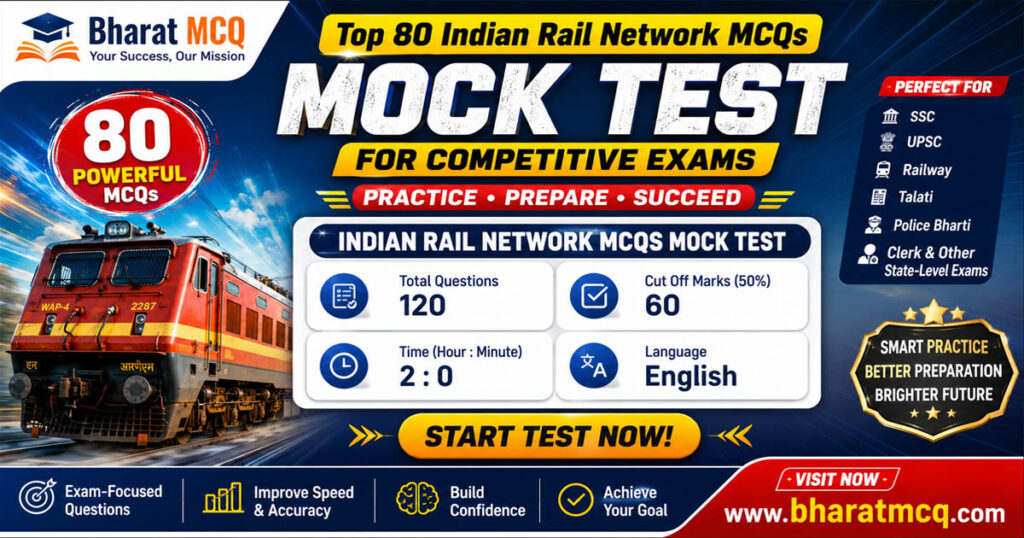
Practice an exam-level Indian Rail Network mock test with 80 MCQs for SSC, UPSC, Railway, Talati, Police Bharti, clerk and state-level exams.
Table of Contents
Indian Rail Network Mock Test for Competitive Exams
Introduction: Why Indian Rail Network Matters in Exams
Indian Rail Network is one of the most important static and current affairs topics for Indian competitive exams. Questions from this area are regularly useful for SSC, Railway exams, UPSC prelims, state PSC, Talati, Police Bharti, clerk exams and other general knowledge papers. The topic is not limited to remembering railway stations or train names. A serious exam paper may test railway zones, headquarters, gauges, safety systems, electrification, dedicated freight corridors, railway PSUs, production units, current infrastructure projects and administrative restructuring.
Indian Railways is also a live current affairs topic. For example, official electrification data available for November 2025 shows 69,427 broad gauge route kilometres electrified, covering about 99.2% of the network. Such facts are highly useful because examiners often convert them into direct MCQs, match-the-following questions or statement-based questions.
Importance of Indian Rail Network in Competitive Exams
The Indian Rail Network connects geography, economy, administration, science and technology in one subject. A question on the Western Dedicated Freight Corridor may test logistics and port connectivity. A question on Kavach may test railway safety and indigenous technology. A question on South Coast Railway may test recent administrative changes. This makes the subject valuable for both static GK and current affairs.
In state-level exams, railway questions often focus on zonal headquarters, important railway projects in a state, famous bridges and station redevelopment schemes. In national-level exams, the focus can shift toward policy, infrastructure, freight movement, electrification and public sector undertakings such as IRFC, RITES, RVNL, RailTel and DFCCIL.
Types of Questions Asked in Real Exams
Real exams usually do not ask only simple memory-based questions. They mix direct facts with applied understanding. A direct question may ask: “Where is the headquarters of North Central Railway?” An applied question may ask why dedicated freight corridors improve passenger train punctuality. The answer requires understanding that freight traffic shifted away from mixed-traffic routes creates more capacity for passenger and coaching services.
Dedicated Freight Corridors are a good example of application-based preparation. According to official information, DFCs support double-stack container trains, higher axle load movement, better access to western ports and development of terminals and linkages along the corridor. The same source also notes that DFC traffic rose from 247 average trains per day in 2023-24 to 352 average trains per day in 2024-25 up to February 2025. This type of fact can be framed as a logistics, economy or railway operations question.
Safety is another major area. Kavach is an indigenously developed train safety system designed to monitor and control train speeds. Kavach 4.0 was commissioned on the Mathura-Kota section of the Delhi-Mumbai route, and the system helps loco pilots through speed control, brake application and in-cab signal information. A real exam may ask its purpose, route, approval authority or safety level.
Preparation Strategy for Indian Rail Network
Start with the basic framework. Learn the railway zones, headquarters and major divisions first. Prepare a table of important pairings such as Northern Railway-New Delhi, North Central Railway-Prayagraj, South Central Railway-Secunderabad, East Central Railway-Hajipur, East Coast Railway-Bhubaneswar, South Western Railway-Hubballi and West Central Railway-Jabalpur.
Next, study infrastructure topics. Focus on dedicated freight corridors, railway electrification, high-speed and semi-high-speed trains, major bridges, station redevelopment and railway safety systems. Chenab Bridge and Anji Bridge are important because official updates describe Chenab Bridge as the world’s highest railway arch bridge and Anji Bridge as India’s first cable-stayed rail bridge.
Then revise organizations. IRCTC, IRFC, DFCCIL, RailTel, RVNL, RITES, CRIS and RDSO are frequently useful in MCQs. Do not only memorize full forms. Understand their functional role. For example, IRCTC is linked with ticketing, catering and tourism, while DFCCIL is linked with freight corridors.
Finally, track current administrative changes. South Coast Railway is especially important because official information stated that its Gazette notification would mention 1 June 2026 as the effective date, strengthening railway administration in Andhra Pradesh. Such current updates are often used in state exams and railway-related GK sections.
Common Mistakes Students Make
The most common mistake is confusing similar zone names. North Eastern Railway and Northeast Frontier Railway are different. South Eastern Railway and South East Central Railway are also different. Students often confuse headquarters such as Gorakhpur, Maligaon, Garden Reach and Bilaspur.
Another mistake is preparing only old static facts. Indian Railways is changing quickly through electrification, Kavach deployment, new zones, DFC operations and station redevelopment. A candidate who studies only old notes may miss current questions.
Students also ignore application-based questions. For example, if the question asks why DFCs help passenger punctuality, the answer is not “because they are new tracks” in a vague sense. The precise reason is that freight movement shifts from congested mixed-use lines to dedicated freight routes, improving line capacity and operations.
Benefits of MCQ Practice
MCQ practice helps students identify weak areas quickly. It also trains the mind to handle close options. In Indian Rail Network questions, options are often similar: Hajipur, Hubballi, Jabalpur, Jaipur; or RDSO, RVNL, RITES, RailTel. Regular practice reduces confusion and improves recall speed.
Full-length practice is better than random question solving because it creates exam-like pressure. A balanced mock test includes headquarters, zones, gauges, safety, freight, electrification, PSUs, bridges and current developments. This improves both accuracy and time management.
Internal CTA: Practice Test
Now attempt the Indian Rail Network Mock Test given above. Treat it like a real competitive exam section. First solve all 80 questions without checking the answers, then review every incorrect response. Revise the related concept immediately. This method will help you build strong command over Indian Railways GK for SSC, UPSC, Railway, Talati, Police Bharti, clerk and state-level competitive exams.