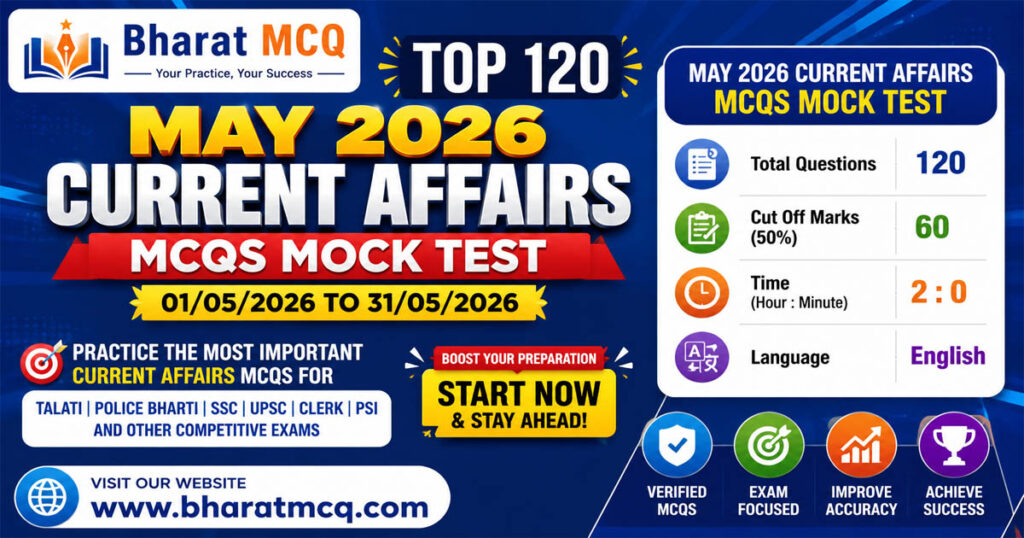
Practice Top 120 verified May 2026 Current Affairs MCQs from 01/05/2026 to 31/05/2026 for Talati, Police Bharti, SSC, UPSC, Clerk, PSI and other exams.
Table of Contents
May 2026 Current Affairs MCQs for Competitive Exams
Current affairs play a major role in almost every Indian competitive exam. Whether an aspirant is preparing for Talati, Police Bharti, SSC, UPSC, Clerk, PSI, Railway, Banking or state-level recruitment exams, monthly current affairs revision helps improve accuracy in the general awareness section. This article covers important current affairs from 01/05/2026 to 31/05/2026 in the form of exam-oriented MCQs.
The questions above are prepared from verified current affairs topics such as government decisions, national appointments, schemes, defence developments, economy, science and technology, sports, awards, important days and international events related to India. Major reference points include official PIB releases, Union Cabinet decisions, official ministry updates and reliable sports/current affairs reports. PIB’s May 2026 releases covered several high-value topics including Cabinet decisions, appointments, defence updates, President’s programmes, Prime Minister’s visits and government initiatives.
Why May 2026 Current Affairs Are Important
May 2026 was a highly relevant month for exam preparation because it included important policy decisions, major appointments and international engagements. The Union Cabinet approved the increase in the sanctioned strength of Supreme Court judges from 33 to 37, excluding the Chief Justice of India. It also approved two semiconductor projects with cumulative investment of more than Rs 3,900 crore, ECLGS 5.0, a ship repair facility at Vadinar, and the Scheme for Promotion of Surface Coal/Lignite Gasification Projects with an outlay of Rs 37,500 crore.
For government exam aspirants, such facts are frequently asked in direct one-line MCQ format. Questions may ask about the name of a bill, an approved financial outlay, a ministry, a location, or a newly launched portal. That is why monthly MCQ practice is one of the most effective methods for revision.
Key National Current Affairs Highlights
Several important national events took place in May 2026. The Swasth Bharat Portal was launched as a health service aggregator compliant with the Ayushman Bharat Digital Mission framework. The PM-AJAY Portal and AJAY Mobile App were launched to strengthen digital monitoring of Scheduled Caste welfare schemes. SARTHAK-PDS was also approved to improve the Public Distribution System with a financial outlay of Rs 25,530 crore and an implementation period up to 31 March 2031.
The Ministry of Statistics and Programme Implementation also released information about the revised Index of Industrial Production series. The IIP base year was revised from 2011-12 to 2022-23, with a new basket of 463 item groups and planned release with a 28-day time lag. This is important for economy-related questions in SSC, UPSC, state PSC and banking exams.
Appointments and Defence Current Affairs
Appointments are a scoring area in competitive exams. In May 2026, Bharat Khera assumed charge as Secretary, Ministry of MSME, Vishvajit Sahay became Secretary, Defence Finance, and Anugraha Narayana Das assumed charge as Controller General of Defence Accounts. Prasoon Joshi was appointed Chairman of Prasar Bharati, while Shashi Shekhar Vempati was appointed Chairperson of the Central Board of Film Certification.
Defence current affairs were equally important. Lt Gen N. S. Raja Subramani (Retd) was appointed Chief of Defence Staff and Secretary, Department of Military Affairs. DRDO completed development trials of UAV-Launched Precision Guided Missile-V3, India test-launched Agni-1, and an Indian War Memorial was inaugurated in Seoul. These defence-related events are particularly useful for Police Bharti, UPSC, CDS, CAPF and other uniformed service exams.
Science, Technology and Economy Highlights
Science and technology questions often focus on portals, missions, space technology and semiconductor developments. The India Semiconductor Mission launched an Investors Support Portal in May 2026. India also marked World Metrology Day 2026 with the launch of the e-Maap Digital Portal and the issue of 40 GATC certificates. The theme of World Metrology Day 2026 was linked with trust in policy making, making it relevant for both science and important-days sections.
Prime Minister Narendra Modi’s international engagements also created several exam-worthy facts. He received the FAO Agricola Medal and also received honours from Norway and Sweden. India-Netherlands cooperation included the Roadmap 2026-2030 and an ASML-Tata Electronics semiconductor-related agreement. Such facts are important for international relations questions in UPSC, SSC and state-level exams.
Sports Current Affairs of May 2026
Sports current affairs from May 2026 were rich in MCQ value. India won 27 medals at the U23 Asian Wrestling Championships 2026 in Da Nang, Vietnam, including 11 gold medals. India’s men’s freestyle team won the team title, while women wrestlers also performed strongly.
In shooting, Esha Singh won gold in the 25m Pistol Women event at the ISSF World Cup Munich 2026 and set a world record. She also qualified for the ISSF World Cup Final in Rome. Other notable results included Suruchi Singh’s gold in women’s 10m air pistol and Manu Bhaker-Samrat Rana’s silver in the mixed team event.
IPL 2026 also produced exam-worthy facts. Royal Challengers Bengaluru won the IPL 2026 title at Narendra Modi Stadium, Ahmedabad. Vaibhav Sooryavanshi won the Orange Cap, while Kagiso Rabada won the Purple Cap.
Important Days and Themes
Important days and themes are asked very frequently in exams. In May 2026, World Press Freedom Day was observed with the theme “Shaping a Future at Peace: Promoting Press Freedom for Human Rights, Development, and Security.” International Nurses Day 2026 carried the theme “Our Nurses. Our Future. Empowered Nurses Save Lives.” World Telecommunication and Information Society Day 2026 focused on “Digital lifelines – strengthening resilience in a connected world.”
Why Practice MCQs for Current Affairs?
Reading current affairs is useful, but solving MCQs helps aspirants remember facts faster. MCQs train the mind to identify keywords, eliminate wrong options and recall data under time pressure. For example, a candidate may know that a portal was launched, but exams usually ask the ministry, date, city, purpose or correct full form. Regular MCQ practice converts reading into exam performance.
The 120 MCQs provided here are designed for easy-to-medium difficulty and cover a broad exam syllabus. Aspirants should revise these questions multiple times and mark difficult topics for later review. This approach is especially useful for candidates preparing for Gujarat Talati, Police Bharti, SSC CGL, SSC CHSL, UPSC prelims, state PSC, Clerk and PSI exams.
Chalo, image_25dd81.jpg na topic (Top 120 May 2026 Current Affairs) pramane 20 important and high-yield questions ready chhe.
Aama પણ badha j Question tags ne bold kari didha chhe ane vachche --- dividers sathe double line spacing raakhi chhe, jethi WordPress block editor ma direct copy-paste karti vakhte automatic alag blocks bani jay.
May 2026 Current Affairs Mock Test: Important Questions with Detailed Explanations
(1) Question: The prestigious ‘World Press Freedom Index’, which is traditionally released every year in the month of May, is published by which international non-governmental organization?
Answer: Reporters Without Borders (Reporters Sans Frontières – RSF)
Explanation: The World Press Freedom Index is published annually in May by Reporters Without Borders. It evaluates and ranks the state of journalism, media independence, and pluralism across 180 countries and territories globally.
(2) Question: Which Southeast Asian nation officially holds the rotating Chairmanship of the Association of Southeast Asian Nations (ASEAN) for the entire calendar year of 2026?
Answer: Philippines
Explanation: The chairmanship of ASEAN rotates annually among its member states based on the alphabetical order of their English names. Following Malaysia’s chairmanship in 2025, the Philippines stepped into the official leadership role for 2026.
(3) Question: What is the primary operational objective of the ‘NISAR’ satellite mission, a landmark joint collaboration between India’s ISRO and USA’s NASA?
Answer: Dual-frequency radar earth-observation to monitor global environmental changes.
Explanation: NISAR (NASA-ISRO Synthetic Aperture Radar) utilizes advanced L-band and S-band dual-frequency radar systems. Its goal is to map the entire globe every 12 days to track ecosystem disturbances, ice-sheet collapses, and natural hazards like earthquakes and tsunamis.
(4) Question: Every year, May 22 is observed globally as the International Day for Biological Diversity. Which landmark international treaty forms the foundation for this global observance?
Answer: The Convention on Biological Diversity (CBD)
Explanation: The International Day for Biological Diversity was instituted by the United Nations to increase understanding and awareness of biodiversity issues. It commemorates the adoption of the text of the Convention on Biological Diversity on May 22, 1992.
(5) Question: The ‘Carbon Border Adjustment Mechanism’ (CBAM), a landmark policy designed to impose carbon taxes on carbon-intensive imports like steel and cement, was introduced by which major economic bloc?
Answer: The European Union (EU)
Explanation: Introduced by the European Union, CBAM is a climate measure aimed at preventing “carbon leakage.” It ensures that goods imported into the EU face equivalent carbon pricing to those produced domestically, pushing global supply chains to decarbonize.
(6) Question: Which international financial institution publishes the bi-annual ‘World Economic Outlook’ (WEO) report, which updates global economic growth projections?
Answer: International Monetary Fund (IMF)
Explanation: The World Economic Outlook report is published by the International Monetary Fund (IMF) twice a year (usually in April/May and October). It provides comprehensive analysis and forecasts regarding global economic growth, inflation, and financial stability.
(7) Question: Which technical intelligence agency operates under the Ministry of Finance as the central national agency responsible for processing and analyzing information related to suspect financial transactions in India?
Answer: Financial Intelligence Unit-India (FIU-IND)
Explanation: FIU-IND was established by the Government of India to serve as the central national agency responsible for receiving, processing, analyzing, and disseminating information relating to suspect financial transactions, primarily under the Prevention of Money Laundering Act (PMLA).
(8) Question: The ‘State of the World’s Forests’ (SOFO) report, which comprehensively tracks the rate of global deforestation and ecosystem health, is published periodically by which specialized agency of the United Nations?
Answer: Food and Agriculture Organization (FAO)
Explanation: The Food and Agriculture Organization (FAO) publishes the State of the World’s Forests report. It outlines data-driven insights into forestry resources, legal frameworks, and sustainable conservation strategies worldwide.
(9) Question: Under the regulatory framework of India, which premier banking institution handles the structural issuance, auction tracking, and operational market framework for Sovereign Green Bonds (SGrBs)?
Answer: Reserve Bank of India (RBI)
Explanation: The Reserve Bank of India (RBI), in consultation with the Government of India, manages the issuance calendar, competitive auctioning process, and market trading infrastructure for Sovereign Green Bonds to fund public clean-energy projects.
(10) Question: The legendary ‘Vikas’ engine, an essential milestone in India’s space program, is primarily utilized to power which crucial stages of ISRO’s launch vehicles?
Answer: Liquid propulsion stages (e.g., Second stage of PSLV and GSLV)
Explanation: The Vikas engine is a highly reliable liquid-fueled rocket engine developed by ISRO’s Liquid Propulsion Systems Centre. It serves as the workhorse powering the second stage of the Polar Satellite Launch Vehicle (PSLV) and Geosynchronous Satellite Launch Vehicle (GSLV) models.
(11) Question: According to the statutory provisions of the Disaster Management Act, 2005, who serves as the ex-officio Chairperson of the National Disaster Management Authority (NDMA) of India?
Answer: The Prime Minister of India
Explanation: The NDMA is the apex statutory body for disaster management in India. As per Section 3(2) of the Disaster Management Act, 2005, the Prime Minister of India serves as its ex-officio Chairperson to ensure high-level executive coordination.
(12) Question: The ‘Global Climate Risk Index’, which analyzes and ranks the extent to which countries have been affected by impacts of weather-related loss events, is released by which independent environmental think tank?
Answer: Germanwatch
Explanation: The Global Climate Risk Index is an influential annual report compiled and published by the non-governmental organization Germanwatch. It measures the socioeconomic vulnerability of nations to severe extreme weather events.
(13) Question: Where is the permanent international headquarters of the Indian Ocean Rim Association (IORA), an intergovernmental organization aimed at strengthening maritime security and cooperation, located?
Answer: Ebene, Mauritius
Explanation: The Indian Ocean Rim Association (IORA) was established in 1997. Its central administrative secretariat is located in Ebene, Mauritius, where it coordinates regional cooperation among its 23 member states bordering the Indian Ocean.
(14) Question: What is the primary objective of the periodic ‘LEADS’ (Logistics Ease Across Different States) report published by the Ministry of Commerce and Industry in India?
Answer: Assessing and ranking the efficiency of logistics ecosystems across Indian states and Union Territories.
Explanation: The LEADS report is an indigenous data-driven index that evaluates states based on crucial logistical parameters like infrastructure quality, regulatory services, and operating efficiency to identify gaps and lower logistics costs across India.
(15) Question: The strategic ‘Zojila Tunnel’, which is designed to provide all-weather, seamless transport connectivity throughout the year, links which two vital regions in northern India?
Answer: Srinagar (Kashmir Valley) and Leh (Ladakh)
Explanation: The Zojila Tunnel is an engineering milestone excavated through the Zojila Pass. Once fully operational, it bypasses heavy seasonal snow hazards to establish an uninterrupted, all-weather strategic link between the Kashmir Valley and Ladakh.
(16) Question: The ‘Global Financial Stability Report’ (GFSR), which assesses key systemic vulnerabilities in international capital markets, is published semi-annually by which global financial entity?
Answer: International Monetary Fund (IMF)
Explanation: The GFSR is a key report issued by the IMF that focuses on current market conditions, highlighting systemic risks, financial sector vulnerabilities, and policy recommendations to safeguard global monetary stability.
(17) Question: India’s massive naval infrastructure development initiative known as ‘Project Seabird’, which aims to create one of the largest naval bases in the Eastern Hemisphere, is located at which site?
Answer: INS Kadamba at Karwar, Karnataka
Explanation: Project Seabird is a major defense infrastructure program focused on expanding the INS Kadamba naval base at Karwar on the western coast of Karnataka. Once complete, it will provide deep-water berths and advanced repair docks for India’s fleet.
(18) Question: The ‘Digital India Act’ (DIA), currently undergoing draft refinement workshops and legislative steps, is designed by the government to completely replace which outdated legislation?
Answer: Information Technology Act, 2000 (IT Act)
Explanation: The Ministry of Electronics and Information Technology (MeitY) is introducing the Digital India Act to succeed the decades-old IT Act, 2000. It aims to address modern cyber realities like AI governance, data privacy, online harms, and digital marketplace monopolies.
(19) Question: The International Booker Prize, which announces its final winner annually in May, is explicitly awarded for a single work of fiction that meets which translation criteria?
Answer: It must be translated into English and published in the United Kingdom or Ireland.
Explanation: Unlike the standard Booker Prize (for books originally written in English), the International Booker Prize celebrates global literature by awarding a book translated into English, with the £50,000 prize money split equally between the author and the translator.
(20) Question: The ‘Global Biodiversity Framework Fund’ (GBFF), established to upscale global investments in wildlife and habitat protection, is managed under the administrative stewardship of which international body?
Answer: Global Environment Facility (GEF)
Explanation: The GBFF was created to help implement the historic Kunming-Montreal Global Biodiversity Framework goals. It is managed and operated by the Global Environment Facility (GEF), channeling international capital toward biodiversity preservation.
Conclusion
The current affairs of 01/05/2026 to 31/05/2026 include many important developments from government policy, defence, economy, appointments, sports, science and international relations. Regular practice of monthly current affairs MCQs can improve speed, confidence and score in competitive exams. Aspirants should revise these questions carefully, connect each fact with its category, and continue monthly practice for stronger exam preparation.