
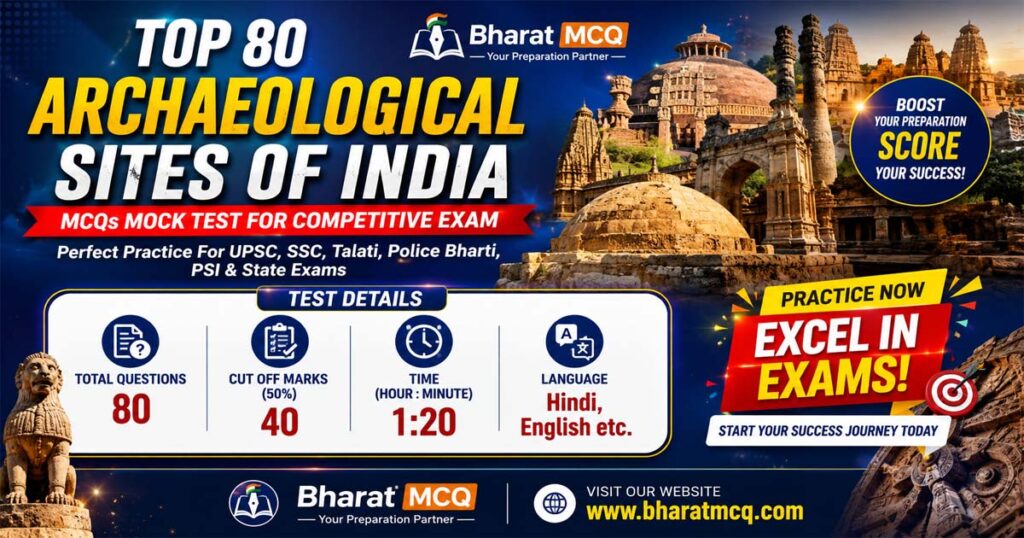
Practice Top 80 exam-level MCQs on archaeological sites of India for UPSC, SSC, Talati, Police Bharti, PSI and state exams.
Table of Contents
Archaeological Sites of India Mock Test for Competitive Exams
Archaeological sites of India are an important part of Indian History and General Knowledge in competitive exams. Questions from this topic appear in UPSC, SSC, Railway, Police Bharti, PSI, Talati, Clerk, State PSC and other government exams. This topic is not limited to remembering names of places. Examiners usually test location, cultural phase, excavation evidence, chronology, architecture, inscriptions, UNESCO status and the historical importance of a site.
India has a very wide archaeological base, from prehistoric rock shelters and Stone Age tools to Harappan cities, Buddhist stupas, ancient universities, cave complexes, temple towns and medieval monuments. The Archaeological Survey of India is the key official institution for archaeological research, conservation and protection of India’s cultural heritage, while UNESCO’s current official page lists India with 44 World Heritage properties.
Importance of Archaeological Sites in Competitive Exams
For Indian competitive exams, archaeological sites are useful because they connect ancient history with physical evidence. A written source can describe an event, but archaeology provides material proof through pottery, tools, seals, inscriptions, coins, buildings, burials and settlement patterns. That is why exam papers often ask direct as well as analytical questions from this area.
In Prehistory, questions may come from Bhimbetka, Attirampakkam, Bagor, Burzahom, Koldihwa and other important sites. These questions usually focus on rock paintings, stone tools, pit dwellings, early agriculture and Mesolithic or Neolithic features.
In Protohistory, Harappan sites are extremely important. Dholavira, Lothal, Kalibangan, Rakhigarhi, Banawali and Surkotada are repeatedly asked. Dholavira is officially described by UNESCO as a Harappan city located on Khadir Island in Gujarat, occupied broadly between 3000 BCE and 1500 BCE. Lothal is important for maritime trade, Kalibangan for the ploughed field, and Rakhigarhi for its large Harappan settlement evidence.
In early historic India, students must study Sanchi, Bharhut, Sarnath, Rajgir, Vaishali, Kausambi, Pataliputra, Nalanda and Vikramshila. These sites help in understanding Buddhism, Jainism, Mahajanapadas, Mauryan administration and ancient education.
Types of Questions Asked in Real Exams
Real competitive exams do not ask only simple one-line questions. They often use matching pairs, statement-based questions, location identification and evidence-based questions. For example, a question may provide archaeological clues such as dockyard, beads and shell objects, and ask the candidate to identify Lothal. Another question may mention reservoirs, a signboard and three-part city planning, and expect Dholavira as the answer.
Exams also ask about incorrectly matched pairs. A question may give pairs such as Rakhigarhi-Haryana, Kalibangan-Rajasthan, Lothal-Gujarat and Burzahom-Kerala. A serious aspirant should immediately identify Burzahom-Kerala as incorrect because Burzahom is in Kashmir.
Another common pattern is culture-based identification. Painted Grey Ware is connected with the later Vedic period, Northern Black Polished Ware with second urbanization, and Ochre Coloured Pottery with Copper Hoard culture. These areas are especially important for UPSC, State PSC and SSC-level exams.
Practical Preparation Strategy
The best way to prepare archaeological sites is to divide the topic into periods. First, prepare Prehistoric and Neolithic sites. Make a short list of site, state, river or region, and special feature. For example, Bhimbetka-Madhya Pradesh-rock shelters, Burzahom-Kashmir-pit dwellings, Bagor-Rajasthan-Mesolithic evidence.
Second, prepare Harappan sites separately. Do not study them randomly. Make a table with columns such as site, state, river or location, important evidence and exam keyword. Dholavira should be linked with Khadir Island, water reservoirs and Harappan urban planning. Lothal should be linked with dockyard, bead-making and trade. Kalibangan should be linked with ploughed field and fire altars.
Third, prepare Buddhist and Jain sites. Sanchi, Bharhut, Sarnath, Nalanda, Vikramshila, Udayagiri-Khandagiri and Kanheri are very important. Learn the difference between Buddhist caves, Jain caves, stupas, monasteries and inscriptions.
Fourth, cover temple and monument sites such as Mahabalipuram, Pattadakal, Aihole, Badami, Hampi, Konark, Khajuraho, Rani ki Vav, Qutb complex and Fatehpur Sikri. In these topics, focus on dynasty, architectural style and location.
Common Mistakes Students Make
The most common mistake is memorizing only the site name without its state. In exams, location is often the deciding factor. For example, students may know Lothal but confuse it with Haryana instead of Gujarat. Similarly, many students confuse Udayagiri in Madhya Pradesh with Udayagiri-Khandagiri in Odisha. The first is important for Gupta-period art, while the second is linked with Jain tradition and Kharavela.
Another mistake is mixing cultural periods. Harappan, Chalcolithic, Painted Grey Ware, Northern Black Polished Ware and Megalithic cultures should not be treated as the same. Each has a different time frame and evidence pattern.
Students also depend too much on static one-line notes. Competitive exams now include application-based questions. If a question describes evidence instead of naming the site, only conceptual clarity will help.
Benefits of MCQ Practice
MCQ practice is essential because archaeology contains many similar-sounding names and closely related facts. Regular practice helps students improve recall speed, eliminate wrong options and identify traps in matching questions.
A good mock test also shows weak areas. If a student repeatedly makes mistakes in Harappan sites, that topic should be revised using maps and tables. If mistakes occur in cave architecture, then Ajanta, Ellora, Elephanta, Kanheri, Karla and Bhaja should be compared side by side.
For state-level exams like Talati, Police Bharti, Clerk and PSI, direct factual questions are common. For UPSC and State PSC, statement-based and analytical questions are more common. Therefore, both factual memory and concept-based practice are necessary.
Practice Test
This 80-question mock test is designed to cover major archaeological sites of India in an exam-oriented manner. It includes prehistoric sites, Harappan centres, early historic cities, Buddhist and Jain sites, cave complexes, temple towns, UNESCO-linked monuments and archaeology methods. Practice the test carefully, revise incorrect answers, and maintain a separate short notebook for site-location-feature combinations. Regular MCQ practice will make this topic easier, faster and more scoring in competitive exams.