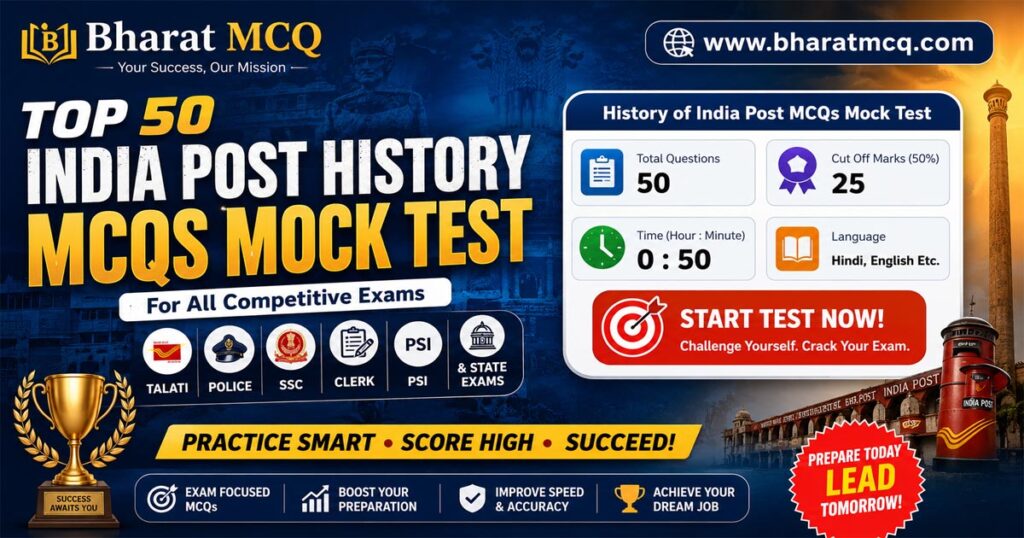
Practice Top 50 exam-level MCQs on India Post history for Talati, Police, SSC, Clerk, PSI and state competitive exam preparation.
Table of Contents
India Post History Mock Test for Competitive Exams
Introduction
The history of India Post is an important part of General Knowledge and Indian administrative history. Many competitive exams ask questions from postal reforms, communication systems, postage stamps, PIN Code, money order, Postal Life Insurance, Speed Post and the development of mail services in India. These topics are useful for exams such as Talati, Police Bharti, PSI, Clerk, SSC, Railway, State PSC and other government recruitment examinations.
India Post is not only a postal service. It is one of the oldest public institutions connected with administration, communication, rural development and financial inclusion. From ancient messenger systems to modern postal services, its history shows how communication shaped governance and public life in India. For this reason, exam setters often include factual as well as conceptual questions from this topic.
Importance of India Post History in Competitive Exams
Questions on India Post history are generally included under Indian History, Modern India, General Knowledge and Public Administration. The topic becomes important because it connects colonial reforms, administrative development and post-independence public services.
For example, Lord Dalhousie’s postal reforms of 1854 are linked with the creation of a uniform modern postal system. The Scinde Dawk of 1852 is important because it was Asia’s first adhesive postage stamp. The first all-India postage stamps were issued in 1854. India joined the Universal Postal Union in 1876. The world’s first official airmail flight took place in India in 1911 between Allahabad and Naini. The PIN Code system was introduced on 15 August 1972. Such facts are often asked directly in one-line MCQs.
At the same time, the topic is not limited to memorising years. Exams may ask why a reform was important, how postal services helped administration, or how the PIN Code improved mail sorting. Therefore, aspirants must study both factual and conceptual aspects.
Types of Questions Asked in Real Exams
In real competitive exams, India Post history questions usually follow a few common patterns. The first type is date-based. These questions ask when a service or reform was introduced. Examples include the year of Scinde Dawk, the 1854 postal reforms, India joining the Universal Postal Union, introduction of money order, Postal Life Insurance, PIN Code or Speed Post.
The second type is personality-based. Questions may ask who introduced the PIN Code system or which Governor-General was associated with postal reforms. Shriram Bhikaji Velankar and Lord Dalhousie are important names for this topic.
The third type is match-the-pair. For example, Scinde Dawk may be matched with 1852, PIN Code with 1972 and Speed Post with 1986. Such questions check whether the student can connect events with correct years.
The fourth type is statement-based. These questions test deeper understanding. A question may ask which statement about the first stamp of independent India is correct, or why the Universal Postal Union was important. These questions require clarity, not guesswork.
The fifth type is chronology-based. Students may be asked to arrange events such as Scinde Dawk, all-India stamps, UPU membership and PIN Code in the correct order. This type is common in SSC, State PSC and police recruitment exams.
Preparation Strategy for India Post History
Start preparation by making a short timeline. Write major events in order: pre-modern dak system, Sher Shah Suri’s road and communication arrangements, Scinde Dawk in 1852, all-India stamps and postal reforms in 1854, India joining the Universal Postal Union in 1876, money order in 1880, Post Office Savings Bank in 1882, Postal Life Insurance in 1884, first official airmail flight in 1911, first independent India stamp in 1947, PIN Code in 1972 and Speed Post in 1986.
Next, prepare a list of important personalities. Lord Dalhousie should be linked with postal reforms. Sir Bartle Frere should be linked with Scinde Dawk in Sindh. Shriram Bhikaji Velankar should be linked with the PIN Code system.
After that, study the purpose of each reform. Do not only memorise that PIN Code was introduced in 1972. Understand that it helped in sorting and delivery of mail in a large and diverse country. Similarly, understand that postage stamps helped prepaid postage and easier accounting. Money order helped people send money safely across distances, especially migrant workers and rural families.
Finally, practise MCQs in sets. A full-length mock test helps you check accuracy, speed and retention. After every test, note wrong answers and revise only those weak points.
Common Mistakes Students Make
One common mistake is confusing Scinde Dawk with the first all-India postage stamp. Scinde Dawk was issued in 1852 in Sindh, while the first all-India postage stamps were issued in 1854.
Another mistake is mixing up PIN Code and Speed Post. PIN Code was introduced in 1972, while Speed Post was launched in 1986. Both are post-independence developments, but they belong to different phases and purposes.
Many students also remember dates without understanding significance. This creates difficulty in statement-based questions. For example, if a question asks the reason behind introducing uniform postage, the answer is not a date but the simplification of postal charges and wider public access.
Some aspirants ignore postal services as a minor topic. This is risky because exams often include one or two questions from such compact factual areas. A small topic can give easy marks if prepared properly.
Benefits of MCQ Practice
MCQ practice is the best way to prepare India Post history because the topic contains many similar-looking facts. Regular practice helps in separating close options such as 1852 and 1854, 1972 and 1986, or money order and Postal Life Insurance.
Mock tests also improve elimination skills. Even when you are not fully sure, you can remove clearly wrong options. For example, if the question is about PIN Code, options related to colonial-era reforms can be eliminated. If the question is about Scinde Dawk, post-independence options can be removed.
Another benefit is exam temperament. Competitive exams demand fast decision-making. Practising 50-question sets helps students manage time and avoid overthinking. It also builds confidence in factual sections of General Knowledge.
Internal CTA: Practice Test
To strengthen your preparation, attempt the full India Post History Mock Test given above. Treat it like a real exam paper. First solve all 50 questions without checking answers. Then review your mistakes and revise the related facts. Focus especially on chronology, important years, personalities and the purpose of major postal reforms.
This mock test is useful for Talati, Police Bharti, PSI, Clerk, SSC, Railway and state-level competitive exams. Regular practice of such topic-wise tests can improve your score in General Knowledge and help you handle factual questions with better accuracy.