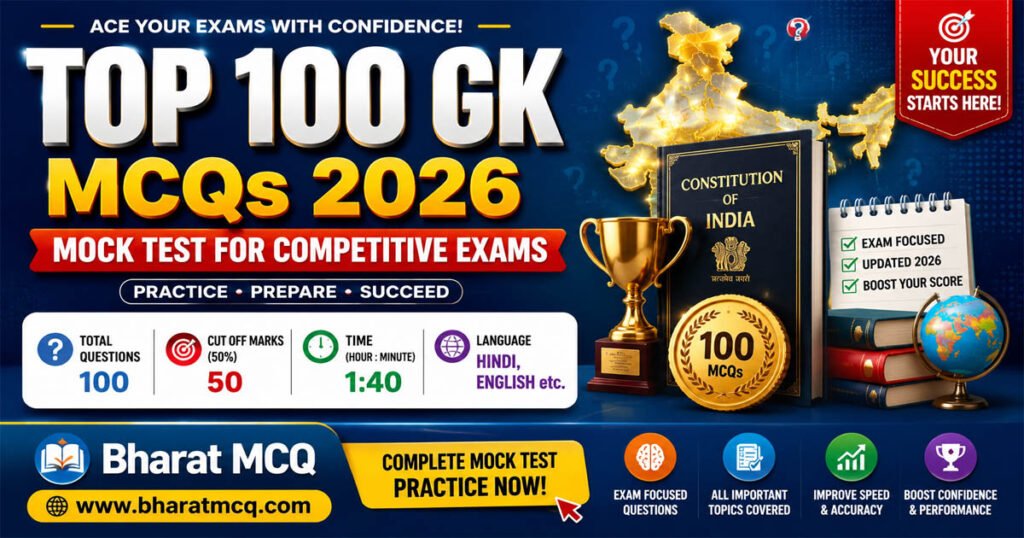
Practice Top 100 GK MCQs 2026 competitive exams with answers, detailed explanations, and exam-focused preparation tips for better scores.
Table of Contents
Top 100 GK MCQs 2026 Mock Test for Competitive Exams
Introduction
General Knowledge is a high-scoring but highly unpredictable section in Indian competitive examinations. Questions may come from current affairs, Indian polity, history, geography, economics, science, environment, international organisations, awards, sports or culture. A candidate who studies only monthly current-affairs notes may struggle with static concepts, while a candidate who studies only traditional GK books may miss recent appointments, awards and policy developments.
This Top 100 GK MCQs 2026 mock test has therefore been structured as a complete mixed-topic practice paper. It combines verified current developments with important static concepts regularly tested in examinations such as Talati, Police Bharti, PSI, Clerk, SSC, UPSC, state public service commissions and other government recruitment examinations.
The questions begin with direct factual recall and gradually progress towards constitutional provisions, economic concepts, environmental agreements and application-based science questions.
Importance of General Knowledge in Competitive Exams
GK questions usually require less calculation time than mathematics or reasoning questions. A well-prepared candidate can answer many of them within a few seconds. This makes General Knowledge an important section for improving the overall score and saving time for lengthy sections.
The subject is also useful beyond the written examination. Knowledge of government institutions, national developments, international organisations and major scientific programmes is frequently assessed during interviews, personality tests and document-verification discussions.
Preparation should not be restricted to memorising names and dates. Examiners increasingly test relationships between facts. For example, instead of asking only the meaning of the repo rate, an examination may ask who borrows at that rate or how a rate change affects liquidity. Similarly, constitutional questions may connect an Article with its institutional purpose.
Types of Questions Asked in Real Exams
Competitive examinations generally use four major types of GK questions.
The first type is direct factual recall, covering appointments, awards, headquarters, historical personalities and important dates. The second type tests associations, such as matching a constitutional amendment with its subject or an environmental convention with the substance it regulates.
The third type is conceptual. Questions on fiscal deficit, GDP deflator, inflation, CRR, gene editing and climate terminology require understanding rather than simple memorisation. The fourth type is elimination-based. In these questions, two options may appear similar, but only one completely satisfies the wording.
Current-affairs questions are often connected with static knowledge. A recent space mission may lead to questions about launch vehicles, orbital locations or electromagnetic radiation. A current monetary-policy announcement may be followed by questions on repo rate, inflation or the Monetary Policy Committee.
Practical Preparation Strategy
Begin by dividing General Knowledge into manageable areas: current affairs, polity, history, geography, economy, science, environment, sports, awards and international organisations. Maintain a separate revision sheet for each area.
For current affairs, record the event, the person or organisation involved, the date and one related static fact. For example, while noting an RBI policy decision, revise the meaning of repo rate, CRR, monetary policy and inflation. This method creates connections that are easier to remember.
Revise constitutional Articles and Schedules through comparison. Keep similar provisions together, such as Articles 123, 148, 280 and 324. Create tables for constitutional amendments, international headquarters, environmental conventions and classical dance forms.
Attempt mixed mock tests under a time limit. Do not immediately check the answer after each question. Complete the entire test first, mark doubtful questions and review them later. This produces a more realistic assessment of accuracy, speed and decision-making.
Maintain an error notebook with three categories: facts not studied, concepts misunderstood and questions lost through confusion. Revising this notebook is usually more valuable than repeatedly reading material already mastered.
Common Mistakes Students Make
One common mistake is depending on unverified social-media posts. Current appointments, award lists and policy rates can change, so they should be checked through reliable official sources.
Another mistake is learning isolated facts without context. Students may remember that Article 32 concerns constitutional remedies but forget that it empowers the Supreme Court to issue writs for enforcing Fundamental Rights.
Candidates also lose marks by ignoring qualifying words such as “only,” “primarily,” “entirely,” “first” and “as of July 2026.” These words can completely change the correct answer.
Excessive guessing is another problem. Where negative marking applies, candidates should attempt an uncertain question only after eliminating enough options to make the risk reasonable. Finally, many students complete mock tests but never analyse their mistakes. A test becomes useful only when wrong and doubtful responses are reviewed.
Benefits of Regular MCQ Practice
MCQ practice improves recall speed, option elimination and familiarity with examination language. It exposes candidates to closely related facts that are difficult to distinguish during the actual paper.
Regular practice also identifies weak areas. A candidate may believe that geography is well prepared but repeatedly make mistakes in climate, soils or river systems. Such patterns become visible only through systematic testing.
Timed mock tests improve concentration and help candidates decide when to answer, skip or revisit a question. Repeated exposure to carefully designed distractors also reduces the likelihood of falling for partially correct options.
20 Sample Questions with Detailed Explanations
1. As of July 2026, who is the President of India?
Correct Answer: Droupadi Murmu
Droupadi Murmu became the 15th President of India on 25 July 2022 and continues to hold the office as of July 2026. The President is the constitutional head of the Union and also serves as the Supreme Commander of the Indian Armed Forces.
2. As of July 2026, who is the Vice-President of India?
Correct Answer: C. P. Radhakrishnan
C. P. Radhakrishnan is serving as the 15th Vice-President of India. The Vice-President is also the ex officio Chairman of the Rajya Sabha and presides over its proceedings.
3. Who is the Chief Justice of India as of July 2026?
Correct Answer: Justice Surya Kant
Justice Surya Kant was sworn in as Chief Justice of India on 24 November 2025. The Chief Justice heads the Supreme Court and also acts as the Patron-in-Chief of the National Legal Services Authority.
4. Who is serving as the Chief Election Commissioner of India in 2026?
Correct Answer: Gyanesh Kumar
Gyanesh Kumar assumed office as the 26th Chief Election Commissioner on 19 February 2025. The Election Commission supervises elections to Parliament, state legislatures and the offices of the President and Vice-President.
5. Who is the Governor of the Reserve Bank of India as of July 2026?
Correct Answer: Sanjay Malhotra
Sanjay Malhotra is the RBI Governor in 2026. The Governor chairs important monetary-policy and central-board proceedings and represents India’s central bank in major domestic and international financial forums.
6. Who is the Chairman of ISRO as of July 2026?
Correct Answer: V. Narayanan
Dr. V. Narayanan assumed charge as Chairman of ISRO and Secretary of the Department of Space on 13 January 2025. He is a specialist in rocket and spacecraft propulsion systems.
7. What policy repo rate did the RBI retain in June 2026?
Correct Answer: 5.25%
The Monetary Policy Committee retained the policy repo rate at 5.25% in June 2026. The repo rate is the rate at which the RBI provides short-term liquidity to eligible banks against approved securities.
8. How many Padma Awards were approved for 2026?
Correct Answer: 131
The 2026 list contained 131 Padma Awards, including five Padma Vibhushan, thirteen Padma Bhushan and 113 Padma Shri awards. Duo cases were counted as one award each.
9. Which city is hosting the 2026 Commonwealth Games?
Correct Answer: Glasgow
Glasgow in Scotland is hosting the 23rd Commonwealth Games from 23 July to 2 August 2026. The city previously hosted the Games in 2014.
10. Mirabai Chanu won Commonwealth Games 2026 gold in which category?
Correct Answer: 48 kg
Mirabai Chanu won the women’s 48 kg weightlifting gold in Glasgow. She lifted a combined total of 190 kg and completed a hat-trick of Commonwealth Games titles.
11. Who received the Nobel Peace Prize for 2025?
Correct Answer: Maria Corina Machado
Maria Corina Machado received the prize for promoting democratic rights in Venezuela and supporting a peaceful transition to democratic government.
12. Who won the Nobel Prize in Literature for 2025?
Correct Answer: László Krasznahorkai
Hungarian author László Krasznahorkai received the award for a body of work recognised for its powerful and visionary literary character.
13. Which film won Best Picture at the 98th Academy Awards?
Correct Answer: One Battle after Another
The film won Best Picture at the ceremony held on 15 March 2026. Paul Thomas Anderson also won the directing award for the same film.
14. When was the Constitution of India adopted?
Correct Answer: 26 November 1949
The Constituent Assembly adopted, enacted and gave itself the Constitution on 26 November 1949. Most provisions came into force on 26 January 1950, which is observed as Republic Day.
15. Which Article was described as the Constitution’s “heart and soul”?
Correct Answer: Article 32
Article 32 guarantees the right to approach the Supreme Court for enforcement of Fundamental Rights. The Court may issue writs including habeas corpus, mandamus, prohibition, quo warranto and certiorari.
16. What does the Ramsar Convention conserve?
Correct Answer: Wetlands
The Ramsar Convention provides an international framework for the conservation and wise use of wetlands and their resources. It was adopted in Ramsar, Iran, in 1971.
17. Gaganyaan is India’s programme for what?
Correct Answer: Human spaceflight
Gaganyaan aims to demonstrate India’s indigenous capability to undertake human spaceflight to low Earth orbit. Its systems include a human-rated launch vehicle, crew module, service module and crew-escape system.
18. What did the 2025 Nobel Prize in Physics recognise?
Correct Answer: Macroscopic quantum tunnelling and energy quantisation in an electric circuit
John Clarke, Michel H. Devoret and John M. Martinis were honoured for experiments showing quantum effects in an electrical circuit large enough to be handled physically.
19. In which year was Garba inscribed on UNESCO’s Representative List?
Correct Answer: 2023
Garba of Gujarat was inscribed in 2023 during the eighteenth session of UNESCO’s Intergovernmental Committee. It is a devotional and community dance associated especially with Navaratri.
20. Which case propounded the Basic Structure doctrine?
Correct Answer: Kesavananda Bharati v. State of Kerala
The 1973 judgment established that Parliament may amend the Constitution but cannot destroy its basic structure. The doctrine protects foundational constitutional features from unlimited use of the amendment power.
Practice the Complete Mock Test
Attempt all 100 questions in one sitting before checking the answers. Use a fixed time limit and record the questions answered incorrectly, guessed correctly or left unanswered.
After completing the test, revise the related concept rather than memorising only the correct option. Reattempt the same mock test after several days and compare your accuracy, speed and number of doubtful responses. This process will show whether the information has moved from temporary recognition to reliable exam-ready recall.