
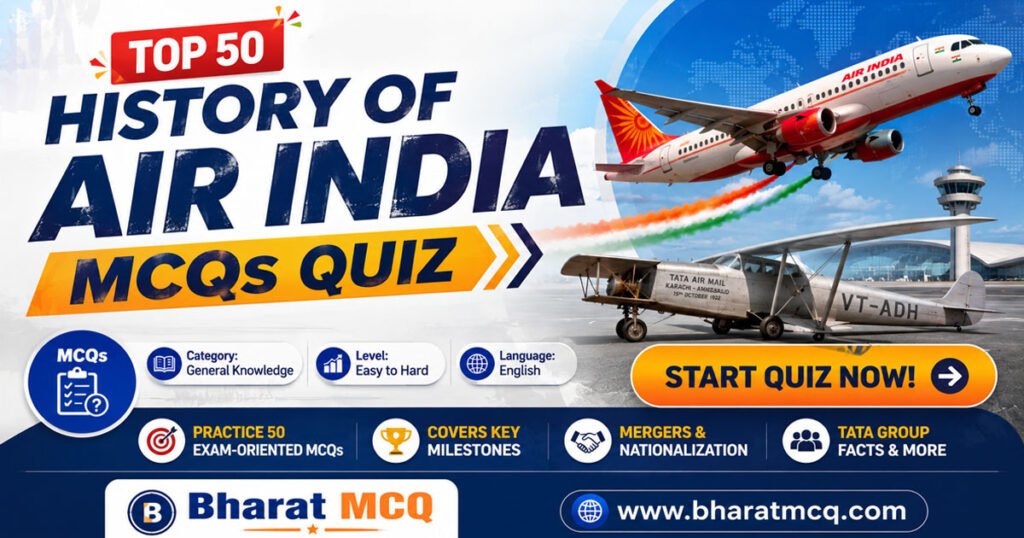
Practice 50 exam-oriented History of Air India MCQs with answers, key milestones, mergers, nationalization, and Tata Group facts for competitive exams.
History of Air India MCQs Quiz
Start QuizTable of Contents
History of Air India MCQ: Top 20 Questions with Answers
Introduction
The history of Air India is closely connected with the development of commercial aviation in India. The airline began with a pioneering airmail service in 1932, became Air-India in 1946, started intercontinental operations in 1948, was nationalized in 1953 and returned to the Tata Group in 2022. Its later history includes the merger with Indian Airlines, membership of Star Alliance, a new brand identity and the consolidation of Vistara and Air India Express operations.
Questions on these milestones may appear in SSC, UPSC, state public service commissions, police recruitment, clerk, railway, banking and other competitive examinations. The following material is based primarily on official records published by Air India, the Tata Group, the Press Information Bureau, India Code and the Ministry of Civil Aviation.
Importance of Air India History in Competitive Exams
Air India is relevant to questions on Indian business history, civil aviation, public-sector enterprises, disinvestment, important legislation and corporate mergers. Examiners may test direct dates, chronological order, founder-related facts, aircraft milestones, government policies or the relationship between Air India and other airlines.
A student should understand the complete sequence rather than memorising isolated facts:
Tata aviation service → Tata Airlines → Air-India → Air-India International → nationalisation → merger with Indian Airlines → strategic disinvestment → return to Tata Group → consolidation with Vistara.
Types of Questions Asked in Exams
Competitive examinations commonly ask about the founder of Air India, the 1932 inaugural flight, the first international service, the Air Corporations Act, the Maharajah mascot, the Air India–Indian Airlines merger, the Tata Group acquisition and recent airline consolidation.
Chronology and statement-based questions are especially important because several major developments occurred in 1932, 1946, 1948, 1953, 2007, 2014, 2022, 2023 and 2024.
Top 20 Important Practice Questions
Question 1: Who founded the aviation enterprise that later became Air India?
A. Jamsetji Tata
B. J. R. D. Tata
C. Dorabji Tata
D. Ratan Tata
Correct Answer: B. J. R. D. Tata
Explanation: J. R. D. Tata established the aviation operation that developed into Tata Airlines and eventually Air India. He was also India’s first commercial pilot licence-holder, making his role important in both corporate and aviation history.
Question 2: When did the first flight of the enterprise now known as Air India take place?
A. 15 October 1932
B. 8 June 1948
C. 1 August 1953
D. 27 January 2022
Correct Answer: A. 15 October 1932
Explanation: On 15 October 1932, J. R. D. Tata piloted the inaugural mail flight from Karachi towards Bombay. This date marks the operational beginning of the airline that later became Air India.
Question 3: Which aircraft was used by J. R. D. Tata for the inaugural mail flight?
A. Boeing 707
B. Douglas DC-3
C. De Havilland Puss Moth
D. Lockheed Constellation
Correct Answer: C. De Havilland Puss Moth
Explanation: J. R. D. Tata flew a De Havilland Puss Moth carrying mail from Karachi to Bombay. The small aircraft could carry a pilot, limited passengers or approximately 100 pounds of mail.
Question 4: What was the complete route of the original Tata airmail service?
A. Karachi-Bombay-Madras
B. Bombay-Delhi-Calcutta
C. Madras-Bombay-Karachi
D. Karachi-Delhi-Calcutta
Correct Answer: A. Karachi-Bombay-Madras
Explanation: The service connected Karachi, Bombay and Madras. Karachi was strategically selected because mail arriving from England through Imperial Airways terminated there and could then be carried onward across India.
Question 5: Where did J. R. D. Tata land after completing the Karachi-Bombay leg?
A. Safdarjung Airport
B. Juhu mudflats
C. Begumpet Airport
D. Dum Dum Airport
Correct Answer: B. Juhu mudflats
Explanation: Bombay did not have a modern operational airport for the service. Tata aircraft used the mudflats at Juhu, which were sometimes affected by monsoon tides and difficult flying conditions.
Question 6: In which year was the Tata aviation department renamed Tata Airlines?
A. 1932
B. 1937
C. 1938
D. 1946
Correct Answer: C. 1938
Explanation: The aviation operation initially functioned as a department of Tata Sons. It was enlarged and renamed Tata Airlines in 1938, before becoming Air India Limited in 1946.
Question 7: What major change occurred to Tata Airlines in 1946?
A. It was nationalised
B. It became a joint stock company named Air-India
C. It merged with Indian Airlines
D. It joined Star Alliance
Correct Answer: B. It became a joint stock company named Air-India
Explanation: Tata Airlines went public and became a joint stock company in 1946. The enterprise was renamed Air-India, marking its transition from a Tata departmental airline into a larger commercial company.
Question 8: When did Air India operate its first intercontinental flight?
A. 15 October 1932
B. 8 June 1948
C. 21 February 1960
D. 1 August 1953
Correct Answer: B. 8 June 1948
Explanation: Air-India International’s first intercontinental service departed Bombay for London on 8 June 1948. It stopped at Cairo and Geneva before reaching London, demonstrating independent India’s growing international aviation capability.
Question 9: Under the original Air-India International proposal, what initial share was allocated to the Government of India?
A. 25%
B. 49%
C. 51%
D. 74%
Correct Answer: B. 49%
Explanation: The joint-sector proposal allocated 49% to the Government of India, 25% to the Tatas and the remaining share to public investors. The government also had the right to acquire an additional 2%, which could raise its holding to 51%.
Question 10: Who was principally associated with creating the Maharajah mascot?
A. Nevill Vintcent
B. S. K. Kooka
C. J. C. K. Peterson
D. Campbell Wilson
Correct Answer: B. S. K. Kooka
Explanation: Sorab Kaikushroo “Bobby” Kooka led the team that conceived the Maharajah. The mascot gave Air India a distinctive human face and represented warmth, courtesy and Indian hospitality in its international advertising.
Question 11: In which year was Air India nationalised?
A. 1948
B. 1950
C. 1953
D. 1960
Correct Answer: C. 1953
Explanation: The Government of India nationalised the airline industry in 1953. J. R. D. Tata recommended maintaining separate organisations for international and domestic operations, and this approach was accepted.
Question 12: Which law provided the framework for airline nationalisation in 1953?
A. Aircraft Act, 1934
B. Air Corporations Act, 1953
C. Airports Authority Act, 1994
D. Companies Act, 1956
Correct Answer: B. Air Corporations Act, 1953
Explanation: The Air Corporations Act, 1953 established the statutory framework for creating government-controlled airline corporations. The international undertaking was assigned to Air-India International, while Indian Airlines handled the principal domestic network.
Question 13: What position did J. R. D. Tata retain after nationalisation?
A. Chairman of the international airline corporation
B. Union Civil Aviation Minister
C. Director General of Civil Aviation
D. Chairman of Airports Authority of India
Correct Answer: A. Chairman of the international airline corporation
Explanation: Despite opposing nationalisation, J. R. D. Tata accepted the chairmanship of the international airline. He also served as a director of Indian Airlines and remained closely associated with Air India until 1977.
Question 14: Which aircraft marked Air India’s entry into the jet age in 1960?
A. Boeing 707
B. Boeing 747
C. Airbus A310
D. Boeing 787
Correct Answer: A. Boeing 707
Explanation: Air India introduced the Boeing 707 in 1960, marking its transition into jet-powered international operations. The development represented a major technological step in the history of Indian civil aviation.
Question 15: What was the effect of the Air Corporations (Transfer of Undertakings and Repeal) Act, 1994?
A. It nationalised all private airlines
B. It transferred airline undertakings to companies and repealed the 1953 Act
C. It created Air India Express
D. It authorised the Vistara merger
Correct Answer: B. It transferred airline undertakings to companies and repealed the 1953 Act
Explanation: The 1994 legislation provided for transferring the undertakings of Air India and Indian Airlines to registered companies. It also repealed the Air Corporations Act, 1953, ending the earlier statutory-corporation structure.
Question 16: When was Air India Express launched?
A. 1994
B. 2001
C. 2005
D. 2014
Correct Answer: C. 2005
Explanation: Air India Express was launched in 2005 as India’s first international budget carrier. It was designed primarily to provide affordable short- and medium-haul connectivity, especially between Indian cities, the Gulf and Southeast Asia.
Question 17: Into which company were Air India and Indian Airlines amalgamated in 2007?
A. Air India Asset Holding Limited
B. National Aviation Company of India Limited
C. Talace Private Limited
D. Tata SIA Airlines Limited
Correct Answer: B. National Aviation Company of India Limited
Explanation: The legal merger of Air India and Indian Airlines was completed in 2007 through National Aviation Company of India Limited, commonly abbreviated as NACIL. The company had been incorporated on 30 March 2007.
Question 18: Which global airline alliance did Air India join in July 2014?
A. SkyTeam
B. oneworld
C. Star Alliance
D. Wings Alliance
Correct Answer: C. Star Alliance
Explanation: Air India became a member of Star Alliance in July 2014. Alliance membership allows airlines to coordinate connectivity, passenger benefits and international network access through partner carriers.
Question 19: Which company submitted the successful bid for Air India in 2021?
A. Tata SIA Airlines Limited
B. Air India Asset Holding Limited
C. Talace Private Limited
D. Singapore Airlines Limited
Correct Answer: C. Talace Private Limited
Explanation: Talace Private Limited, a wholly owned subsidiary of Tata Sons, submitted the successful enterprise-value bid of ₹18,000 crore. The transaction covered Air India, Air India Express and Air India’s 50% stake in AISATS.
Question 20: Which sequence correctly represents the Tata Group’s airline mergers completed in 2024?
A. Vistara merger first, followed by the AIX Connect merger
B. AIX Connect merged with Air India Express first, followed by Vistara’s merger with Air India
C. Both mergers occurred on the same date
D. Indian Airlines merged with Vistara before Air India Express
Correct Answer: B. AIX Connect merged with Air India Express first, followed by Vistara’s merger with Air India
Explanation: Air India Express completed its merger with AIX Connect on 1 October 2024. Air India then completed its merger with Vistara on 12 November 2024, resulting in a consolidated group centred on one full-service airline and one low-cost airline. Former Vistara-operated flights could be identified through four-digit Air India codes beginning with “2.”
Preparation Strategy
Prepare the topic by dividing the timeline into five phases: Tata origins, international expansion, nationalisation, restructuring and privatisation. Create a one-page chronology containing the most important dates:
- 1932: First Tata aviation service
- 1938: Tata Airlines name adopted
- 1946: Air-India formed
- 1948: First intercontinental service
- 1953: Nationalisation
- 2005: Air India Express launched
- 2007: Air India–Indian Airlines merger
- 2014: Star Alliance membership
- 2022: Return to Tata Group
- 2023: New brand identity
- 2024: Airline consolidation
Practise matching personalities, laws, companies and dates. Pay particular attention to distinctions such as the difference between the 2021 winning bid and the 2022 transfer of management.
Common Mistakes Students Make
A common mistake is treating 1932 as the year in which the name “Air India” was adopted. The airline began as a Tata aviation operation in 1932, while the Air-India name emerged in 1946.
Students also confuse the first domestic aviation service with the first intercontinental flight. The inaugural Tata mail flight occurred in 1932, whereas the Bombay-London international service began in 1948.
Another frequent error is assuming that Tata Group regained control immediately after winning the bid in October 2021. The strategic disinvestment transaction was formally completed on 27 January 2022.
Benefits of MCQ Practice
Regular MCQ practice improves chronological recall and helps students distinguish between closely related dates, organisations and legal developments. It also develops the ability to eliminate incorrect options by identifying anachronisms.
For example, Star Alliance cannot be connected with the 1953 nationalisation phase, and Vistara cannot be part of the 2007 merger. Understanding the sequence makes such options easier to reject.
Practice Quiz
Attempt the complete 50-question History of Air India MCQ quiz without checking the answer index. After completing it, review incorrect responses and revise the associated phase of the timeline rather than memorising only the correct option.