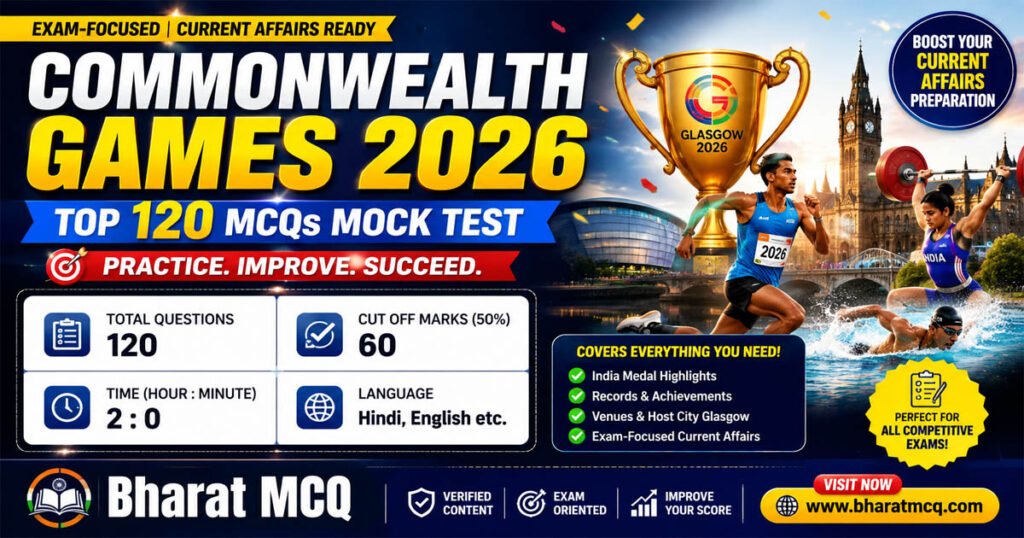
Practice 120 verified Commonwealth Games 2026 MCQs with answers, India medal highlights, records, venues and exam-focused current affairs preparation.
Table of Contents
Commonwealth Games 2026 Mock Test for Competitive Exams
The Commonwealth Games 2026 became an important current-affairs topic for UPSC, SSC, state PSC, police recruitment, clerk, Talati, banking and other government examinations. The 23rd Commonwealth Games were held in Glasgow, Scotland, from 23 July to 2 August 2026. The event brought together athletes from 74 nations and territories across a compact 10-sport programme that included six integrated Para sports. Glasgow used four principal venues, while 215 medal events were contested during the Games.
This mock test covers the facts most likely to be converted into objective questions: host city, dates, edition number, venues, sports programme, medal design, mascot, King’s Baton Relay, records, final medal table and India’s performance. The questions are arranged from direct factual recall to comparison, matching and analytical current-affairs patterns.
Importance of Commonwealth Games 2026 in Competitive Exams
Major multi-sport events are frequently tested because they combine geography, sports administration, international organisations, personalities, records and Indian achievements. A single event can produce questions on the host country, participating nations, opening and closing ceremonies, medal standings, individual champions and historical firsts.
Glasgow 2026 is particularly relevant because it followed the withdrawal of Victoria, Australia, and introduced a smaller, venue-efficient model. Around 3,000 athletes competed in 215 medal events across 10 sports, and the Games welcomed approximately 434,000 ticketed spectators. The next Commonwealth Games will be the Centenary Games in Amdavad, Gujarat, in 2030.
For Indian examinations, the performance of India deserves special attention. India finished fourth with 39 medals: 13 gold, 17 silver and nine bronze. Indian athletes won medals in Boxing, Athletics, Para Athletics, Judo, Weightlifting and Para Powerlifting. Boxing produced seven gold medals, while India also secured its first Commonwealth Judo gold medals.
Types of Questions Asked in Real Exams
Examiners generally use five patterns. The first is direct recall, such as the host city, dates or mascot. The second is venue-sport matching, for example identifying the venue used for Swimming, Netball or Athletics. The third is numerical information, including the number of participating nations, medal events or India’s final tally.
The fourth pattern tests records and firsts. Examples include the first Commonwealth medals with Braille and tactile elements, Chad le Clos becoming the most decorated Commonwealth Games athlete, and Tuvalu winning its first-ever Commonwealth Games medal. The fifth pattern uses statements or comparisons, such as why India ranked above Scotland despite both nations winning 13 golds and 39 total medals.
Practical Preparation Strategy
Start by dividing the topic into six revision blocks: overview, venues and sports, symbols and ceremonies, medal table, international records, and Indian performance. Do not try to memorise all information as one long list.
Create a one-page event profile containing the host, dates, edition, number of sports, number of Para sports, medal events, nations, athletes and next host. Then prepare a venue map: Scotstoun Stadium for Athletics and Para Athletics; Tollcross for Swimming and Para Swimming; The Hydro for Netball and the ceremonies; SEC spaces for Boxing, Judo, Basketball, Weightlifting and Para Powerlifting; and the Sir Chris Hoy Velodrome and Arena for Track Cycling and Artistic Gymnastics.
For the medal table, memorise the top five countries with gold and total medals. Australia led with 70 golds and 171 medals, followed by England and Canada. India and Scotland both collected 13 golds and 39 medals, but India ranked fourth because it won more silver medals.
Study Indian medals sport-wise rather than athlete-wise at first. Remember the distribution: Boxing 10 medals, Athletics 10, Para Athletics six, Weightlifting eight, Judo four and Para Powerlifting one. After learning this structure, attach major names such as Mirabai Chanu, Asmita Dey, Harsh Singh, Dilip Mahadu Gavit, Murali Sreeshankar and Tejaswin Shankar.
Finally, practise mixed MCQs without looking at notes. Mark every wrong answer under one of the six revision blocks. Revisit only the weak block, then retake the questions after a gap. This is more efficient than repeatedly reading the entire topic.
Common Mistakes Students Make
A common error is confusing Glasgow 2026 with Birmingham 2022 or Glasgow 2014. Keep the sequence clear: Birmingham hosted in 2022, Glasgow hosted in 2026, and Amdavad will host in 2030.
Students also mix up venue names within the Scottish Event Campus. The Hydro hosted Netball and ceremonies, the SEC Armadillo hosted Weightlifting and Para Powerlifting, and the SEC Centre hosted Boxing, Judo, Bowls and the two 3×3 Basketball disciplines. Another frequent mistake is assuming that every sport from Birmingham 2022 continued in Glasgow. Hockey, Badminton, Table Tennis, Wrestling and Shooting were among the omitted sports.
In medal-table questions, rank is determined first by gold medals, then silver and bronze. Therefore, total medals alone do not determine position. Students should also distinguish between an athlete’s medal at Glasgow 2026 and an all-time Commonwealth Games record.
Benefits of MCQ Practice
MCQ practice improves factual retrieval, option elimination and speed. Well-designed distractors expose common confusions, such as Scotland versus Glasgow, The Hydro versus SEC Armadillo, and total medals versus gold medals.
Timed practice also trains candidates to identify keywords such as “first,” “final,” “all-time,” “Para,” and “overall.” These words often decide the correct answer. Repeated testing helps convert isolated news facts into structured memory, which is essential when a competitive exam combines current affairs with sports history and Indian achievements.
20 Sample Questions with Detailed Explanations
1. Which city hosted the 2026 Commonwealth Games?
A. Glasgow
B. Birmingham
C. Cardiff
D. Edinburgh
Correct Answer: A. Glasgow
Explanation: Glasgow in Scotland hosted the 23rd Commonwealth Games. The city had previously hosted the event in 2014, making Glasgow 2026 its second Commonwealth Games and Scotland’s fourth hosting of the event overall.
2. What were the official dates of the Glasgow 2026 Commonwealth Games?
A. 17–28 July 2026
B. 1–11 August 2026
C. 25 July–5 August 2026
D. 23 July–2 August 2026
Correct Answer: D. 23 July–2 August 2026
Explanation: The opening ceremony took place on 23 July 2026, and the Games concluded with the closing ceremony on 2 August 2026. The complete event therefore covered 11 calendar days.
3. Glasgow 2026 was which edition of the Commonwealth Games?
A. 21st
B. 22nd
C. 24th
D. 23rd
Correct Answer: D. 23rd
Explanation: Glasgow 2026 was officially designated as the 23rd Commonwealth Games. The first edition of the competition was held in 1930, while the 2030 edition in Amdavad will mark the centenary of the Games.
4. Which proposed host withdrew from staging the 2026 Commonwealth Games before Glasgow stepped in?
A. Auckland
B. Cape Town
C. Victoria
D. Kuala Lumpur
Correct Answer: C. Victoria
Explanation: The Australian state of Victoria was originally selected to organise a regional, multi-hub edition of the 2026 Games. The Victorian Government withdrew in July 2023, after which Glasgow was selected to deliver a more compact edition.
5. How many medal events were contested at Glasgow 2026?
A. 180
B. 200
C. 215
D. 240
Correct Answer: C. 215
Explanation: Glasgow 2026 featured 215 medal events across 10 sports. Of these, 47 were Para sport gold-medal events, making the programme particularly significant for integrated Para competition.
6. Which venue hosted both the opening and closing ceremonies?
A. The Hydro
B. Scotstoun Stadium
C. SEC Armadillo
D. Tollcross International Swimming Centre
Correct Answer: A. The Hydro
Explanation: The Hydro, part of the Scottish Event Campus, hosted the opening and closing ceremonies. It was also the competition venue for Netball, while the SEC Armadillo and SEC Centre hosted other sports.
7. The Commonwealth Mile returned in 2026 for the first time since which year?
A. 1966
B. 1958
C. 1962
D. 1970
Correct Answer: A. 1966
Explanation: The one-mile race returned to the Commonwealth Games athletics programme after an absence of 60 years. It had last appeared in 1966, before metric distances became standard in major international competitions.
8. The opening gold medal at Glasgow 2026 was awarded in which category?
A. Men’s Artistic Gymnastics
B. Women’s Swimming
C. A Para sport event
D. Men’s Boxing
Correct Answer: C. A Para sport event
Explanation: Para Powerlifting produced the first gold medal of Glasgow 2026. This was the first time in Commonwealth Games history that the opening gold medal was awarded to a Para athlete.
9. What was the name of the official Glasgow 2026 mascot?
A. Finnie
B. Clyde
C. Thistle
D. Kelvin
Correct Answer: A. Finnie
Explanation: Finnie was a Glaswegian unicorn named after the Finnieston Crane. A unicorn was selected because it is Scotland’s national animal. The mascot was developed with help from 76 children and young people representing 24 Glasgow schools.
10. Who designed the Glasgow 2026 prize medals?
A. Siobhan Mackenzie
B. Agnes Jones
C. Libby McArthur
D. Militsa Milenkova
Correct Answer: D. Militsa Milenkova
Explanation: Artist, designer and Glasgow School of Art Artist in Residence Militsa “Milly” Milenkova designed the medals. Their Reuleaux-triangle form drew inspiration from Glasgow’s coat of arms, industrial heritage, Finnieston Crane and cultural identity.
11. Which accessibility feature appeared on Commonwealth Games medals for the first time in 2026?
A. Braille and tactile elements
B. Audio chips
C. Digital QR displays
D. Magnetic lettering
Correct Answer: A. Braille and tactile elements
Explanation: Glasgow 2026 introduced Braille and tactile detailing on the medals. It was the first time these inclusive features had been physically incorporated into Commonwealth Games prize medals.
12. When was the Glasgow 2026 King’s Baton Relay launched at Buckingham Palace?
A. 11 March 2025
B. 10 March 2025
C. 23 July 2025
D. 2 July 2026
Correct Answer: B. 10 March 2025
Explanation: The relay began at Buckingham Palace on Commonwealth Day, 10 March 2025. It travelled for 479 days before beginning its final Scottish leg in July 2026.
13. Which nation finished first in the final Glasgow 2026 medal table?
A. England
B. Canada
C. Australia
D. India
Correct Answer: C. Australia
Explanation: Australia dominated the final standings with 70 gold, 45 silver and 56 bronze medals, giving it 171 medals overall. England finished second, while Canada took third place.
14. Which option gives India’s correct final medal tally?
A. 13 gold, 9 silver, 17 bronze
B. 13 gold, 17 silver, 9 bronze
C. 17 gold, 13 silver, 9 bronze
D. 10 gold, 17 silver, 12 bronze
Correct Answer: B. 13 gold, 17 silver, 9 bronze
Explanation: India won 39 medals in total, consisting of 13 gold, 17 silver and nine bronze. The contingent finished fourth in the official medal standings.
15. Why was India ranked above Scotland despite both winning 13 golds and 39 medals?
A. India had more bronze medals
B. India had more silver medals
C. India won the final event
D. India entered more athletes
Correct Answer: B. India had more silver medals
Explanation: Medal tables are ranked by gold medals first. When two nations have the same number of golds, silver medals become the tiebreaker. India won 17 silvers compared with Scotland’s nine, so India ranked fourth and Scotland fifth.
16. Which athlete won six gold medals, the highest individual gold haul at Glasgow 2026?
A. Emma Finucane
B. Felix Dolci
C. Meg Harris
D. Josh Kerr
Correct Answer: C. Meg Harris
Explanation: Australian swimmer Meg Harris won six gold medals at Tollcross International Swimming Centre. Her achievement represented the largest individual gold-medal haul of the Glasgow Games.
17. Chad le Clos became the most decorated Commonwealth Games athlete with how many medals?
A. 19
B. 20
C. 21
D. 22
Correct Answer: C. 21
Explanation: South African swimmer Chad le Clos collected his 21st Commonwealth Games medal after helping his country win bronze in the men’s 4x100m medley relay. The result moved him past Australian swimmer Emma McKeon on the all-time list.
18. How many gold medals did Welsh cyclist Emma Finucane win at Glasgow 2026?
A. Two
B. Three
C. Four
D. Five
Correct Answer: C. Four
Explanation: Emma Finucane won the Team Sprint, individual Sprint, 1000m Time Trial and Keirin. Her four-title campaign made her the most successful Welsh woman in Commonwealth Games history.
19. Asmita Dey made Indian history by winning Commonwealth Judo gold in which category?
A. Women’s 52kg
B. Women’s 48kg
C. Women’s 57kg
D. Women’s 63kg
Correct Answer: B. Women’s 48kg
Explanation: Asmita Dey defeated Canada’s Heidi Quach in the women’s 48kg final. She became India’s first female Commonwealth Judo champion, while Harsh Singh added another Indian gold in the men’s 60kg category.
20. Mirabai Chanu won her third consecutive Commonwealth Games gold in which event?
A. Women’s 45kg Weightlifting
B. Women’s 53kg Weightlifting
C. Women’s 58kg Weightlifting
D. Women’s 48kg Weightlifting
Correct Answer: D. Women’s 48kg Weightlifting
Explanation: Mirabai Chanu won the women’s 48kg Weightlifting title at Glasgow 2026. The victory gave her a third consecutive Commonwealth Games gold medal and contributed to India’s eight-medal Weightlifting campaign.
Practice the Full Test
Attempt all 120 questions without checking the answer indexes. Record your score, review incorrect responses and repeat the test after two or three days. Use the explained questions above to understand the concepts behind important facts instead of memorising isolated answers.