
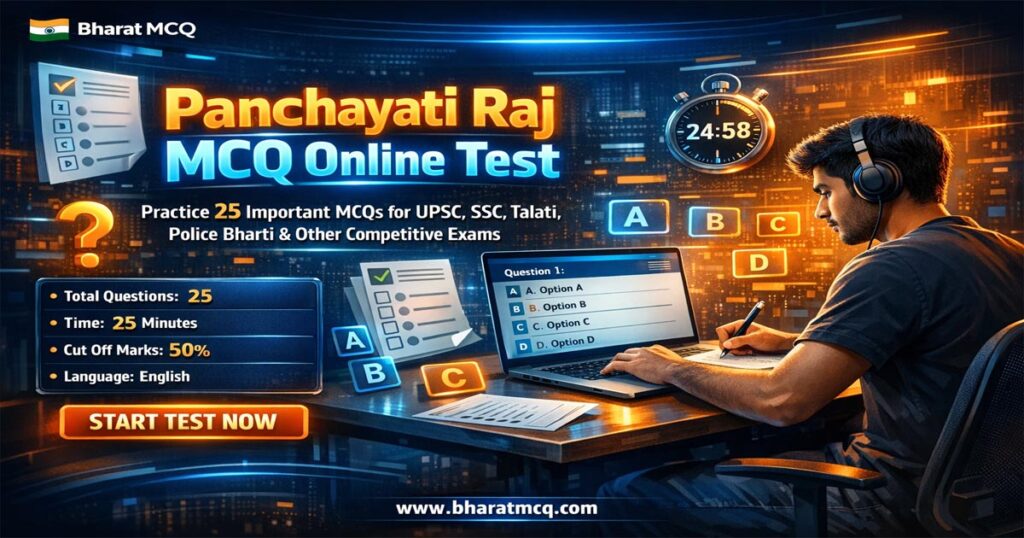
Practice 25 important Panchayati Raj MCQs for UPSC, SSC, Talati, Police Bharti and other competitive exams. Improve accuracy with this exam-level Online Test.
Table of Contents
Panchayati Raj MCQ Online Test – 25 MCQs for Competitive Exams
Panchayati Raj and local self-government form an important part of Indian Polity in most competitive examinations in India. Exams such as UPSC, SSC, Talati, Police Bharti, PSI, and various state-level recruitment tests regularly include questions related to Panchayati Raj institutions, constitutional provisions, and important committees.
For aspirants preparing for these examinations, understanding the structure, powers, and constitutional framework of Panchayati Raj is essential. This Online test containing 25 exam-level MCQs is designed to help candidates evaluate their conceptual clarity and improve their performance in real competitive exams.
Importance of Panchayati Raj in Competitive Exams
Panchayati Raj represents decentralized governance in rural India. It plays a significant role in strengthening grassroots democracy and local development. Because of its constitutional importance and administrative relevance, this topic frequently appears in competitive exams.
Several aspects of Panchayati Raj are commonly tested:
- Constitutional provisions related to local self-government
- The 73rd Constitutional Amendment Act
- Structure of the three-tier Panchayati Raj system
- Functions of Gram Sabha and Gram Panchayat
- Reservation provisions for women and SC/ST
- Panchayati Raj committees and their recommendations
- Financial and electoral mechanisms of Panchayats
In exams like UPSC and SSC, questions may also focus on analytical understanding rather than simple factual recall. Therefore, aspirants must develop a deeper conceptual understanding of the subject.
Types of Questions Asked in Real Exams
Competitive exams usually ask Panchayati Raj questions in multiple formats. Understanding these patterns helps candidates prepare more effectively.
1. Constitutional Provision-Based Questions
Many questions focus on articles of the Constitution related to Panchayats. For example, candidates may be asked about:
- Article related to Gram Sabha
- Provisions of State Election Commission
- Duration of Panchayats
- Articles dealing with powers of Panchayats
Such questions require clarity about constitutional articles and schedules.
2. Committee Recommendation Questions
Several committees played a major role in shaping the Panchayati Raj system in India. Competitive exams often ask questions about:
- Balwant Rai Mehta Committee
- Ashok Mehta Committee
- L.M. Singhvi Committee
- G.V.K. Rao Committee
Aspirants should understand the key recommendations of these committees rather than memorizing isolated facts.
3. Institutional Structure Questions
Questions frequently test knowledge about the three-tier structure:
- Gram Panchayat (village level)
- Panchayat Samiti (block level)
- Zila Parishad (district level)
Understanding the functions and responsibilities of each level is important for answering application-based questions.
4. Governance and Administrative Questions
Some exams include scenario-based questions regarding planning, financial allocation, and administrative responsibilities of Panchayati Raj institutions.
These questions assess how well a candidate understands the functioning of decentralized governance.
Preparation Strategy for Panchayati Raj
Preparing this topic effectively requires a structured approach. The following strategy can help aspirants improve both accuracy and conceptual understanding.
Study the Constitutional Framework
Start with the constitutional provisions related to Panchayati Raj, especially the 73rd Constitutional Amendment Act. Focus on:
- Articles from 243 to 243O
- Eleventh Schedule subjects
- Structure and election process of Panchayats
Understanding these provisions provides the foundation for answering most questions.
Focus on Important Committees
Candidates should study the major committees that influenced Panchayati Raj reforms. Instead of memorizing details randomly, focus on:
- Key recommendations
- Structural changes suggested
- Differences between committee proposals
This approach makes it easier to answer conceptual MCQs.
Use MCQ Practice for Revision
Practicing MCQs regularly helps candidates identify weak areas and improve exam readiness. Mock tests simulate the exam environment and train candidates to think quickly and accurately.
Regular practice also helps in recognizing common question patterns.
Common Mistakes Students Make
Many aspirants lose marks in Panchayati Raj questions due to avoidable mistakes. Some of the most common errors include:
Memorizing Without Understanding
Students often try to memorize committee names and constitutional articles without understanding their relevance. This leads to confusion in application-based questions.
Ignoring Local Governance Topics
Some aspirants focus heavily on central government topics while ignoring local governance. However, Panchayati Raj remains an important scoring area in many exams.
Lack of MCQ Practice
Even if the theoretical concepts are clear, lack of MCQ practice can result in mistakes during the exam. Timed practice is essential for improving speed and accuracy.
Benefits of Practicing MCQ Tests
Practicing structured mock tests offers several advantages for competitive exam preparation.
First, it helps in improving conceptual clarity. When candidates attempt different types of questions, they understand how concepts are applied in exams.
Second, MCQ practice improves time management. Competitive exams have strict time limits, and mock tests train aspirants to answer quickly.
Third, mock tests help identify weak areas. By reviewing incorrect answers, candidates can revise topics that require more attention.
Finally, regular practice builds confidence. Candidates become familiar with exam patterns and feel more prepared for the actual test.
Panchayati Raj Mock Test: Important Questions with Detailed Explanations
(1) Question: Which constitutional amendment act gave constitutional status to the Panchayati Raj institutions in India?
Answer: 73rd Constitutional Amendment Act, 1992
Explanation: The 73rd Constitutional Amendment Act of 1992 added a new Part IX to the Constitution of India and gave constitutional sanctity to rural local self-governing bodies. It came into effect on April 24, 1993.
(2) Question: Which committee first recommended the establishment of a three-tier Panchayati Raj system in India?
Answer: Balwant Rai Mehta Committee
Explanation: Appointed in 1957, the Balwant Rai Mehta Committee recommended a three-tier Panchayati Raj system: Gram Panchayat at the village level, Panchayat Samiti at the block level, and Zilla Parishad at the district level.
(3) Question: National Panchayati Raj Day is celebrated every year in India on which date?
Answer: April 24
Explanation: India celebrates National Panchayati Raj Day on April 24 every year to commemorate the historic day when the 73rd Constitutional Amendment Act, 1992 came into official enforcement in 1993.
(4) Question: Which part of the Indian Constitution specifically contains provisions related to the Panchayats?
Answer: Part IX
Explanation: Part IX of the Constitution, titled ‘The Panchayats’, contains Articles 243 to 243-O covering definitions, constitution, composition, powers, authority, and responsibilities of Panchayats.
(5) Question: Which schedule was added to the Constitution of India by the 73rd Amendment Act?
Answer: 11th Schedule
Explanation: The 73rd Amendment added the Eleventh Schedule to the Indian Constitution. This schedule explicitly contains the functional items over which the Panchayats are allocated administrative and developmental control.
(6) Question: How many functional items are listed in the 11th Schedule of the Indian Constitution for Panchayats to handle?
Answer: 29 functional items
Explanation: The 11th Schedule contains 29 subjects or functional items, including agriculture, land improvement, minor irrigation, animal husbandry, fisheries, social forestry, and small-scale industries.
(7) Question: What is the minimum age required to contest elections for any tier of a Panchayati Raj institution?
Answer: 21 years
Explanation: While the minimum age to vote is 18 years, a person must have attained the age of 21 years to be qualified to contest an election to a membership or official position in a Panchayat.
(8) Question: Which Article under the Directive Principles of State Policy (DPSP) directs the state to organize village panchayats?
Answer: Article 40
Explanation: Article 40 of the Indian Constitution states that the State shall take steps to organize village panchayats and endow them with such powers and authority as may be necessary to enable them to function as units of self-government.
(9) Question: Who is historically considered the “Father of Local Self-Government” in India during the British colonial period?
Answer: Lord Ripon
Explanation: Viceroy Lord Ripon is known as the Father of Local Self-Government in India due to his historic resolution of 1882, which laid the foundational framework for democratic local institutions in the country.
(10) Question: Which state was the very first to formally inaugurate the Panchayati Raj system in independent India?
Answer: Rajasthan
Explanation: The Panchayati Raj system was first inaugurated by Prime Minister Jawaharlal Nehru on October 2, 1959, in the Nagaur district of Rajasthan. Andhra Pradesh followed shortly after as the second state.
(11) Question: What is the mandatory minimum reservation percentage for women in Panchayati Raj institutions as per the 73rd Amendment?
Answer: One-third (or 33%) of the total seats
Explanation: Article 243-D mandates that not less than one-third of the total number of seats to be filled by direct election in every Panchayat must be reserved for women. Several states have voluntarily increased this to 50%.
(12) Question: Who holds the constitutional responsibility to conduct regular elections for the Panchayati Raj institutions within a state?
Answer: State Election Commission
Explanation: The superintendence, direction, and control of the preparation of electoral rolls and the conduct of all elections to the Panchayats are vested in the State Election Commission under Article 243-K.
(13) Question: Which body is constituted by the Governor under Article 243-I to review the financial position of the Panchayats?
Answer: State Finance Commission
Explanation: The Governor of a state constitutes a State Finance Commission every five years to review the financial position of the Panchayats and make recommendations regarding the distribution of taxes between the state and local bodies.
(14) Question: At which administrative tier of the structure is the ‘Panchayat Samiti’ constituted?
Answer: Intermediate or Block Level
Explanation: In the standard three-tier structural setup, the Gram Panchayat operates at the village level, the Panchayat Samiti functions at the intermediate (block/taluka) level, and the Zilla Parishad manages the district level.
(15) Question: What is the normal tenure or term of office prescribed for a Panchayat at any level?
Answer: 5 years
Explanation: Every Panchayat operates for a normal duration of five years from the date of its first meeting, unless it is dissolved earlier under state law provisions.
(16) Question: Which committee explicitly recommended that Panchayati Raj institutions should be constitutionally recognized and protected?
Answer: L.M. Singhvi Committee
Explanation: Appointed in 1986 by the Rajiv Gandhi government, the L.M. Singhvi Committee strongly recommended giving constitutional status to local bodies to preserve their identity and ensure regular, fair elections.
(17) Question: In case of the premature dissolution of a Panchayat, within what maximum period must fresh elections be conducted?
Answer: 6 months
Explanation: If a Panchayat is dissolved before its full term expires, the mandatory fresh elections to reconstitute it must be completed within a maximum period of six months from the date of dissolution.
(18) Question: What exactly comprises the constitution of a ‘Gram Sabha’ according to the provisions?
Answer: All persons registered in the electoral rolls of the village
Explanation: The Gram Sabha is the foundation of the Panchayati Raj system. It is a statutory body consisting of all individuals whose names are included in the electoral rolls for the village area covered by the Panchayat.
(19) Question: Which Indian state became the first to implement a new Panchayati Raj Act after the 73rd Constitutional Amendment Act was passed?
Answer: Madhya Pradesh
Explanation: Following the ratification of the 73rd Amendment, Madhya Pradesh was the first state in India to pass and implement its corresponding state Panchayati Raj Act to hold elections under the new constitutional system.
(20) Question: The mandatory provisions of the 73rd Constitutional Amendment Act do not automatically apply to which northeastern states of India?
Answer: Nagaland, Meghalaya, and Mizoram
Explanation: Article 243-M exempts the states of Nagaland, Meghalaya, and Mizoram, alongside specific scheduled and tribal areas, from the regular application of Part IX to respect their traditional tribal councils and local administrative customs.
Practice Panchayati Raj Online Test
To strengthen your preparation, attempt the 25-question Panchayati Raj Online Test provided above. The questions are designed according to real competitive exam standards and cover constitutional provisions, committees, and institutional structure.
After completing the test, review your answers and analyze areas where improvement is needed. Consistent practice with such tests can significantly improve performance in exams like UPSC, SSC, Talati, Police Bharti, and PSI.
Regular revision combined with MCQ practice is the most effective way to master topics like Panchayati Raj in competitive exam preparation.