
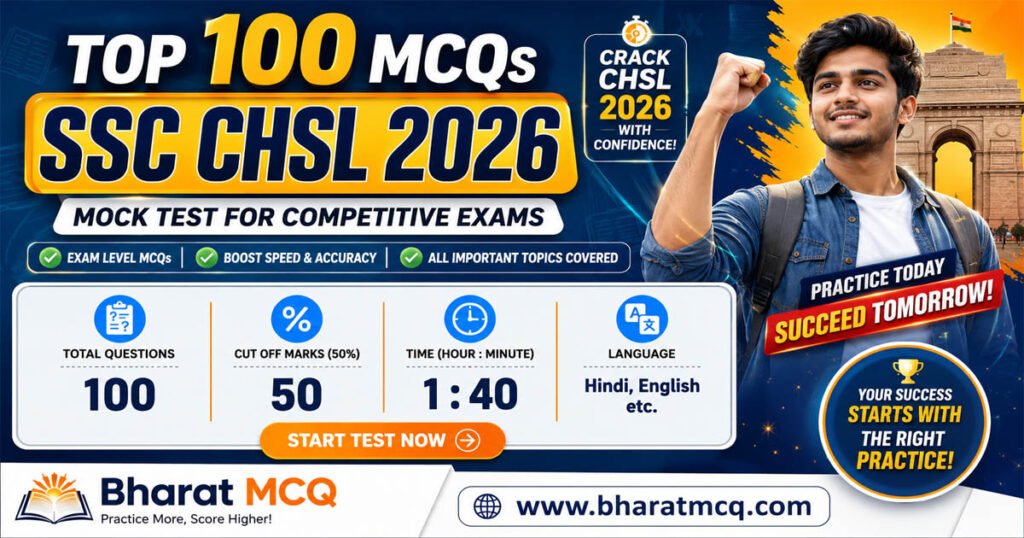
Practice SSC CHSL mock test with 100 exam-level MCQs covering reasoning, GK, maths and English for better speed and accuracy.
Table of Contents
SSC CHSL Mock Test: Complete Practice for Tier-I Preparation
SSC CHSL is one of the most important competitive exams for candidates who want central government clerical and data entry posts after the 10+2 level. The exam demands more than basic knowledge. It checks speed, accuracy, concept clarity and decision-making under time pressure. A full-length mock test helps students understand the real level of competition and prepares them for the computer-based exam environment.
The official SSC platform provides exam-related notices, syllabus information, previous year paper resources and scheme details for candidates preparing for SSC examinations. Candidates should use such official resources along with regular mock practice to stay aligned with the exam format.
Importance of Subjects in SSC CHSL
SSC CHSL Tier-I preparation mainly revolves around four major areas: General Intelligence and Reasoning, General Awareness, Quantitative Aptitude and English Language. Each subject plays a different role in the final score.
Reasoning tests logical thinking. Questions from series, analogy, coding-decoding, direction sense, ranking, syllogism and non-verbal reasoning are designed to check how quickly a candidate can identify patterns. This section is scoring when concepts are clear and practice is regular.
General Awareness is important because it saves time in the exam. A factual question can be answered in a few seconds if the candidate has revised polity, history, geography, science, economy and culture properly. Static GK should be prepared with standard notes, while official exam updates should be checked from SSC sources.
Quantitative Aptitude measures numerical ability. Topics such as percentage, ratio, average, profit and loss, simple interest, compound interest, time and work, speed, algebra and mensuration are frequently useful. This section requires formula knowledge as well as calculation speed.
English Language tests grammar, vocabulary and comprehension. Common areas include synonyms, antonyms, idioms, error spotting, sentence improvement, active-passive voice, narration and fill in the blanks. A candidate with strong grammar rules and regular reading practice can score well in this section.
Types of Questions Asked in Real Exams
SSC CHSL questions are usually objective and time-bound. The difficulty level is not extremely high, but the challenge lies in solving 100 questions with accuracy. Reasoning questions often use patterns, hidden relationships and logical conclusions. Quantitative questions are based on direct application of formulas, but some require smart simplification.
General Awareness questions may come from the Constitution, important amendments, national parks, rivers, freedom movement, science, classical dances, economics and basic computer awareness. English questions generally test practical language usage rather than literary theory.
A good mock test should not feel like a random set of questions. It should include easy, moderate and slightly difficult questions in a balanced order. This helps the candidate develop exam temperament and avoid panic when a tricky question appears.
Practical Preparation Strategy
Start with the syllabus and divide preparation into daily slots. Do not study one subject for many days and ignore the others. SSC CHSL requires balanced preparation, so all four sections should be revised regularly.
For Reasoning, solve topic-wise sets first. Once basic patterns become familiar, move to mixed practice. This is important because the real exam does not announce the topic before each question. Practice series, analogy, coding-decoding, syllogism and direction questions under a timer.
For Quantitative Aptitude, maintain a formula notebook. Write formulas for percentage, profit and loss, time and work, speed, interest, mensuration and algebra. Revise this notebook daily. After learning a formula, solve at least 20 questions from that topic to understand different applications.
For General Awareness, avoid random reading. Prepare short notes on polity, geography, history, science, economics and culture. Revise repeatedly. Facts are forgotten quickly if they are not revised. Use previous year papers to identify high-frequency topics.
For English, focus on grammar rules and vocabulary usage. Learn words with example sentences instead of memorising isolated meanings. Error spotting and sentence improvement become easier when the candidate understands subject-verb agreement, tense, articles, prepositions and modifiers.
Common Mistakes Students Make
Many students attempt mock tests without analysis. This is a major mistake. The real benefit of a mock test comes after the test, when the candidate checks wrong answers, identifies weak topics and improves strategy.
Another common mistake is spending too much time on one question. In SSC CHSL, time management is as important as knowledge. If a question is lengthy or confusing, mark it for review and move ahead.
Some candidates over-focus on current affairs and ignore static GK. For CHSL, static general awareness is very important. Polity articles, constitutional bodies, national parks, rivers, historical events and science basics should not be neglected.
In Quantitative Aptitude, students often remember formulas but make calculation errors. Regular simplification practice is necessary. In English, many candidates guess answers without knowing grammar rules. Guesswork may reduce accuracy, especially where negative marking is applicable in SSC examinations. Official SSC examination resources mention objective-type questions and marking-related instructions in exam notices and scheme documents.
Benefits of MCQ Practice
MCQ practice improves both speed and accuracy. It trains the mind to eliminate wrong options and select the best answer quickly. Regular practice also builds familiarity with exam language. Many candidates know the concept but fail because they are not used to the way questions are framed.
Full-length practice helps students build stamina. Solving 20 questions is different from solving 100 questions in one sitting. A complete mock test teaches time division, pressure handling and section-wise strategy.
MCQs also help in revision. A single question can revise a formula, a grammar rule or a GK fact. When students maintain an error notebook from mock tests, they create a personalised revision tool. This is much more useful than reading the same notes again and again without testing.
Internal CTA: Practice Test
Use the SSC CHSL mock test above as a serious exam practice set. Attempt all 100 questions in one sitting, follow a fixed time limit and avoid checking answers during the test. After completion, calculate your score and divide your mistakes into four categories: concept error, calculation error, memory gap and time-pressure mistake.
Repeat this process with more practice sets. The aim is not only to increase marks but also to understand why marks are lost. A candidate who analyses every mock test properly can improve accuracy, reduce negative attempts and build confidence for the actual SSC CHSL examination.