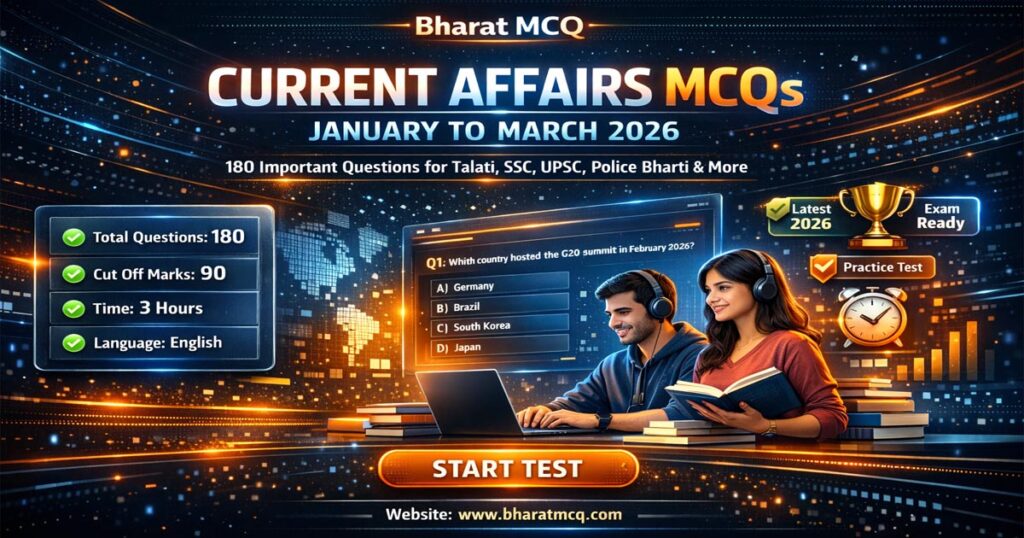
Practice 180 verified Current Affairs MCQs January to March 2026 for Talati, Police Bharti, SSC, UPSC, Clerk, PSI and other competitive exams. Includes national news, Budget 2026-27, schemes, appointments, awards, sports, science, economy, and important day themes.
Table of Contents
Current Affairs MCQs January to March 2026: Smart Practice for Competitive Exams
Preparing current affairs from a fixed date range is one of the most effective ways to improve exam performance. For aspirants of Talati, Police Bharti, SSC, UPSC, Clerk, PSI, and similar competitive exams, the period from 01/01/2026 to 31/03/2026 is especially important because it includes major national developments, Budget announcements, key appointments, sports results, awards, and science updates. This is the kind of content that frequently appears in one-mark objective questions.
That is why a well-structured set of MCQs matters so much. Instead of reading random headlines, aspirants can revise the most important events in an exam-friendly format. When questions are prepared carefully and based on verified facts, they help students understand patterns, remember details faster, and avoid confusion during the exam.
Why January to March 2026 Current Affairs Matter for Exams
The first three months of 2026 were packed with high-value events from an exam point of view. This period included the Union Budget 2026-27, the Economic Survey 2025-26, major government announcements, Republic Day highlights, new appointments in diplomacy and public sector leadership, national reports released by NITI Aayog, and important international and sports events.
Competitive exams often ask factual questions from exactly these kinds of developments. A question may be asked about the amount announced in a budget measure, the city from which a scheme instalment was released, the theme of an international day, the winner of a tournament, or the person appointed to a new post. Students who revise these events through MCQs usually perform better because they become familiar with names, dates, institutions, and numbers together.
Exam Relevance Across Different Recruitment Tests
Talati, Clerk and Police Bharti Exams
In state-level recruitment exams, current affairs questions are usually direct and fact-based. Questions often focus on government schemes, awards, days and themes, sports winners, and important appointments. A student who regularly practises multiple-choice questions can answer such items quickly without wasting time.
SSC, Banking and Central Recruitment Exams
SSC and other central-level exams frequently ask about Budget highlights, official reports, national missions, international observances, and recent appointments. These exams also include current affairs from economy, science, and sports. Practising a mixed set of MCQs helps aspirants cover all categories together.
UPSC and Higher-Level Competitive Exams
For UPSC and similar exams, current affairs preparation must be accurate and broad-based. Even when the preliminary questions are objective, they test careful reading. A question may look simple, but one wrong number, date, or institution can change the answer. That is why fact-based MCQ practice from a defined date range is extremely useful.
Key Current Affairs Highlights from 01/01/2026 to 31/03/2026
The January to March 2026 period offered a rich variety of topics for exam preparation.
Budget, Economy and Policy
The Union Budget 2026-27 remained one of the most important developments of the quarter. Budget-related MCQs are always relevant because they include exact figures, new funds, sectoral support, and policy changes. Along with this, the Economic Survey 2025-26 provided useful statistics on telecom reach, 5G expansion, tap water coverage, and the broader economic direction of the country.
NITI Aayog also released significant reports during this period. These included the Fiscal Health Index 2026, a roadmap for the technology services sector, and reports connected with education, skilling, and sports equipment exports. Such reports are valuable because exam setters often frame questions around their titles, release dates, institutions, and targets.
Government Schemes and National Events
The release of the 22nd instalment of PM-KISAN became an important current affairs topic because it involved official beneficiary numbers and transfer amounts. Similarly, National Voters’ Day 2026 is important for exams because themes and taglines from such observances are frequently asked.
This period also featured the India-AI Impact Summit 2026, which carried significance because of its international profile and policy relevance. The inauguration of Noida International Airport Phase I was another major national development with strong exam potential, especially for questions related to location, capacity, and investment.
Republic Day, Awards and Honours
Republic Day 2026 generated several possible MCQ topics, including chief guests, tableaux participation, parade results, and popular choice awards. These are ideal for competitive exams because they are factual, easy to frame, and easy to revise when presented properly.
The Padma Awards 2026 also formed a major section of current affairs preparation. Questions can be asked on the number of awards, award categories, notable recipients, women awardees, posthumous awards, and foreign-origin recipients. In addition, the Jnanpith Award announcement added literary importance to the quarter.
Sports and International Recognition
Sports remained a very strong current affairs segment in early 2026. The ICC Men’s T20 World Cup 2026, Women’s Premier League 2026, India Open 2026, Australian Open 2026, and the start of IPL 2026 all provided exam-worthy questions. Sports questions are often direct and scoring, especially when based on winners, runners-up, venues, player awards, and dates.
The quarter also included major international honours such as the 98th Academy Awards, which can appear in general awareness sections, especially in broad-based competitive exams.
Science, Technology and Important Days
Science and technology updates from this period were also useful. ISRO-related developments like START 2026, the YUVIKA 2026 registration timeline, the ISRO-AIIMS framework on space medicine, and the ESA-ISRO agreement are all strong MCQ topics. National Science Day and other observances added another layer of important factual content.
Themes of days such as World Wildlife Day, International Women’s Day, World Consumer Rights Day, International Day of Forests, World Water Day, and World TB Day are exactly the type of questions that appear regularly in competitive examinations.
Why Practising MCQs Improves Current Affairs Preparation
Reading current affairs alone is not enough. Real improvement happens when students test themselves repeatedly. MCQs help aspirants in five practical ways:
1. Better Retention
When you answer questions, you remember facts more strongly than by passive reading.
2. Faster Revision
A single MCQ set can revise dozens of topics in a short time.
3. Stronger Accuracy
Objective practice reduces confusion between similar names, dates, and figures.
4. Exam Pattern Familiarity
Most competitive exams ask current affairs in objective form. MCQ practice matches the real test style.
5. Self-Assessment
Students quickly understand which areas are strong and which need one more revision round.
Chalo, image_25fca3.jpg na topic (Current Affairs MCQs January to March 2026) pramane 20 important ane high-yield questions ready chhe.
Aama પણ badha j Question tags ne bold kari didha chhe ane vachche --- dividers sathe double line spacing raakhi chhe, jethi WordPress block editor ma direct copy-paste karti vakhte automatic alag blocks bani jay ane tame aasaani thi publish kari sako.
Current Affairs (January to March 2026) Mock Test: Important Questions with Detailed Explanations
(1) Question: On which date was the Union Budget 2026-27 formally presented in the Parliament by the Union Finance Minister?
Answer: February 1, 2026
Explanation: In accordance with the institutionalized calendar practice introduced in 2017, the Union Budget for the fiscal year 2026-27 was presented on the first day of February to ensure structural implementation of budgetary allocations before the start of the new financial year on April 1.
(2) Question: The prestigious Padma Awards 2026, announced on the eve of the 77th Republic Day, are conferred by which authority of the Government of India?
Answer: The President of India
Explanation: The Padma Awards (Padma Vibhushan, Padma Bhushan, and Padma Shri)—which recognize exceptional and distinguished service across various disciplines—are officially announced on January 25 every year and formally conferred by the President of India at a civil investiture ceremony.
(3) Question: The Annual Meeting of the World Economic Forum (WEF) held in January 2026, which gathers global political and business leaders to discuss international macroeconomic challenges, traditionally takes place in which city?
Answer: Davos, Switzerland
Explanation: The World Economic Forum hosts its high-profile annual winter meeting at the alpine resort town of Davos, Switzerland. The summit serves as a premier international platform to formulate collaborative frameworks for global economic, security, and environmental policies.
(4) Question: The recommendations of the 16th Finance Commission of India, which actively finalized its stakeholder consultations in early 2026, will cover a structural award period of how many years starting from April 1, 2026?
Answer: 5 years
Explanation: Constituted under Article 280 of the Constitution and chaired by Dr. Arvind Panagariya, the 16th Finance Commission’s structural recommendations regarding the devolution of tax revenues between the Union and the States apply to a five-year fiscal period spanning from 2026-27 to 2030-31.
(5) Question: India’s flagship global geo-political and geo-economic conference, the ‘Raisina Dialogue’, which held its annual edition in New Delhi in February 2026, is jointly organized by the Ministry of External Affairs and which independent think tank?
Answer: Observer Research Foundation (ORF)
Explanation: The Raisina Dialogue is structured as India’s premier conference on geopolitics and geoeconomics. Hosted annually in New Delhi since 2016, it is engineered as a multi-stakeholder cross-sectoral discussion co-produced by the Ministry of External Affairs and the Observer Research Foundation.
(6) Question: The ‘Corruption Perceptions Index’ (CPI) report released in early 2026, which ranks 180 countries and territories by their perceived levels of public sector corruption, is published by which international civil society organization?
Answer: Transparency International
Explanation: Transparency International, an independent global non-governmental organization based in Berlin, Germany, scores and publishes the Corruption Perceptions Index annually using data compilation from various independent expert institutional assessments.
(7) Question: Which two African nations co-hosted the ICC Under-19 Men’s Cricket World Cup tournament in January and February 2026?
Answer: Zimbabwe and Namibia
Explanation: The 16th edition of the ICC Under-19 Men’s Cricket World Cup was jointly hosted by Zimbabwe and Namibia under the tournament allocation framework organized by the International Cricket Council (ICC).
(8) Question: National Science Day is celebrated across India every year on February 28 to commemorate which historic scientific milestone?
Answer: The discovery of the ‘Raman Effect’ by Sir C.V. Raman.
Explanation: India observes National Science Day on February 28 to honor the landmark day in 1928 when physicist Sir Chandrasekhara Venkata Raman discovered the inelastic scattering of photons, known as the Raman Effect. This breakthrough earned him the Nobel Prize in Physics in 1930.
(9) Question: The International Intellectual Property (IP) Index, which evaluates the IP ecosystems of major global economies and was published in early 2026, is compiled by which organization?
Answer: US Chamber of Commerce (Global Innovation Policy Center)
Explanation: The International IP Index is an analytical benchmarking report released annually by the Global Innovation Policy Center (GIPC) of the US Chamber of Commerce. It maps the intellectual property framework, patent enforcement mechanisms, and copyright protections across global markets.
(10) Question: The flagship clean-energy rooftop solar program, ‘PM-Surya Ghar: Muft Bijli Yojana’, which achieved significant deployment milestones in the first quarter of 2026, provides up to how many units of free electricity per month to participating households?
Answer: 300 units
Explanation: Launched by the Government of India, the PM-Surya Ghar: Muft Bijli Yojana aims to provide up to 300 units of free electricity every month to one crore households across the country by subsidizing the installation of residential rooftop solar systems.
(11) Question: Which nation officially assumed the rotating Chairmanship of the BRICS bloc for the entire 2026 calendar year, overseeing strategic policy integrations?
Answer: Brazil
Explanation: The leadership chair of the expanded BRICS intergovernmental organization rotates annually among its member countries. Following Russia’s chairmanship in 2024 and South Africa’s term in 2025, Brazil assumed the operational chair for 2026.
(12) Question: The Henley Passport Index for the first quarter (Q1) of 2026, which ranks the world’s passports according to the number of destinations their holders can access visa-free, bases its exclusive data on which international entity?
Answer: International Air Transport Association (IATA)
Explanation: The Henley Passport Index is a global authority on passport power rankings. It updates its data quarterly using exclusive, comprehensive travel information maintained by the International Air Transport Association (IATA).
(13) Question: India celebrated its 77th Republic Day on January 26, 2026. In which year did the Constitution of India officially come into force, marking the birth of the Republic?
Answer: 1950
Explanation: While the Constituent Assembly formally adopted the Constitution on November 26, 1949, it came into full legal enforcement on January 26, 1950. This specific date was selected to honor the 1930 declaration of Purna Swaraj (Complete Independence) by the Indian National Congress.
(14) Question: The specialized UN agency known as the World Meteorological Organization (WMO), which issued critical global climate warnings in early 2026 regarding rising sea surface temperatures, is headquartered in which city?
Answer: Geneva, Switzerland
Explanation: The World Meteorological Organization (WMO) is the United Nations system’s authoritative voice on the state and behavior of the Earth’s atmosphere, its interaction with the land and oceans, and the resulting climate distribution. It is headquartered in Geneva, Switzerland.
(15) Question: The world-renowned 98th Academy Awards (Oscars), which celebrated outstanding cinematic achievements in a grand ceremony in March 2026, are presented annually by which organization?
Answer: Academy of Motion Picture Arts and Sciences (AMPAS)
Explanation: The Oscars are prestigious international film awards presented annually by the Academy of Motion Picture Arts and Sciences, a professional honorary organization based in Beverly Hills, California, USA.
(16) Question: What is the primary focus of the ‘Sipri Arms Transfers’ report published in March 2026, which tracks global defense acquisition trends?
Answer: Monitoring the international transfer of major conventional weapons and military equipment.
Explanation: The Stockholm International Peace Research Institute (SIPRI) releases an annual authoritative assessment detailing global trends in arms imports, exports, and military expenditures, identifying the world’s largest weapon-supplying and weapon-purchasing nations.
(17) Question: World Wildlife Day is celebrated globally every year on March 3 to commemorate the signing of which landmark international conservation convention?
Answer: CITES (Convention on International Trade in Endangered Species of Wild Fauna and Flora)
Explanation: On December 20, 1913, the United Nations General Assembly proclaimed March 3 as World Wildlife Day to celebrate and raise awareness of the world’s wild fauna and flora. This date marks the day CITES was adopted in 1973.
(18) Question: The ‘World Happiness Report’ published in March 2026, which utilizes global survey data to rank nations based on average life evaluations, is released by which UN-backed body?
Answer: United Nations Sustainable Development Solutions Network (SDSN)
Explanation: The World Happiness Report is an annual publication of the UN Sustainable Development Solutions Network. It analyzes Gallup World Poll data based on six key variables: GDP per capita, social support, healthy life expectancy, freedom, generosity, and absence of corruption.
(19) Question: In March 2026, the central banks of multiple nations continued scaling up testing for their respective Central Bank Digital Currencies (CBDCs). What is the official name given to India’s institutionalized digital rupee?
Answer: e₹ (Digital Rupee)
Explanation: The Digital Rupee (e₹) is a sovereign currency issued by the Reserve Bank of India (RBI) in a digital form. It is structured as a legal tender utilizing blockchain-backed distributed ledger technology, operating in both retail (e₹-R) and wholesale (e₹-W) segments.
(20) Question: World Water Day is celebrated globally on March 22 every year. Which international summit first formally recommended the creation of an official world day for water resources?
Answer: United Nations Conference on Environment and Development (UNCED) / 1992 Rio Earth Summit
Explanation: The formal proposal for World Water Day was initiated as an agenda item under Chapter 18 of Agenda 21 at the 1992 United Nations Conference on Environment and Development in Rio de Janeiro, Brazil. The UN General Assembly responded by designating March 22 as the annual observance day starting in 1993.
Final Words
If you are preparing for Talati, Police Bharti, SSC, UPSC, Clerk, PSI, or any other competitive exam, the current affairs from 01/01/2026 to 31/03/2026 deserve focused revision. This date range includes many high-probability topics from economy, government policy, appointments, awards, sports, science, and important days.
A carefully prepared MCQ set does more than test memory. It builds confidence, improves speed, and makes revision practical. Study these questions more than once, note down the tricky facts, and revise the themes, dates, institutions, and winners regularly. Consistent practice is what turns current affairs into marks.
Keep preparing with discipline, revise smartly, and treat every MCQ as one step closer to your selection.