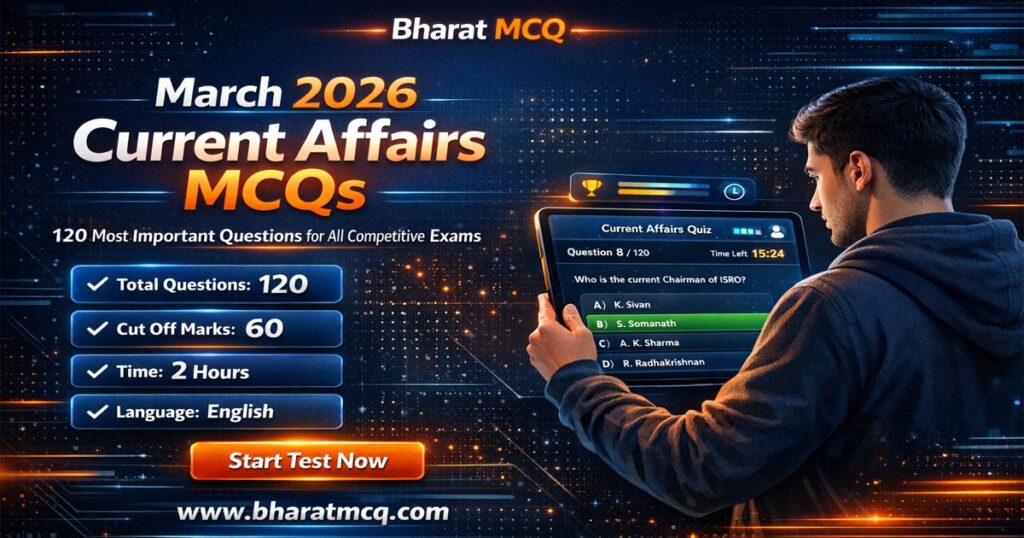
Practice 120 verified March 2026 current affairs MCQs in English for Talati, Police Bharti, SSC, UPSC, Clerk, PSI and other competitive exams. Covers national affairs, government schemes, appointments, awards, sports, economy, science, technology and important days from 01/03/2026 to 31/03/2026.
March 2026 Current Affairs MCQs in English (01/03/2026 to 31/03/2026)
For every serious competitive exam aspirant, monthly current affairs practice is not optional anymore. Whether you are preparing for Talati, Police Bharti, SSC, UPSC, Clerk, PSI or any other government exam, one month of well-prepared current affairs can make a visible difference in your score. This set of March 2026 Current Affairs MCQs in English has been prepared with a clear exam focus so that students can revise important developments from 01/03/2026 to 31/03/2026 in an objective format.
The biggest challenge in current affairs preparation is not reading the news. The real challenge is selecting the right news, remembering the important facts, and practicing them in the style asked in exams. That is why MCQ-based revision works so well. It turns news into question-answer memory points and helps you identify what examiners are most likely to ask.
Why March 2026 Current Affairs Matter for Competitive Exams
March 2026 was packed with important developments across national affairs, government decisions, financial inclusion, renewable energy, sports, diplomacy, important days and policy updates. Many of these topics are exactly the type of fact-based questions seen in one-liner current affairs sections of state-level and national-level exams.
This month included major Cabinet approvals such as the extension of Jal Jeevan Mission, the approval of India’s updated Nationally Determined Contribution for 2031–2035, the Modified UDAN Scheme, the Small Hydro Power Development Scheme, and the BHAVYA industrial parks initiative. These are highly relevant because exam papers often ask about the latest schemes, ministry-linked initiatives, approved outlays and full forms.
March 2026 also brought important updates from the Reserve Bank of India, including Payments Vision 2028 and fresh balance of payments data. For aspirants, economy questions may look difficult at first, but they become manageable when revised through MCQs. When you repeatedly practice figures such as current account deficit, services receipts, remittances or scheme coverage, they become easy scoring points.
Key Highlights Covered in These MCQs
Government Schemes and Cabinet Decisions
Aspirants will find multiple questions from major government decisions announced in March 2026. These include Jal Jeevan Mission 2.0, the Cabinet approval of Madurai Airport as an international airport, changes in investment guidelines for countries sharing land borders with India, continuation of the IVFRT scheme, and expansion of renewable-energy related policy measures.
Questions on PM-KISAN, PMJDY, PMJJBY, PM Surya Ghar Yojana and PM-KUSUM are especially useful for exam preparation because such schemes are repeatedly asked in Talati, Clerk, Police Bharti and SSC-level papers. Facts like beneficiary count, deposits, outlay, launch location and target group are often framed into direct MCQs.
Economy, Banking and Financial Inclusion
March 2026 current affairs also included strong exam-oriented material from RBI and the Ministry of Finance. Payments Vision 2028, Digital Payments Awareness Week, PMJDY account figures, PMJJBY claim settlement ratio and PM-KISAN installment details are all practical topics for quick revision.
For many students, current affairs from the economy section feel too technical. The best way to study them is through short MCQs that test a single fact at a time. Instead of memorising long paragraphs, students can remember one statistic, one date, one organisation, and one purpose.
Science, Technology and Energy
Science and technology questions in competitive exams are usually asked from recent developments rather than theory. That is why START-2026, space awareness programmes, Bharat Electricity Summit 2026, Prakriti 2026, the Indian Carbon Market Portal, Green Hydrogen capacity, and standards for Green Ammonia and Green Methanol become important.
These topics are useful not only for UPSC-style preparation but also for state exams where modern technology and government-led innovation are now asked more frequently than before.
Appointments, Diplomacy and National Events
March 2026 also saw notable diplomatic and administrative updates. Questions based on Vikram K. Doraiswami’s appointment as Ambassador to China, Naba Kumar Pal’s appointment to Chad, and President Droupadi Murmu’s official engagements fit well into exam current affairs sections.
Such items are easy to score when revised properly because they are usually direct fact questions based on names, posts, countries or venues.
Sports and Awards
Sports current affairs remain one of the most scoring sections in exam papers. This month’s highlights include the All England Open 2026, the WPL 2026 title, the ICC Men’s Under-19 Cricket World Cup 2026, and honours announced at the BCCI Naman Awards 2026. We have also included questions related to Sheetal Devi’s recognition at the Times of India Sports Awards.
These are the kinds of sports questions that appear in railway exams, police recruitment exams, clerical exams and general competitive tests because they are recent, factual and easy to verify.
Why Practicing MCQs Is Better Than Only Reading Notes
Improves Recall Speed
When you solve MCQs regularly, your brain starts storing current affairs in a question-answer format. This makes recall faster in the exam hall. Instead of trying to remember a full article, you remember the correct option.
Identifies Weak Areas Quickly
If you are repeatedly getting questions wrong from economy or sports, you immediately know where to focus. MCQ practice gives direction to your revision.
Builds Exam Temperament
Competitive exams are not just about knowledge. They are also about speed, concentration and accuracy. Practicing monthly current affairs in MCQ form creates a real exam-like habit and improves confidence.
Helps in Layered Revision
Aspirants often read newspapers, YouTube summaries, PDFs and handwritten notes, but still forget facts after a few days. MCQs solve this problem. They create a second revision layer. First you read, then you test yourself. This method is much more effective.
Best Way to Use These March 2026 Current Affairs MCQs
Start by attempting all 120 questions honestly without looking at the answers. After that, mark the questions you found difficult. In the second round, revise only the weak areas such as schemes, appointments, sports or economy. In the third round, take a timed self-test to improve speed.
Students preparing for multiple exams should especially maintain monthly revision discipline. One smart approach is to revise the full month once, then solve MCQs twice before moving to the next month. This keeps current affairs fresh and exam-ready.
Conclusion
Current affairs preparation becomes easy when it is selective, factual and practice-based. These March 2026 Current Affairs MCQs in English from 01/03/2026 to 31/03/2026 are designed to help aspirants revise real exam-relevant topics in a compact and effective way. From government schemes and Cabinet approvals to sports, awards, RBI updates, science, diplomacy and important days, this set covers the key areas that matter most for competitive exams.
If you want to improve your current affairs score, do not just read the news. Practice it. Revise it. Reattempt it. Consistent MCQ practice every month can turn current affairs from a weak subject into one of your strongest scoring sections.