
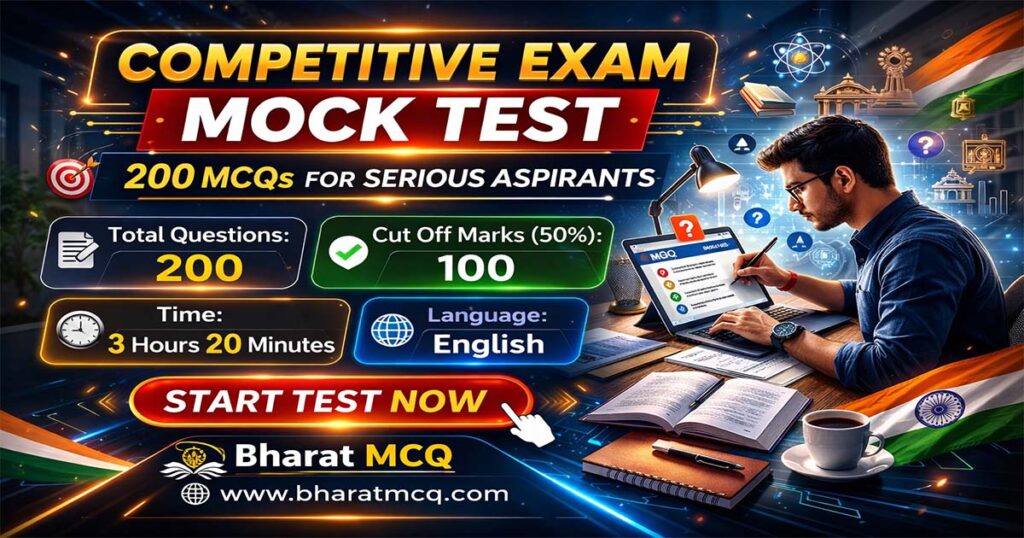
Practice a full-length competitive exam mock test with 200 MCQs covering GK, Polity, History, Geography, Science and Economy for SSC, GPSC, UPSC, Talati and Police exams.
Free Competitive Exam Mock Test – 200 MCQs Practice
Preparing for competitive exams in India requires a structured study approach and regular practice with exam-level questions. Aspirants preparing for exams such as Talati, Police Bharti, SSC, GPSC, UPSC, Clerk, and other state-level recruitment tests must consistently evaluate their preparation through mock tests.
A full-length mock test helps students simulate the real examination environment. It improves time management, strengthens conceptual clarity, and highlights weak areas that require additional focus.
This 200-question mock test has been designed based on the pattern commonly seen in major Indian competitive exams. The questions cover key subjects such as Indian Polity, History, Geography, General Science, and Economy, which form the core of most government exam syllabi.
Importance of These Subjects in Competitive Exams
Competitive exams typically assess a candidate’s awareness of the country, its governance system, and fundamental scientific knowledge.
Indian Polity
Indian Polity is one of the most important sections in almost every government exam. Questions often come from the Constitution, fundamental rights, directive principles, constitutional bodies, and governance structure. Understanding the Constitution helps aspirants answer conceptual and factual questions with confidence.
History
Indian History questions focus mainly on ancient civilizations, the medieval period, and the modern freedom struggle. The freedom movement, social reform movements, and major historical personalities frequently appear in competitive exams.
Geography
Geography questions test knowledge about physical features, rivers, climate, natural resources, and economic geography of India. Candidates should be familiar with major rivers, mountain ranges, plateaus, and climatic zones.
General Science
Basic concepts from Physics, Chemistry, and Biology are commonly asked. Instead of deep theoretical knowledge, competitive exams emphasize conceptual clarity and real-world application of scientific principles.
Indian Economy
Economic awareness is increasingly important in competitive exams. Topics such as GDP, banking institutions, taxation systems, and government economic policies are frequently tested.
Types of Questions Asked in Real Exams
Competitive exams generally include a mix of conceptual, factual, and analytical questions.
Conceptual Questions
These questions test understanding of fundamental concepts. For example, a question on the relationship between voltage, current, and resistance checks whether the candidate understands Ohm’s Law.
Factual Questions
Factual questions require knowledge of historical events, constitutional provisions, and geographical facts. Examples include identifying the year of a historical event or the article of the Constitution related to a specific provision.
Application-Based Questions
These questions assess how well a candidate can apply knowledge in practical scenarios. For instance, interpreting economic indicators or understanding the implications of a policy decision.
Mixed GK Questions
Many exams combine questions from multiple disciplines in a single section. This ensures that candidates have a well-rounded understanding of general knowledge.
Preparation Strategy for Competitive Exams
A smart preparation strategy can significantly improve performance in competitive exams.
Understand the Exam Pattern
Before starting preparation, candidates should carefully analyze the exam pattern and syllabus. Understanding the weightage of different subjects helps prioritize study topics effectively.
Focus on Concept Clarity
Rather than memorizing facts blindly, aspirants should focus on understanding concepts. This approach helps solve both direct and application-based questions.
Regular Mock Test Practice
Mock tests are one of the most effective tools for exam preparation. They help candidates become familiar with the question pattern and improve their speed and accuracy.
Revise Frequently
Revision is essential to retain information for a longer period. Regular revision ensures that important facts and concepts remain fresh in memory.
Analyze Mistakes
After completing a mock test, students should carefully analyze their mistakes. Identifying weak areas helps improve performance in future tests.
Common Mistakes Students Make
Many aspirants fail to achieve their desired results due to avoidable mistakes.
Ignoring Basic Concepts
Some students focus only on memorizing facts without understanding the underlying concepts. This leads to difficulty in solving analytical questions.
Lack of Practice
Competitive exams require speed and accuracy. Without sufficient practice, candidates struggle to complete the exam within the time limit.
Poor Time Management
Spending too much time on difficult questions can reduce the chances of attempting easier ones. Time management is crucial for maximizing the number of correct answers.
Not Reviewing Mock Tests
Taking mock tests without analyzing mistakes limits improvement. Reviewing incorrect answers is essential for identifying knowledge gaps.
Benefits of MCQ Practice
MCQ practice provides several advantages for competitive exam aspirants.
First, it improves recall ability and strengthens conceptual understanding. When candidates repeatedly solve questions from different topics, they become more comfortable with the exam format.
Second, MCQ practice helps identify weak areas. Students can focus on subjects where their accuracy is lower.
Third, it enhances speed and confidence. Regular practice allows candidates to answer questions quickly and accurately during the actual exam.
Finally, MCQ practice helps simulate real exam conditions. Practicing full-length mock tests builds the mental stamina required for long examination sessions.
Practice This Full Mock Test
If you are preparing for government recruitment exams such as SSC, GPSC, Talati, Police Bharti, or Clerk exams, solving high-quality MCQ mock tests is essential.
The above 200-question competitive exam mock test has been carefully designed to reflect the level and structure of real examinations. Attempt the full test seriously, evaluate your performance, and identify areas where further improvement is needed.
Consistent practice with exam-level questions is one of the most reliable ways to improve accuracy, increase confidence, and perform better in competitive exams.