
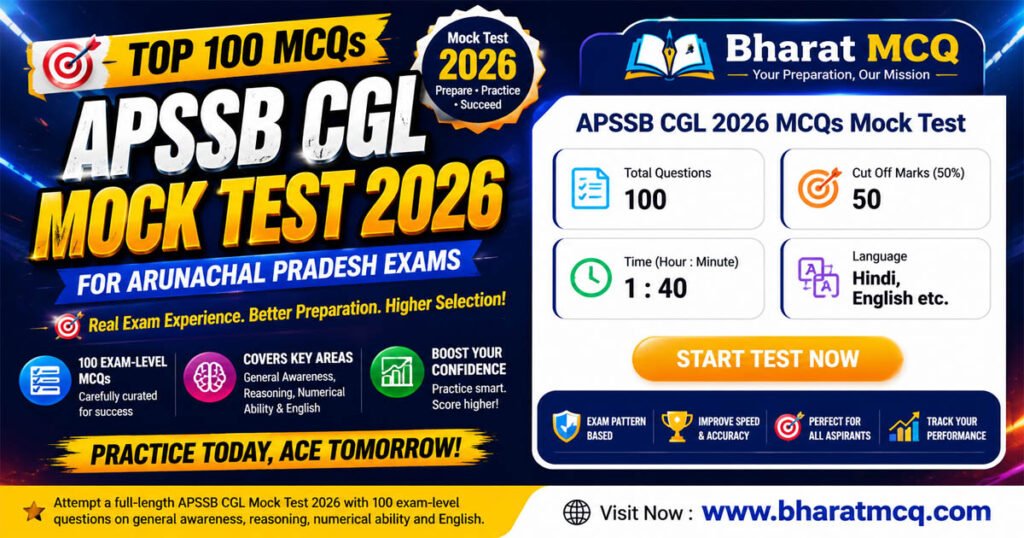
Attempt a full-length APSSB CGL Mock Test 2026 with 100 exam-level questions on general awareness, reasoning, numerical ability and English.
Table of Contents
APSSB CGL Mock Test 2026: Exam-Relevant Practice
The Arunachal Pradesh Staff Selection Board Combined Graduate Level Examination tests whether a graduate-level candidate can apply knowledge accurately under time pressure. The official 2026 written examination scheme contains four equally weighted components: General Awareness, General Intelligence and Reasoning Ability, Arithmetical and Numerical Ability, and English Language and Comprehension. Each component carries 50 marks, giving a total of 200 marks for the two-hour objective paper. The notified syllabus assigns 25 questions to each component, requires at least 33% aggregate marks, provides no sectional cut-off, and has no negative marking.
This full-length APSSB CGL mock test follows that four-section structure. Its 100 questions are arranged to move from direct knowledge and standard applications toward multi-step reasoning, calculation and language analysis. The paper is useful for candidates targeting posts covered through the graduate-level recruitment process and needing a realistic test rather than isolated topic-wise exercises.
Importance of the Four Subjects
General Awareness
General Awareness is broader than memorising current affairs. The APSSB syllabus includes current events, history, polity, the Constitution, geography, economics, science, sports, culture, institutions and state-specific knowledge. Arunachal Pradesh topics deserve systematic preparation because they can distinguish candidates who have studied only national-level material.
Festivals, rivers, protected areas, constitutional provisions and state symbols should be revised together with national developments. Candidates should also connect facts with concepts. For example, learning that the Finance Commission is created under Article 280 is more useful when its constitutional function is understood.
General Intelligence and Reasoning Ability
Reasoning measures how accurately a candidate recognises relationships, evaluates conclusions and handles structured information. Questions may involve analogy, series, coding, syllogism, direction, ranking, blood relations, arrangements, data sufficiency and cause-effect reasoning.
This section rewards a clear method. Guessing from verbal appearance often produces errors, especially in syllogism and statement-based questions. Candidates should represent information through symbols, diagrams, short tables or directional sketches whenever appropriate.
Arithmetical and Numerical Ability
The numerical section tests operational accuracy and selection of the correct method. The syllabus covers number systems, simplification, fractions, decimals, HCF, LCM, ratio, percentage, average, profit and loss, discount, interest, mensuration, time and work, time and distance, data interpretation, tables and graphs.
Candidates should know formulas, but they must also identify the quantities to which those formulas apply. A correct formula applied to the wrong base value will still produce an incorrect answer.
English Language and Comprehension
English questions examine practical command over grammar, vocabulary and comprehension. The notified areas include error spotting, blanks, synonyms, antonyms, spelling, idioms, one-word substitution, sentence improvement, voice, narration, sentence arrangement, cloze tests and comprehension.
Strong performance depends on understanding sentence structure rather than merely remembering rules in isolation. Candidates should identify the subject, verb, tense, modifier and logical connection before selecting an option.
Types of Questions Asked in Real Exams
A realistic paper contains several layers of difficulty. Direct questions test recall, such as a constitutional Article or state festival. Application questions require a known rule, such as successive percentage change or subject-verb agreement. Analytical questions combine conditions, as in arrangements, data sufficiency and multi-step arithmetic.
Comprehension questions test whether the candidate can identify a central idea, contextual meaning or valid inference without importing outside assumptions. The present mock therefore uses four options with one defensible answer, distributes questions equally across the official subjects, and includes Arunachal Pradesh-specific material alongside national and recent verified developments.
Current-affairs items have been limited to formally released facts from competent institutions, including ISRO, the Union Budget portal and the Press Information Bureau.
Practical Preparation Strategy
First, attempt the complete paper in one uninterrupted two-hour sitting. Do not pause to consult notes. Record the time at the end of every 25-question block so that section-wise speed becomes visible.
Second, use a two-round approach. In the first round, answer questions that can be solved confidently within about one minute. Mark calculation-heavy or uncertain questions for the second round. Because the official scheme has no negative marking, every unanswered question should be revisited before submission, but blind guessing should not replace elimination.
Third, maintain an error log with four columns: question topic, reason for error, correct method and revision date. Classify mistakes as knowledge gaps, calculation errors, misreading, weak elimination or excessive time use. This diagnosis is more useful than simply recording a low score.
Fourth, revise by clusters. Study Arunachal festivals with communities, constitutional Articles with their functions, arithmetic formulas with one worked example, and English rules with contrasting sentences. Clustered revision improves recall because related facts are retrieved together.
Fifth, retake only the incorrect and doubtful questions after three to five days. A second correct answer is meaningful only when the candidate can explain why the other three options are wrong.
Common Mistakes Students Make
One frequent mistake is treating General Awareness as an unlimited fact bank. Preparation should remain tied to the notified domains and state relevance. Another is applying shortcuts without checking conditions: percentage changes are multiplicative, work rates must be added, and partnership shares depend on capital multiplied by time.
In reasoning, candidates often reverse relationships or assume facts that are not stated. “Some tools are costly” does not prove that any pen is costly, even when all pens are tools. In English, candidates sometimes choose an option that sounds familiar rather than checking agreement, tense sequence, preposition or modifier placement.
Time mismanagement is equally damaging. Spending five minutes on one arrangement can cost several direct questions. A disciplined skip-and-return rule protects the overall score.
Benefits of Full-Length MCQ Practice
Full-length practice develops three abilities simultaneously: knowledge retrieval, decision speed and endurance. It also reveals whether a candidate’s weakness is concentrated in one section or spread across the paper. Balanced mock tests improve option elimination, calculation control and confidence in switching between unrelated subjects.
After evaluation, calculate accuracy separately for all four sections. Review every wrong answer and every correct answer obtained through guessing. The objective is not merely to complete more tests, but to reduce repeated error patterns. A candidate who converts recurring mistakes into stable methods gains more than one who attempts many papers without analysis.
20 Sample Questions with Detailed Explanations
1. Under which Article does the Governor of Arunachal Pradesh have special responsibility for law and order?
Correct Answer: Article 371H
Explanation: Article 371H contains special constitutional provisions for Arunachal Pradesh. It gives the Governor special responsibility regarding law and order in the state. In performing this responsibility, the Governor acts after consulting the Council of Ministers but may exercise individual judgment where constitutionally required.
2. The Yarlung Tsangpo enters Arunachal Pradesh and is primarily known locally as which river?
Correct Answer: Siang
Explanation: The river originates in Tibet, where it is called the Yarlung Tsangpo. After entering Arunachal Pradesh, it is commonly known as the Siang or Dihang. Farther downstream, after joining major tributaries such as the Dibang and Lohit, it becomes the Brahmaputra in Assam.
3. The Finance Commission is constituted under which Article?
Correct Answer: Article 280
Explanation: Article 280 provides for the constitution of a Finance Commission by the President. The Commission recommends how divisible tax revenues should be distributed between the Union and the states and among the states themselves. Article 324 relates to the Election Commission, while Article 360 concerns a financial emergency.
4. Western Disturbances generally originate near which region?
Correct Answer: Mediterranean region
Explanation: Western Disturbances are extra-tropical weather systems that usually originate around the Mediterranean and adjoining areas. They move eastward with the westerly winds and bring winter rainfall to north-western India. They are particularly important for rabi crops and can also produce snowfall in the western Himalayas.
5. Which launch vehicle launched NISAR in July 2025?
Correct Answer: GSLV-F16
Explanation: NISAR is a joint Earth-observation satellite developed by NASA and ISRO. It was launched aboard ISRO’s GSLV-F16 from the Satish Dhawan Space Centre on 30 July 2025. The satellite uses synthetic aperture radar technology to observe changes in the Earth’s land and ice surfaces.
6. What fiscal deficit was projected for Budget Estimates 2026-27?
Correct Answer: 4.3% of GDP
Explanation: The Union Budget 2026-27 projected the fiscal deficit at 4.3% of GDP. Fiscal deficit represents the difference between the government’s total expenditure and its total receipts excluding borrowings. A lower fiscal-deficit ratio generally indicates movement toward fiscal consolidation.
7. How many Padma Awards were approved for 2026?
Correct Answer: 131
Explanation: The approved 2026 list contained 131 Padma Awards, including two duo cases counted as one award each. The list comprised five Padma Vibhushan, thirteen Padma Bhushan and 113 Padma Shri awards. The Padma Awards recognise distinguished service in a wide range of fields.
8. Complete the analogy: 7 : 56 :: 9 : ?
Correct Answer: 90
Explanation: The relationship is based on multiplying a number by its immediate successor. Thus, 7 × 8 = 56. Applying the same rule, 9 × 10 = 90. The answer is therefore 90, not 81, which would result from simply squaring 9.
9. All pens are tools. Some tools are costly. Which conclusion follows?
Correct Answer: Only conclusion II follows
Explanation: “Some tools are costly” can validly be converted to “Some costly things are tools,” so conclusion II follows. However, the costly tools are not necessarily pens. The first statement only places all pens inside the category of tools; it does not connect pens with the costly portion of that category.
10. A person walks north, east, south and west as given. Where does the person finish?
Correct Answer: 3 km east
Explanation: The 8 km northward movement and the 8 km southward movement cancel each other. Horizontally, the person travels 6 km east and then 3 km west. The remaining displacement is 6 − 3 = 3 km toward the east.
11. What is the smaller angle between the clock hands at 4:20?
Correct Answer: 10°
Explanation: At 20 minutes, the minute hand is at 20 × 6 = 120°. The hour hand moves 30° per hour and 0.5° per minute. At 4:20, its position is 4 × 30 + 20 × 0.5 = 130°. The difference is 130° − 120° = 10°.
12. Are the two data-sufficiency statements together sufficient to determine x?
Correct Answer: Both statements together are sufficient
Explanation: The equations are x + y = 12 and x − y = 4. Adding them gives 2x = 16, so x = 8. Neither equation alone can determine a unique value of x because each contains two variables. Together, however, they provide two independent equations and a unique solution.
13. What must be added to 1260 to make it divisible by 17?
Correct Answer: 15
Explanation: Dividing 1260 by 17 gives a remainder of 2 because 17 × 74 = 1258. The next multiple is 17 × 75 = 1275. Therefore, the required addition is 1275 − 1260 = 15.
14. A population rises by 20% and then falls by 10%. What is the net change?
Correct Answer: 8% increase
Explanation: Assume the initial population is 100. After a 20% increase, it becomes 120. A 10% decrease is then calculated on 120, reducing it by 12. The final population is 108, representing an 8% increase over the original population.
15. Find the profit percentage after markup and discount.
Correct Answer: 12.5%
Explanation: The cost price is ₹800. A 25% markup makes the marked price ₹1,000. A 10% discount on ₹1,000 gives a selling price of ₹900. Profit is ₹900 − ₹800 = ₹100. Therefore, profit percentage is 100 ÷ 800 × 100 = 12.5%.
16. A completes work in 12 days and B in 18 days. How long together?
Correct Answer: 36/5 days
Explanation: A’s one-day work is 1/12 and B’s is 1/18. Their combined rate is 1/12 + 1/18 = 3/36 + 2/36 = 5/36. Time required is the reciprocal, 36/5 days, which is equal to 7.2 days.
17. How much water must be added to the milk-water mixture?
Correct Answer: 8 litres
Explanation: In 40 litres with a 7:3 ratio, milk equals 28 litres and water equals 12 litres. For a final ratio of 7:5, 28 litres of milk must correspond to 20 litres of water. Therefore, 20 − 12 = 8 litres of water must be added.
18. Identify the error in the sentence using “neither…nor.”
Correct Answer: “was willing”
Explanation: With “neither…nor,” the verb normally agrees with the subject placed closest to it. The nearest subject is “employees,” which is plural. Therefore, the plural verb “were” is required: “Neither the manager nor the employees were willing to accept the revised schedule.”
19. Change the audit sentence into passive voice.
Correct Answer: The records will be examined by the audit team tomorrow.
Explanation: In the active sentence, “the audit team” is the subject, “will examine” is the future-tense verb, and “the records” is the object. In passive voice, the object becomes the subject. The future passive structure is “will be + past participle,” producing “will be examined.”
20. What is the central idea of the digital-services passage?
Correct Answer: Digital reforms succeed best when combined with accessibility and accountability.
Explanation: The passage recognises the benefits of digitisation, including lower delays and greater traceability, but rejects the idea that technology alone guarantees good governance. Its main argument is that digital efficiency must be supported by accessibility, official accountability, audits, grievance systems and protection of personal data.
Practice Test
Attempt the complete APSSB CGL practice test under a strict two-hour limit. After submitting your answers, calculate section-wise accuracy, review every doubtful response and revise the weakest three topics before taking the next mock test.