
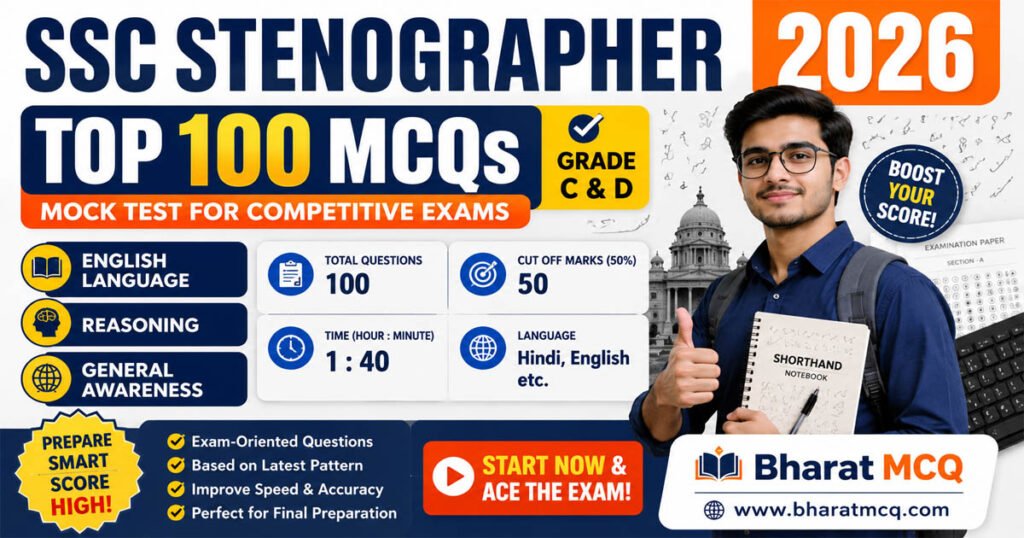
Attempt this SSC Stenographer mock test with 100 exam-level questions on reasoning, general awareness, and English for Grade C and D preparation.
Table of Contents
SSC Stenographer Mock Test: Exam-Relevant Practice
The SSC Stenographer Grade C and Grade D examination requires more than memorising isolated facts or grammar rules. Candidates must answer accurately under strict time pressure while switching between reasoning, general awareness, and English language questions. A well-designed mock test should therefore reproduce the structure, variety, and decision-making pressure of the real computer-based examination.
The official SSC scheme assigns 50 questions to General Intelligence and Reasoning, 50 to General Awareness, and 100 to English Language and Comprehension. This 100-question practice test follows the same proportional distribution with 25 reasoning questions, 25 general awareness questions, and 50 English questions. It is designed as a compact full-syllabus mock for Grade C and Grade D aspirants.
Candidates should attempt the test in one continuous sitting. Avoid checking answers midway. Mark uncertain questions for review, complete the easier questions first, and return to time-consuming items only after securing the questions that can be solved quickly.
Importance of the Three Core Sections
General Intelligence and Reasoning
The reasoning section evaluates how efficiently a candidate identifies patterns, relationships, sequences, and logical consequences. It includes number series, analogy, coding-decoding, syllogism, ranking, direction sense, blood relations, arrangement, statement-based reasoning, and mathematical operations.
This section is scoring when the candidate uses a fixed method instead of relying on intuition. For example, a direction question should be converted into a simple path diagram, while a syllogism should be tested through set relationships. Candidates who repeatedly solve such questions generally improve both speed and accuracy because the underlying structures recur even when the wording changes.
General Awareness
General awareness tests whether candidates understand important areas of polity, history, geography, economics, science, culture, and national developments. The purpose is not merely to recall disconnected facts. Many questions require candidates to distinguish between closely related constitutional provisions, historical events, scientific principles, institutions, and geographical features.
Preparation should combine standard reference material with concise revision notes. Static subjects such as the Constitution, physical geography, basic economics, and general science should be revised repeatedly. Facts that are easily confused should be organised in comparison tables or short one-line notes.
English Language and Comprehension
English carries the largest share in the SSC Stenographer computer-based examination. It tests grammar, vocabulary, sentence structure, usage, voice, narration, idioms, one-word substitution, prepositions, sentence arrangement, and reading comprehension.
Candidates should not treat English as a collection of rules learned separately. Grammar must be applied within complete sentences. Vocabulary should be studied with context, synonyms, antonyms, and common usage. Reading comprehension requires careful identification of the central idea, supporting details, implied meaning, and the author’s recommendation or conclusion.
Types of Questions Asked in SSC Stenographer
Reasoning questions commonly involve progressive number patterns, alphabet positions, logical deductions, coded language, seating arrangements, and statement-conclusion problems. These questions are usually brief, but some contain conditions that must be processed in the correct order.
General awareness questions may test a direct fact, a constitutional article, the purpose of an amendment, a historical association, a geographical characteristic, an economic term, or the application of a scientific law. Options are often deliberately similar, so partial knowledge can lead to incorrect selection.
English questions generally include error detection, fill-in-the-blanks, sentence improvement, active and passive voice, direct and indirect speech, vocabulary, idioms, spelling, punctuation, para-jumbles, and passage-based questions. Candidates must understand both grammatical form and intended meaning.
Practical Preparation Strategy
Begin with a diagnostic mock test and record section-wise accuracy. Do not judge performance only by the total score. A candidate may have strong English performance but lose marks in reasoning because of slow calculations, or may know general awareness facts but confuse similar options.
For reasoning, practise topic-wise sets and maintain a notebook of recurring patterns. After gaining accuracy, solve mixed sets under a timer. Draw diagrams wherever necessary rather than attempting to hold all conditions mentally.
For general awareness, divide revision into polity, history, geography, economics, science, and current developments. Use short daily revision cycles. Revisit incorrect facts after one day, one week, and again before the examination. This spaced revision is more effective than reading a large amount once.
For English, revise one grammar area at a time and immediately solve questions based on it. Read editorials or well-edited articles to observe sentence construction and word usage. Maintain a vocabulary list containing the word, meaning, one synonym, one antonym, and a sample sentence. Practise at least one short comprehension passage regularly.
During the mock test, begin with the section that gives you stable accuracy. Do not spend excessive time on one arrangement or one difficult vocabulary item. Since incorrect answers can reduce the final score under the examination’s marking rules, avoid blind guessing and use option elimination carefully.
Common Mistakes Students Make
A common reasoning mistake is assuming a relationship that is not stated. In syllogisms and statement-conclusion questions, only logically necessary conclusions should be accepted. In arrangements, overlooking words such as immediately, only, left, right, or facing can change the answer.
In general awareness, candidates often remember a related fact but select the wrong option. For example, they may confuse the constitutional article for the Finance Commission with another constitutional body, or confuse a freshwater lake with a brackish-water lake. Precise revision is essential.
In English, frequent errors include using than after senior, using since for a duration, applying singular verbs incorrectly after each or neither, and choosing a word that fits the topic but not the grammar. Candidates should read the entire sentence after filling the blank.
Another major mistake is reviewing only correct answers. Incorrect answers reveal knowledge gaps, while guessed-but-correct answers reveal unstable knowledge. Both should be analysed.
Benefits of Regular MCQ Practice
Quality MCQ practice trains retrieval, discrimination, and time management. Retrieval means recalling the required fact or rule without notes. Discrimination means separating the correct answer from plausible distractors. Timed practice helps candidates decide when to solve, skip, eliminate, or review.
After every mock, classify errors into four groups: concept error, factual error, careless error, and time-pressure error. Concept errors require relearning. Factual errors require revision. Careless errors require slower reading of key words. Time-pressure errors require better question selection and repeated timed sets.
A mock test becomes valuable only when its analysis changes the next study session. Record the topics that caused errors, revise them, and solve a small follow-up set. This creates a direct link between testing and improvement.
20 Sample Questions with Detailed Explanations
1. What number should replace the question mark in the series 3, 8, 15, 24, 35, ?
Correct Answer: 48
Explanation: The differences between consecutive terms are 5, 7, 9, and 11. These are consecutive odd numbers increasing by 2. The next difference must therefore be 13. Adding 13 to 35 gives 48.
2. Statements: All pens are books. Some books are papers. Which conclusion follows?
Correct Answer: Only conclusion II follows: Some books are pens.
Explanation: If all pens are books, every pen belongs to the set of books. Therefore, some books are pens, provided the set of pens exists. However, the books that are papers need not be the same books that are pens. Hence, no definite relationship between pens and papers can be established.
3. A person walks 8 km north, 6 km east, and then 8 km south. Where is the person from the starting point?
Correct Answer: 6 km east
Explanation: The 8 km northward movement is cancelled by the later 8 km southward movement. Only the 6 km movement toward the east remains. The final position is therefore 6 km east of the starting point.
4. Five persons P, Q, R, S and T sit in a row. Who sits in the middle?
Correct Answer: Q
Explanation: Q is immediately to the right of P, while S is immediately between Q and T. Since P is not at an end and R occupies one end, the only valid arrangement is R–P–Q–S–T. Q therefore occupies the middle position.
5. A cube is painted on all faces and cut into 27 equal smaller cubes. How many have exactly two painted faces?
Correct Answer: 12
Explanation: Cutting the cube into 27 pieces creates a 3 × 3 × 3 arrangement. Cubes with exactly two painted faces lie at the centres of the 12 edges. Since each edge contains one non-corner cube, the answer is 12.
6. If A > B = C, C < D and D < E, which conclusion is definitely true?
Correct Answer: E > B
Explanation: B equals C. Since C is less than D and D is less than E, E must be greater than D, C, and B. The relationship between A and E cannot be determined from the information given.
7. A is twice as old as B. Five years ago, A was three times as old as B. Find B’s present age.
Correct Answer: 10 years
Explanation: Let B’s present age be x. A’s age is 2x. Five years ago, their ages were 2x − 5 and x − 5. Therefore, 2x − 5 = 3(x − 5). Solving gives x = 10.
8. Which Article empowers the Supreme Court to issue writs for Fundamental Rights?
Correct Answer: Article 32
Explanation: Article 32 guarantees the right to approach the Supreme Court for enforcement of Fundamental Rights. The Court may issue writs such as habeas corpus, mandamus, prohibition, certiorari, and quo warranto.
9. Under which Article is the Finance Commission constituted?
Correct Answer: Article 280
Explanation: Article 280 provides for the constitution of a Finance Commission by the President. The Commission recommends how tax revenue should be distributed between the Union and the states and among the states.
10. Which Harappan site is known for its dockyard?
Correct Answer: Lothal
Explanation: Lothal, located in present-day Gujarat, is known for its large brick-built basin generally identified as a dockyard. The site provides evidence of maritime trade and commercial activity during the Harappan period.
11. The Tropic of Cancer passes through how many Indian states?
Correct Answer: Eight
Explanation: It passes through Gujarat, Rajasthan, Madhya Pradesh, Chhattisgarh, Jharkhand, West Bengal, Tripura, and Mizoram. Candidates should remember both the total number and the west-to-east sequence.
12. Which is the largest natural freshwater lake in India by surface area?
Correct Answer: Wular Lake
Explanation: Wular Lake is a large natural freshwater lake in Jammu and Kashmir. Sambhar is a saline lake, while Loktak is famous for its floating phumdis but has a smaller surface area than Wular.
13. What does the repo rate represent?
Correct Answer: The rate at which the RBI lends short-term funds to commercial banks against securities.
Explanation: The repo rate is an important monetary-policy instrument. Raising it generally makes borrowing from the RBI more expensive, while reducing it can make liquidity cheaper for banks, subject to other economic conditions.
14. Choose the grammatically correct sentence using “neither.”
Correct Answer: Neither of the two proposals is acceptable.
Explanation: “Neither” refers individually to not one and not the other of two items. It therefore normally takes a singular verb. The noun after “of the” remains plural, but the governing subject is “neither,” requiring “is.”
15. No sooner did the bell ring ___ the students left the room.
Correct Answer: Than
Explanation: The standard correlative construction is “no sooner…than.” It indicates that the second event happened immediately after the first. “Hardly” and “scarcely,” by contrast, are normally followed by “when.”
16. Choose the synonym of “lucid.”
Correct Answer: Clear
Explanation: “Lucid” describes something expressed in a clear and easily understandable manner. A lucid explanation is logically organised and free from unnecessary confusion or ambiguity.
17. Change into passive voice: The manager approved the proposal.
Correct Answer: The proposal was approved by the manager.
Explanation: The object “the proposal” becomes the subject of the passive sentence. The simple-past verb “approved” changes to “was approved,” and the original subject may be introduced with “by.”
18. Change into indirect speech: She said to me, “Do you know the answer?”
Correct Answer: She asked me if I knew the answer.
Explanation: A yes-or-no question is reported using “if” or “whether.” “Said to” becomes “asked,” the interrogative word order changes to statement order, and “know” changes to “knew” because the reporting verb is in the past.
19. The judge arrived ___ a decision after considering all the evidence.
Correct Answer: At
Explanation: The correct fixed expression is “arrive at a decision.” Although “arrive in” and “arrive at” are also used for places, the abstract expression involving a conclusion or decision specifically takes “at.”
20. What is the central idea of the digital public services passage?
Correct Answer: Digital services are useful but must be supported by inclusive measures.
Explanation: The passage recognises the benefits of digital services but states that technology alone cannot guarantee access for everyone. It recommends assisted support, accessible interfaces, connectivity, digital literacy, and grievance mechanisms as part of an inclusive system.
Practice the Complete SSC Stenographer Mock Test
Attempt all 100 questions without checking the answer indices during the test. After completion, calculate your section-wise accuracy separately for reasoning, general awareness, and English. Review every incorrect or guessed response, identify the underlying topic, and revise that topic before attempting another mock test. Regular analysis-based practice will provide a clearer picture of your actual preparation than repeatedly solving questions without reviewing errors.