
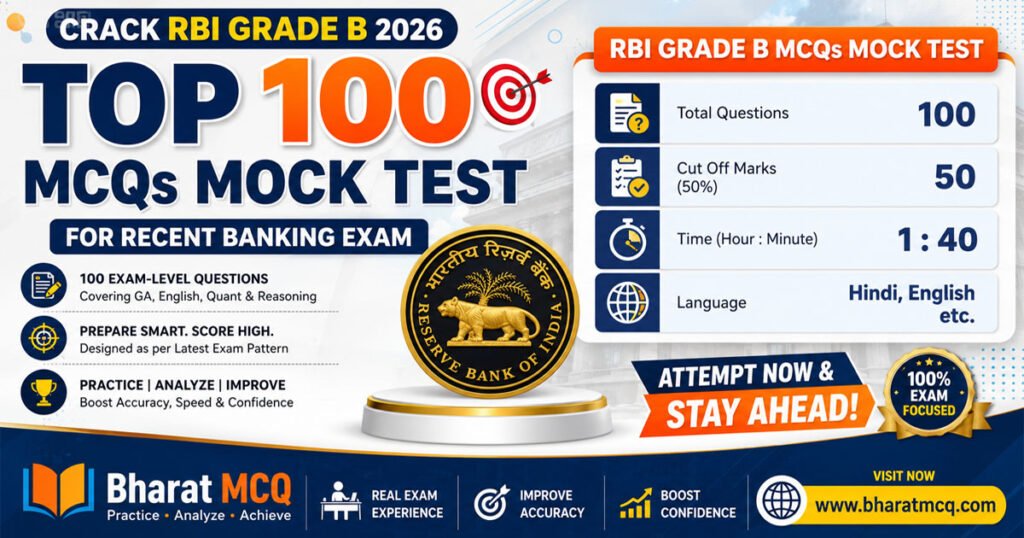
Attempt a full-length RBI Grade B mock test with 100 exam-level questions covering GA, English, Quant and Reasoning, plus answers and explanations.
Table of Contents
RBI Grade B Mock Test: 100 Exam-Level Questions
Introduction
The RBI Grade B examination demands more than factual recall. It tests whether a candidate can connect monetary policy, banking regulation, economics, language, numerical analysis and logical decision-making under strict time pressure. The official 2026 recruitment notice confirms a three-stage process consisting of Phase I, Phase II and interview. This mock test is designed as a compact Phase I-style paper for the General cadre, with 100 questions that preserve the established relative weight of the four objective sections.
The paper contains 40 General Awareness questions, 15 English Language questions, 15 Quantitative Aptitude questions and 30 Reasoning questions. This is a proportional half-length version of the established 80-30-30-60 Phase I distribution reflected in official RBI records and information handouts. It is therefore suitable for timed practice, sectional diagnosis and revision without becoming a random collection of unrelated MCQs.
Importance of the Subjects in RBI Grade B
General Awareness has the largest share because an RBI officer is expected to understand the financial system, not merely memorise definitions. Banking regulation, monetary policy instruments, payment systems, inflation, balance of payments, fiscal indicators and financial institutions are central areas. A strong candidate should know both what a term means and how a policy action affects liquidity, credit, interest rates or financial stability.
Reasoning carries substantial weight and measures structured thinking. RBI questions often require candidates to process several conditions, reject tempting but unsupported conclusions and identify the only logically valid answer. Seating arrangements, coded relations, syllogisms, data sufficiency, assumptions and decision-based questions reward disciplined analysis.
Quantitative Aptitude tests numerical control rather than lengthy mathematics. Percentages, ratios, averages, work and time, probability, algebra and data interpretation frequently appear in applied form. The important skill is selecting a short method, calculating accurately and avoiding unnecessary steps.
English Language evaluates comprehension, grammar, vocabulary and logical flow. Candidates must interpret policy-oriented passages, identify precise usage and recognise how sentences connect. Accuracy matters because plausible options are often grammatically acceptable but contextually weak.
Types of Questions Asked in Real Exams
A realistic RBI Grade B mock should mix direct knowledge with application. In General Awareness, a direct question may ask about the regulator of a market, while an application question may ask what an open market purchase does to liquidity. Questions on non-performing assets, capital adequacy, payment systems and macroeconomic indicators commonly test distinctions between closely related concepts.
English questions may involve error detection, sentence improvement, contextual vocabulary, inference, tone and paragraph sequencing. Quantitative questions usually combine familiar concepts with time pressure. Reasoning questions may begin with short inequalities and series, then progress to arrangements, assumptions, evidence evaluation and data sufficiency.
This paper follows that progression. The early questions establish conceptual coverage, while later questions demand multi-step interpretation. Each item has four options and only one correct answer.
Practical Preparation Strategy
Attempt the test in a fixed sitting. A useful target for this 100-question version is 60 minutes, preserving the broad speed requirement of the full examination. Do not divide time equally. General Awareness should be completed rapidly because questions are primarily knowledge-based. Save more time for reasoning sets and calculation-heavy Quantitative Aptitude items.
Use a three-pass method. In the first pass, answer questions that can be solved confidently within a short time. In the second pass, return to moderate questions requiring calculation or arrangement. In the final pass, review marked questions only when you can identify a specific error or overlooked condition. Randomly changing answers usually reduces accuracy.
Maintain an error log with four columns: topic, error type, correct method and revision date. Classify mistakes as conceptual, calculation-based, language-based or caused by haste. Revision should focus on repeated error patterns rather than on rereading everything.
For General Awareness, build interconnected notes. Link each institution with its purpose, regulator, legal basis and policy relevance. For Quant, revise formulas through mixed problems rather than isolated chapters. For Reasoning, draw clean diagrams and write only confirmed information. For English, read economic and financial writing and summarise the argument in one sentence.
Common Mistakes Students Make
The first common mistake is treating every question as equally valuable in time. A difficult puzzle can consume the time needed for several easier questions. The second is using remembered keywords without reading qualifiers such as “generally,” “primarily,” “only” or “definitely.” These words often determine the answer.
In Quantitative Aptitude, candidates frequently approximate too early, mix percentage bases or ignore units. In Reasoning, they convert a possible conclusion into a definite one. In English, they choose an option that sounds familiar but does not fit the sentence’s logic. In banking awareness, they confuse institutions with similar functions or mix liquidity tools with prudential requirements.
Another mistake is analysing the final score without analysing the process. A low score caused by weak knowledge requires revision; a low score caused by poor selection requires a different test strategy. The remedy depends on the error.
Benefits of MCQ Practice
Well-designed MCQ practice improves retrieval speed, option elimination and decision confidence. It also reveals whether knowledge is operational. A candidate may understand fiscal deficit in theory but still fail when asked to distinguish it from revenue or primary deficit. Repeated application builds the ability to recognise such distinctions instantly.
Mock tests also generate measurable evidence. Section-wise accuracy, average time per question and the number of avoidable errors show where improvement is possible. Consistent practice should produce fewer blind attempts, faster recognition of standard structures and better control during difficult sections.
20 Sample Questions with Detailed Explanations
1. Monetary Policy Committee
Question: Under which provision of the Reserve Bank of India Act, 1934 is the Monetary Policy Committee constituted?
Correct Answer: Section 45ZB
Explanation: Section 45ZB provides for the constitution of the Monetary Policy Committee. The committee determines the policy rate required to achieve the inflation target. Section 42 relates to the cash reserves maintained by scheduled banks, while Section 49 deals with the Bank Rate. Remembering the function associated with each provision is more useful than memorising section numbers in isolation.
2. Standing Deposit Facility
Question: Which RBI facility is designed to absorb liquidity without requiring the RBI to provide collateral?
Correct Answer: Standing Deposit Facility
Explanation: The Standing Deposit Facility allows the RBI to absorb surplus liquidity from the banking system without giving government securities as collateral. It is therefore a collateral-free liquidity-absorption instrument. The Marginal Standing Facility works in the opposite direction because it allows eligible banks to borrow overnight funds from the RBI against approved securities.
3. Non-Performing Asset Classification
Question: A term loan account is generally classified as a non-performing asset when interest or instalment of principal remains overdue for more than how many days?
Correct Answer: 90 days
Explanation: Under the standard income-recognition and asset-classification framework, a term loan generally becomes an NPA when interest or principal remains overdue for more than 90 days. The classification is linked to the contractual due date. A temporary delay of less than the prescribed period does not automatically make the account an NPA.
4. TReDS
Question: The Trade Receivables Discounting System primarily facilitates financing of what?
Correct Answer: MSME trade receivables
Explanation: TReDS is an electronic platform through which invoices or trade receivables of micro, small and medium enterprises can be financed. After a buyer accepts an invoice, financiers can bid to discount it. The MSME receives funds before the invoice’s maturity, improving working-capital liquidity without waiting for the buyer’s normal payment cycle.
5. Corporate Insolvency Authority
Question: Which authority generally handles corporate insolvency resolution under the Insolvency and Bankruptcy Code?
Correct Answer: National Company Law Tribunal
Explanation: The NCLT is the adjudicating authority for insolvency resolution and liquidation involving corporate persons. The Debt Recovery Tribunal primarily handles insolvency matters involving individuals and partnership firms under the relevant provisions. The Securities Appellate Tribunal hears appeals against certain orders of financial-market regulators and does not conduct corporate insolvency resolution.
6. GDP at Market Prices
Question: How is GDP at market prices obtained from GVA at basic prices?
Correct Answer: By adding product taxes and subtracting product subsidies
Explanation: Gross Value Added measures the value created by producers at basic prices. To move from GVA at basic prices to GDP at market prices, net product taxes must be added. Net product taxes equal product taxes minus product subsidies. Therefore, GDP at market prices equals GVA at basic prices plus product taxes minus product subsidies.
7. Primary Deficit
Question: Primary deficit is calculated as fiscal deficit minus what?
Correct Answer: Interest payments
Explanation: Fiscal deficit includes the Government’s current interest burden on past borrowing. Primary deficit removes this interest component. The formula is: primary deficit equals fiscal deficit minus interest payments. A zero primary deficit would indicate that fresh borrowing is being used only to meet interest obligations, not additional non-interest expenditure.
8. Appreciation of the Rupee
Question: Other things remaining unchanged, what is a likely effect of an appreciation of the Indian rupee?
Correct Answer: Imports become cheaper in rupee terms
Explanation: Appreciation means that one unit of the rupee can purchase more foreign currency than before. Consequently, an importer needs fewer rupees to purchase the same amount of foreign currency, making imported products cheaper in rupee terms. Exporters may face the opposite effect because foreign buyers may find Indian products relatively more expensive.
9. Inflation Inference
Question: What can be inferred from the statement that a temporary fall in headline inflation caused by volatile food prices need not indicate durable disinflation?
Correct Answer: A temporary decline in headline inflation alone is insufficient to establish a durable trend.
Explanation: The passage does not say that headline inflation is irrelevant. It says that a temporary movement caused by a volatile component may not persist. Policymakers therefore examine broader indicators such as core inflation, inflation expectations and demand conditions before concluding that inflationary pressure has durably weakened.
10. Paragraph Sequencing
Question: Arrange the sentences describing monetary-policy transmission.
Correct Answer: B-C-D-A
Explanation: The sequence begins with the central bank changing its policy rate. Banks then respond by adjusting deposit and lending rates. Those changes influence borrowing, saving and aggregate demand. The final sentence names the entire chain of events as monetary-policy transmission. A sentence beginning with “This process” should normally follow the description of that process.
11. No Sooner Construction
Question: Which sentence correctly uses “no sooner”?
Correct Answer: No sooner had the circular been issued than banks began to comply.
Explanation: The standard construction is “No sooner had + subject + past participle + than.” The sentence uses inversion because the negative expression appears at the beginning. “When” and “then” are incorrect in this structure. The past perfect form also establishes that issuance of the circular occurred immediately before compliance began.
12. Successive Discounts
Question: An article is marked 40% above cost and sold after discounts of 10% and 5%. What is the profit percentage?
Correct Answer: 19.7%
Explanation: Assume the cost price is ₹100. The marked price is ₹140. After a 10% discount, the price becomes ₹126. Applying the second discount of 5% gives ₹119.70. The profit is therefore ₹19.70 on a cost of ₹100, producing a profit percentage of 19.7%. Successive discounts must be applied multiplicatively, not added directly.
13. Time and Work
Question: A completes a task in 12 days and B in 18 days. They work together for four days, after which B leaves. How many more days does A need?
Correct Answer: 5⅓ days
Explanation: A’s daily work rate is 1/12 and B’s is 1/18. Together, they complete 5/36 of the task per day. In four days, they complete 20/36, or 5/9. The remaining work is 4/9. At A’s rate of 1/12 per day, the time required is 4/9 × 12 = 16/3 days, or 5⅓ days.
14. Probability of the Same Colour
Question: A box has five red, four blue and three green balls. What is the probability that two balls drawn without replacement have the same colour?
Correct Answer: 19/66
Explanation: The total number of ways to choose two balls from 12 is C(12,2) = 66. Favourable selections are two red, two blue or two green balls. These equal C(5,2) + C(4,2) + C(3,2), which is 10 + 6 + 3 = 19. Therefore, the required probability is 19/66.
15. Absolute-Value Inequality
Question: Solve |2x − 5| < 7.
Correct Answer: −1 < x < 6
Explanation: For |A| < b, the equivalent compound inequality is −b < A < b. Therefore, −7 < 2x − 5 < 7. Adding five throughout gives −2 < 2x < 12. Dividing by two gives −1 < x < 6. The endpoints are excluded because the original inequality is strict.
16. Syllogism
Question: All bonds are securities. Some securities are tradable. No tradable item is illiquid. Which conclusion follows?
Correct Answer: Only Conclusion II: Some securities are not illiquid.
Explanation: Because some securities are tradable and no tradable item is illiquid, those tradable securities must be non-illiquid. Conclusion II therefore follows. However, no statement establishes that any bond belongs to the tradable group. All bonds are securities, but only some unspecified securities are tradable, so Conclusion I does not follow.
17. Linear Seating Arrangement
Question: Five persons sit in a row. C is in the middle, A is second left of C, E is immediately right of C and B is not at an end. Who is second right of B?
Correct Answer: E
Explanation: C must occupy position 3. A, being second left of C, occupies position 1. E occupies position 4. The remaining positions are 2 and 5 for B and D. Since B cannot be at an end, B occupies position 2 and D position 5. The person second to the right of B is therefore E at position 4.
18. Circular Seating Arrangement
Question: Six persons sit around a circle. A is opposite D, B is immediately clockwise of A, C is immediately anticlockwise of D and E is not adjacent to A. Who is opposite B?
Correct Answer: E
Explanation: Fix A at one position and place D opposite A. B occupies the immediate clockwise position from A. C occupies the immediate anticlockwise position from D. Two positions remain for E and F. One of them is adjacent to A, so E must occupy the other position because E cannot be adjacent to A. That position is opposite B.
19. Evaluating Evidence
Question: Which evidence most strongly supports the claim that financial-literacy workshops increase formal saving?
Correct Answer: A randomised trial showing higher formal-account use among invited households than among a comparable control group.
Explanation: Random assignment creates comparable treatment and control groups, reducing the influence of income, location, prior financial knowledge and other confounding factors. A difference emerging after the workshop therefore provides stronger evidence of a causal effect. Participant satisfaction and simple correlation between workshops and bank presence do not establish that the workshops caused greater formal saving.
20. Data Sufficiency
Question: Is P north of Q? Statement I says P is east of R. Statement II says R is north of Q.
Correct Answer: Both statements together are sufficient.
Explanation: Statement I alone gives P’s location only relative to R and provides no relationship with Q. Statement II alone locates R north of Q but gives no location for P. Combined, P is east of R while R is north of Q. P must therefore be northeast of Q and is definitely north of Q.
Internal CTA: Practice the Full Test
Attempt all 100 questions before reading the explanations. Record your section-wise score and list every doubtful answer. Then review the 20 selected explanations, revisit the related concepts and retake only the questions you answered incorrectly. Use the full JavaScript question set to publish or run the mock in a dynamic quiz interface.