
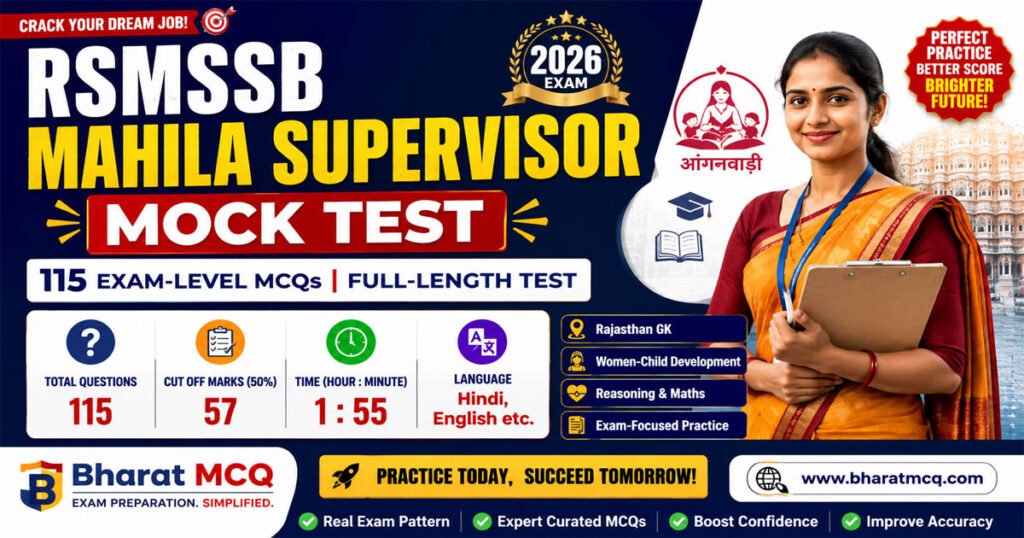
Attempt a full-length RSMSSB Mahila Supervisor mock test with 115 exam-level MCQs on Rajasthan GK, women-child development, reasoning, maths and English.
Table of Contents
RSMSSB Mahila Supervisor Mock Test: Exam-Oriented Practice Guide
Introduction
The RSMSSB Mahila Supervisor examination requires more than memorising isolated facts. A strong candidate must connect Rajasthan-specific knowledge with Indian polity, social legislation, women and child development, nutrition, reasoning, arithmetic, language ability, computer awareness and field-level programme management. The Rajasthan Staff Selection Board’s official archive lists separate recent master papers for Supervisor (Women), Supervisor (Woman Empowerment) and Supervisor (Women) under the Anganwadi-worker quota, showing that the recruitment area has a broad and specialised assessment base.
This 115-question mock test is designed as an integrated practice paper. The questions move from direct factual recall to conceptual understanding, numerical application, legal interpretation and practical supervisory situations. It should be attempted in one sitting so that accuracy, speed and decision-making can be evaluated together.
Importance of the Subjects in the Examination
Rajasthan history, art, culture, geography and administration form the state-specific foundation of the paper. Questions from archaeological sites, peasant movements, integration of Rajasthan, folk traditions, rivers, soils, canals and constitutional institutions test whether a candidate understands the social and administrative environment in which she may work.
Women and child development is the professional core. A supervisor is expected to understand Anganwadi services, growth monitoring, maternal and child nutrition, breastfeeding, complementary feeding, anaemia, child protection and referral systems. Official Anganwadi guidance identifies six key services: supplementary nutrition, pre-school education, nutrition and health education, immunisation, health check-up and referral services.
Indian polity, social laws and public administration are equally important. Field responsibilities frequently involve rights, documentation, confidentiality, workplace safety and coordination with health, education, police and local-government institutions. Reasoning, mathematics, English and computer questions assess the operational skills needed for registers, reports, beneficiary data, correspondence and digital systems.
Types of Questions Asked in Real Competitive Exams
A realistic paper contains several question forms. Static knowledge questions test facts such as historical sites, constitutional schedules or geographical features. Conceptual questions ask why a provision exists or which principle applies. Application questions present a field situation, data set or supervisory problem and require the best course of action.
Professional questions may combine law and administration. For example, candidates may need to distinguish domestic violence from ordinary disagreement, identify the age definition under child-protection law, or recognise the appropriate workplace complaints mechanism. Nutrition questions commonly test both recommendations and their practical purpose, such as why growth monitoring is conducted or why complementary feeding begins at six months.
Quantitative questions usually involve percentages, ratios, averages, interest, time and work, mensuration and data interpretation. Reasoning questions may cover series, coding, blood relations, directions, rankings, syllogisms and arrangements. Language questions test grammar in official communication rather than literary interpretation.
Practical Preparation Strategy
Begin by dividing the syllabus into four blocks: Rajasthan studies, general studies, professional women-child development, and aptitude-language-computer skills. Prepare a weekly plan that gives the largest share to Rajasthan and professional subjects, while keeping daily practice for mathematics, reasoning and English.
For Rajasthan studies, create compact revision sheets for dynasties, movements, forts, painting schools, folk deities, rivers, soils, protected areas and constitutional institutions. Link facts geographically. A map-based revision method is more reliable than memorising disconnected lists.
For professional preparation, organise notes under nutrition, child development, maternal health, legislation, schemes, monitoring and community work. Study the purpose of every service, not only its name. For laws, remember the protected group, prohibited conduct, responsible institution and field-level response. Use primary government material wherever possible.
Attempt this mock in timed conditions. Mark uncertain questions instead of spending excessive time on one item. After completion, classify every error as a knowledge gap, calculation error, misreading, weak elimination or time-pressure mistake. Revision should then target the cause of the error.
Maintain an error notebook. Record only the rule, concept or fact that caused the mistake. Reattempt incorrect questions after two days and again after one week. For arithmetic, practise without a calculator. For English, revise subject-verb agreement, prepositions, articles, voice, narration and error detection. For computers, focus on spreadsheets, email, cyber safety, storage, operating systems and keyboard shortcuts.
Common Mistakes Candidates Make
The first major mistake is overemphasising general knowledge while neglecting women and child development. A Mahila Supervisor paper is not simply a Rajasthan GK test. Professional concepts and practical judgement can separate well-prepared candidates from those relying on memorisation.
The second mistake is confusing similar laws, schemes or institutions. Candidates should not mix child-marriage age limits with the definition of a child under POCSO, or confuse an Internal Committee with a Local Committee. A comparison chart can prevent such errors.
The third mistake is solving numerical questions mentally without writing intermediate steps. Ratio distribution, compound interest and combined work questions often produce avoidable errors. Another common mistake is reading options too quickly. Words such as “NOT”, “primarily”, “definitely” and “most appropriate” change the required answer.
Benefits of Full-Length MCQ Practice
A full mock reveals whether knowledge can be applied under time limits. It improves option elimination, question selection and concentration across mixed subjects. It also exposes uneven preparation: a candidate may be strong in Rajasthan history but weak in nutrition law, data handling or English grammar.
Repeated MCQ practice builds retrieval speed. Reviewing explanations converts a guessed answer into a reusable concept. The greatest benefit comes from analysis, not merely from the score. Track subject-wise accuracy, average time per question and the number of careless errors after every attempt.
20 Sample Questions with Detailed Explanations
1. The ploughed field evidence of the Harappan period was discovered at which Rajasthan site?
Correct Answer: Kalibangan
Explanation: Kalibangan, situated in the Ghaggar river region of Rajasthan, produced important evidence of a ploughed agricultural field. Archaeologists identified intersecting furrows, suggesting that crops may have been cultivated in two directions. The finding makes Kalibangan particularly significant for understanding Harappan agricultural practices.
2. The Vijay Stambha at Chittorgarh was built by Rana Kumbha to commemorate his victory over whom?
Correct Answer: Mahmud Khilji of Malwa
Explanation: Rana Kumbha constructed the Vijay Stambha, or Tower of Victory, at Chittorgarh during the fifteenth century. It commemorated his military success over Mahmud Khilji, the Sultan of Malwa. The monument is also notable for its detailed sculptures and inscriptions.
3. The Matsya Union initially included Alwar, Bharatpur, Dholpur and which princely state?
Correct Answer: Karauli
Explanation: The Matsya Union was formed during the phased political integration of Rajasthan. It combined the princely states of Alwar, Bharatpur, Dholpur and Karauli. It was later merged into the larger political unit that developed into present-day Rajasthan.
4. In which direction does the Aravalli Range generally extend across Rajasthan?
Correct Answer: North-east to south-west
Explanation: The Aravallis extend from the Delhi region toward Gujarat through Rajasthan in a north-east to south-west direction. The range influences drainage, climate, vegetation and settlement. It also acts as an important physical division between eastern Rajasthan and the western desert region.
5. Where is the principal seat of the Rajasthan High Court?
Correct Answer: Jodhpur
Explanation: The principal seat of the Rajasthan High Court is located at Jodhpur. A bench also functions at Jaipur. Competitive-exam questions frequently distinguish between the principal seat and the location of the additional bench.
6. Which Fundamental Right is available to both citizens and non-citizens?
Correct Answer: Protection of life and personal liberty
Explanation: Article 21 uses the expression “no person,” so its protection extends to citizens as well as non-citizens. By contrast, some rights, including freedom of speech under Article 19, are specifically guaranteed only to citizens.
7. The 73rd Constitutional Amendment is primarily associated with which institutions?
Correct Answer: Panchayati Raj Institutions
Explanation: The 73rd Amendment gave constitutional status to rural local-government institutions. It introduced provisions relating to Gram Sabhas, three-tier Panchayati Raj structures, regular elections, reservations, State Election Commissions and State Finance Commissions.
8. Which national-income method avoids double counting by summing value added at each production stage?
Correct Answer: Value-added method
Explanation: The value-added method calculates the additional value created by each producer. Since the value of intermediate goods is not repeatedly counted, it avoids double counting. The value added at all stages is combined to estimate final production.
9. Through which centres are ICDS services mainly delivered?
Correct Answer: Anganwadi centres
Explanation: Anganwadi centres function as the community-level delivery platform for nutrition, early childhood care and related services. Official guidance lists supplementary nutrition, pre-school education, nutrition and health education, immunisation, health check-up and referral among the six key services.
10. Exclusive breastfeeding is generally recommended for the first how many months?
Correct Answer: Six months
Explanation: Exclusive breastfeeding means that the infant receives breast milk without other foods or drinks, apart from medically required exceptions. After about six months, appropriate complementary foods should begin while breastfeeding continues.
11. Which forms of abuse are covered under the Protection of Women from Domestic Violence Act, 2005?
Correct Answer: Physical, sexual, verbal, emotional or economic abuse
Explanation: Domestic violence is not restricted to physical assault. Section 3 recognises physical, sexual, verbal, emotional and economic abuse, along with conduct connected with unlawful demands or threats. This broad definition is important in field-level identification and referral.
12. Which workplace mechanism is mandated under the Sexual Harassment of Women at Workplace Act, 2013?
Correct Answer: Internal Committee
Explanation: Covered workplaces are required to establish an internal redressal mechanism for complaints of sexual harassment. The Act also provides for a Local Committee at the district level in specified situations, including cases where an internal mechanism is unavailable.
13. Find the next number: 3, 8, 15, 24, 35, ?
Correct Answer: 48
Explanation: The differences are 5, 7, 9 and 11. These are consecutive odd numbers. The next difference is 13, so the required number is 35 + 13 = 48.
14. If P + Q means P is the mother of Q and P – Q means P is the brother of Q, which expression shows A as the maternal uncle of B?
Correct Answer: A – C + B
Explanation: A – C means A is the brother of C. C + B means C is the mother of B. Therefore, A is the brother of B’s mother, which makes A the maternal uncle of B.
15. A village has 1,250 children and 48% are girls. How many girls are there?
Correct Answer: 600
Explanation: Calculate 48% of 1,250:
1,250 × 48 ÷ 100 = 12.5 × 48 = 600.
Therefore, the village has 600 girls.
16. A completes a survey in 12 days and B in 18 days. How long will they take together?
Correct Answer: 7.2 days
Explanation: A completes 1/12 of the work daily and B completes 1/18. Their combined rate is 1/12 + 1/18 = 5/36. Time required is 36/5 days, which equals 7.2 days.
17. Which sentence has correct subject-verb agreement?
Correct Answer: Each of the workers has submitted her report.
Explanation: The grammatical subject is “each,” which is singular. Therefore, it takes the singular verb “has.” The plural noun “workers” appears inside the prepositional phrase and does not control the verb.
18. Convert into indirect speech: She said, “I am preparing the monthly report.”
Correct Answer: She said that she was preparing the monthly report.
Explanation: The pronoun “I” changes to “she” according to the speaker. Because the reporting verb is in the past tense, the present continuous “am preparing” generally changes to the past continuous “was preparing.”
19. In a spreadsheet, which symbol normally begins a formula?
Correct Answer: =
Explanation: Spreadsheet applications use the equals sign to indicate that the cell entry is a formula. For example, =SUM(A1:A5) adds the values from cells A1 through A5.
20. What is the principal purpose of a baseline survey?
Correct Answer: To measure conditions before an intervention begins
Explanation: A baseline establishes the initial situation against which future progress can be compared. After implementation, monitoring or evaluation data can be compared with the baseline to determine whether meaningful change has occurred.
Internal CTA: Practice the Test
Attempt all 115 questions before checking any answer. Then review the 20 explained samples above and revisit every incorrect topic in your notes. Repeat the complete mock after seven days and compare accuracy, speed and error type.