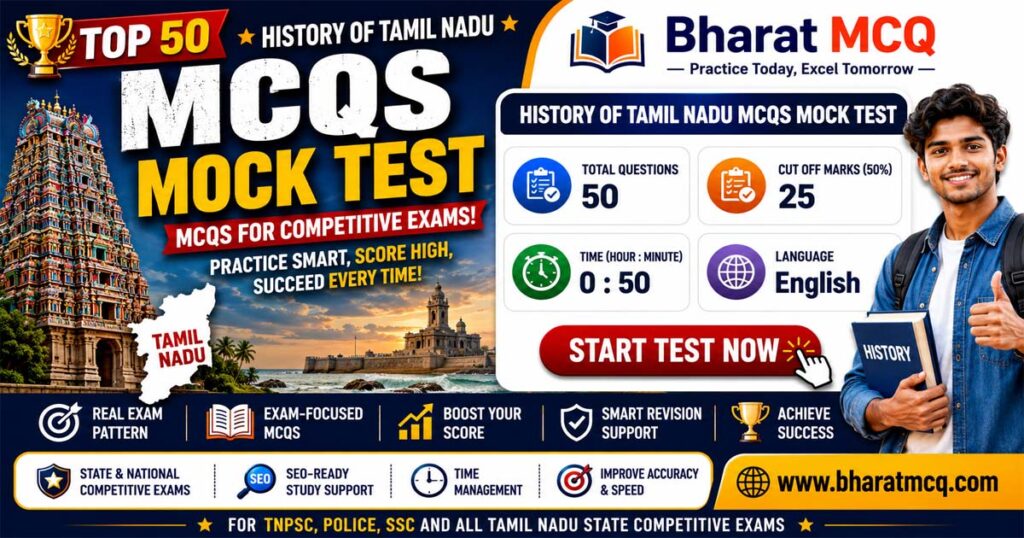
Practice Top 50 exam-level MCQs on History of Tamil Nadu for TNPSC, Police, SSC and state exams with realistic difficulty and smart revision focus.
Table of Contents
History of Tamil Nadu Mock Test for Competitive Exam Preparation
History of Tamil Nadu is one of the most important areas for aspirants preparing for state-level and national-level competitive exams. Whether the exam is TNPSC, Police Bharti, Clerk, SSC, UPSC, PSI, Talati-type recruitment, or any other government exam, questions from Tamil Nadu history often test more than memory. They check whether the candidate understands dynasties, social change, culture, administration, literature, freedom movement, and regional identity in a connected manner.
A well-designed mock test on the History of Tamil Nadu helps students revise major topics in a realistic exam format. It also trains them to identify factual traps, eliminate wrong options, and manage time during the actual examination. The subject should not be treated as a collection of isolated facts. It must be studied as a timeline of political, cultural, economic, and social developments.
Importance of History of Tamil Nadu in Competitive Exams
Tamil Nadu has a rich historical background, beginning from prehistoric and megalithic cultures to the Sangam age, Pallavas, Cholas, Pandyas, Nayaks, colonial rule, freedom struggle, social reform movements, and post-independence political developments. This wide coverage makes the subject highly useful for examiners because they can frame questions at different difficulty levels.
In state-level exams, Tamil Nadu history is especially important because it directly connects with regional identity and administrative history. Questions are often asked from Sangam literature, ancient Tamil kingdoms, temple architecture, Bhakti saints, Chola administration, European settlements, Poligar resistance, Vellore Mutiny, Justice Party, Self-Respect Movement, and the renaming of Madras State as Tamil Nadu.
For national-level exams, Tamil Nadu history is relevant because it forms part of the larger history of India. The Chola naval expeditions, Indo-Roman trade, Bhakti movement, anti-caste reform, and language politics are all connected to wider themes in Indian history.
Types of Questions Asked in Real Exams
Competitive exams usually do not ask only simple one-line facts. They often frame questions that require comparison, chronology, interpretation, and application of knowledge. For example, instead of directly asking who built the Brihadisvara Temple, the paper may ask why Chola temples are important for understanding medieval society and economy.
Common question types include dynasty-based questions, inscription-based questions, literature-based questions, architecture-based questions, reform movement questions, and freedom struggle questions. Aspirants may also face statement-based questions where they must identify the correct historical interpretation.
Ancient Tamil history questions often focus on Sangam texts, trade routes, Roman contacts, Chera-Chola-Pandya polity, and archaeological discoveries. Medieval questions usually cover Pallava architecture, Chola administration, temple economy, bronze art, and Pandya maritime trade. Modern history questions are commonly based on colonial conflicts, Poligar revolts, Vellore Mutiny, nationalist leaders, Justice Party, Periyar, Self-Respect Movement, and Dravidian politics.
Preparation Strategy for History of Tamil Nadu
The best way to prepare this subject is to divide it into clear periods. Start with prehistoric and megalithic Tamil Nadu, then move to the Sangam age. After that, study the Pallavas, Cholas, Pandyas, Vijayanagara-Nayak period, European arrival, colonial rule, freedom movement, social reform movements, and post-independence developments.
While studying ancient Tamil history, focus on sources. Understand the importance of Sangam literature, Tamil-Brahmi inscriptions, archaeological sites, coins, and foreign accounts. Do not memorize literary names without knowing their historical value.
For the Pallava and Chola periods, prepare architecture and administration carefully. Pallava rock-cut temples, Mamallapuram monuments, Chola temples, Uttaramerur inscriptions, Chola bronzes, irrigation, village assemblies, and maritime trade are high-value exam topics.
For modern Tamil Nadu, prepare events in proper sequence. Poligar resistance, Kattabomman, Maruthu Brothers, Vellore Mutiny, Swadeshi movement, V.O. Chidambaram Pillai, Bharati, Rajaji, Kamaraj, Justice Party, Periyar, and the Dravidian movement should be studied with dates, causes, and impact.
Use short notes for revision. Make separate lists for rulers, capitals, inscriptions, literary works, movements, leaders, and important years. Revise these lists regularly through MCQ practice.
Common Mistakes Students Make
One common mistake is studying Tamil Nadu history as only a list of kings and battles. Exams increasingly ask about society, economy, literature, inscriptions, religion, and administration. Students who ignore these areas lose marks in moderate and difficult questions.
Another mistake is confusing dynasties and their contributions. For example, Pallava architecture, Chola administration, Pandya maritime trade, and Nayak temple expansion must be clearly distinguished. Mixing these themes leads to wrong answers even when the student has basic knowledge.
Many aspirants also ignore the modern period. The Justice Party, Self-Respect Movement, anti-Hindi agitations, and social reform politics are highly important in Tamil Nadu-based exams. These topics should not be left for last-minute reading.
A further mistake is memorizing dates without understanding context. Dates are important, but they become useful only when connected with events. For example, 1806 should be linked with Vellore Mutiny, 1916 with the Justice Party, 1925 with the Self-Respect Movement, and 1969 with the renaming of Madras State as Tamil Nadu.
Benefits of MCQ Practice
MCQ practice is essential because competitive exams test speed, accuracy, and judgment. A student may know the topic but still choose the wrong option due to similar-sounding choices. Regular mock tests improve option elimination and help students understand how examiners frame traps.
Practicing MCQs also reveals weak areas. If a student repeatedly makes mistakes in inscriptions, architecture, or social reform movements, that area can be revised separately. This makes preparation targeted and efficient.
Full-length mock tests are better than random questions because they create exam-like pressure. They help candidates maintain concentration for a fixed number of questions and develop a realistic sense of difficulty. A balanced mock test includes easy, moderate, and difficult questions, just like an actual exam paper.
Internal CTA: Practice Test
Use the above History of Tamil Nadu mock test as a serious revision tool. Attempt all 50 questions without checking the answers first. After completing the test, review your wrong answers topic-wise. Revise the related period, movement, ruler, inscription, or concept before attempting another mock test.
For best results, practice this test under timed conditions. Treat it like a real competitive exam paper. Regular MCQ practice, combined with structured revision, can significantly improve your performance in Tamil Nadu history and general studies sections.