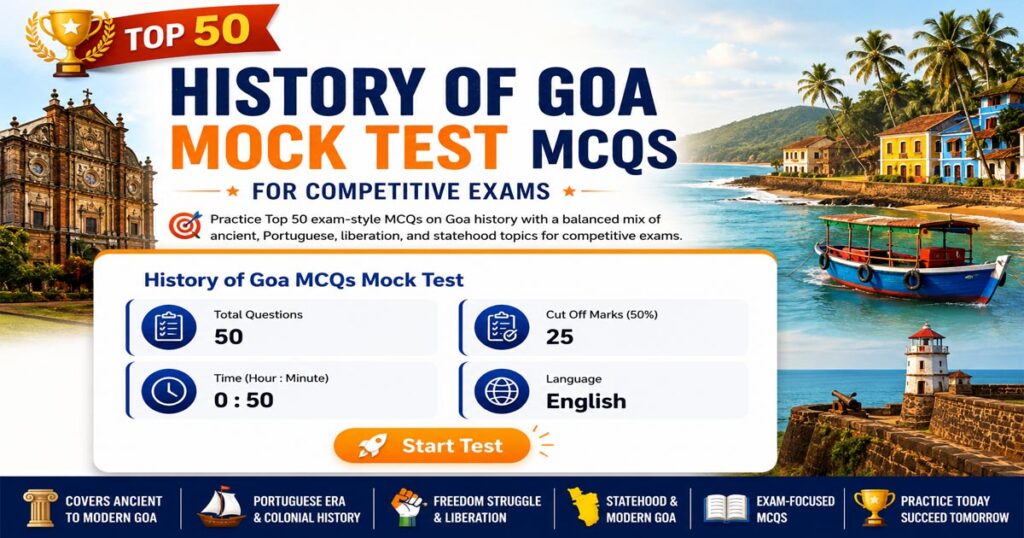
Practice Top 50 exam-style MCQs on Goa history with a balanced mix of ancient, Portuguese, liberation, and statehood topics for competitive exams.
Table of Contents
Goa History Mock Test: 50 MCQs for Competitive Exams
Introduction
Goa history is a high-value topic in Indian competitive exams because it combines ancient dynasties, medieval trade, Portuguese colonial rule, the liberation movement, and statehood milestones. Questions from this area often appear in exams such as Talati, Police Bharti, PSI, Clerk, SSC, UPSC prelims, and various state-level tests. A strong command over Goa history helps candidates score well in both direct factual questions and chronology-based questions.
This mock test is designed to follow the pattern of real competitive papers. It moves from basic historical background to more analytical and event-based questions. That makes it useful not only for memorizing facts, but also for understanding the sequence of major developments in Goa’s history.
Why Goa History Matters in Competitive Exams
Goa is small in size, but its historical relevance is huge. It was an important maritime region in early Indian history, later became a major Portuguese colony, and finally joined the Indian Union in 1961. Because of this long and layered history, exam setters often use Goa to test a candidate’s knowledge of ancient India, colonial history, freedom struggle, and post-independence political changes in one topic.
Another reason this topic matters is its mix of easy and tricky questions. Some questions are direct, such as the year of liberation or statehood. Others test awareness of names, causes, and order of events. For example, a paper may ask about the Kadamba dynasty, the Portuguese conquest, the Goa Opinion Poll, or the official language question. This means students need more than casual reading. They need structured revision.
Ancient and Medieval Goa
Goa’s history begins long before the Portuguese arrival. The Kadamba dynasty played a major role in the political consolidation of the region. Early Goa was connected to trade routes and coastal commerce, and ports such as Gopakapattana became important. Medieval Goa also saw regional rule under different powers before the Portuguese entered the picture in the 16th century.
For exam preparation, this phase is useful because questions are often asked on rulers, capitals, ports, and trade. Candidates should remember broad ideas such as the importance of Chandor, the role of maritime trade, and the fact that Goa was not always a Portuguese territory. Historical continuity is important here. If you know what came before the colonial period, you can answer chronology questions much faster.
Portuguese Period and Liberation
The Portuguese captured Goa in 1510 under Afonso de Albuquerque, and this changed the region’s political and cultural direction for centuries. Goa remained under Portuguese rule for 451 years, which makes it one of the longest colonial experiences in Indian history. That is why questions on Goa often include the conquest year, colonial administration, and the institutions linked to Portuguese rule.
Old Goa became the administrative center, later replaced by Panaji in 1843. The Portuguese period also produced strong religious and cultural influences, including famous churches and heritage sites. The Basilica of Bom Jesus, which houses the relics of St. Francis Xavier, is one of the most important historical landmarks in Goa and is frequently mentioned in exams.
The liberation movement is another major part of the syllabus. Ram Manohar Lohia’s 1946 satyagraha gave fresh energy to anti-Portuguese protest. Tristão de Bragança Cunha is remembered as the Father of Goan nationalism. Finally, Goa was liberated through Operation Vijay in 1961. This is one of the most important dates in modern Indian history and should be memorized clearly.
Statehood and Modern Identity
After liberation, Goa became a Union Territory along with Daman and Diu. This phase is especially important for post-independence questions. In 1967, the Goa Opinion Poll decided that Goa should remain separate rather than merge with Maharashtra. Later, in 1987, Goa became a full-fledged state of India.
The official language issue is also exam relevant. Konkani was accorded official status in 1987, reflecting the identity and linguistic history of the region. This is why Goa history is not just about political control. It is also about language, identity, and democratic choice.
Types of Questions Asked in Real Exams
Competitive exams generally ask Goa history in a few clear patterns. Some questions are direct factual items, such as dates, dynasties, rulers, and capital cities. Others are conceptual, such as asking why Panaji replaced Old Goa or why the Goa Opinion Poll was important. Many papers also ask chronology-based questions, where candidates must identify which event came first or which event followed another.
In higher-level tests, questions may connect Goa with the freedom struggle, Portuguese administration, or historical personalities. These questions are usually not difficult if the candidate has revised the topic in a systematic way. The real challenge is avoiding confusion between similar years and events.
Preparation Strategy for Goa History
The best way to prepare Goa history is to divide it into four blocks: ancient and medieval Goa, Portuguese conquest and administration, liberation movement, and post-1961 developments. Study each block separately first, then revise them together in chronological order. This method reduces confusion and improves retention.
Use a timeline approach. Fix the main years in your memory: 1510 for the Portuguese capture, 1843 for the capital shift to Panaji, 1961 for liberation, 1967 for the Opinion Poll, and 1987 for statehood. Along with dates, revise key names such as Afonso de Albuquerque, Ram Manohar Lohia, and Tristão de Bragança Cunha.
Practice elimination as well. In competitive exams, the options often contain nearby but wrong years or unrelated dynasties. If you know the broad historical sequence, you can remove wrong choices faster even when you do not remember the exact answer immediately.
Common Mistakes Students Make
One common mistake is treating Goa history as only a colonial topic. That leads to weak performance on pre-Portuguese questions. Another mistake is mixing up liberation and statehood. Goa was liberated in 1961, but it became a state only in 1987. Many students also confuse the Goa Opinion Poll with the liberation movement, even though the poll came later and dealt with merger versus separate identity.
Students also tend to forget the significance of Old Goa and Panaji in administrative history. These details are small, but they often appear in MCQ form. Careful revision of places, dates, and personalities is essential.
Benefits of MCQ Practice
MCQ practice improves memory, accuracy, and speed. It also trains the mind to spot distractors and avoid common traps. For Goa history, MCQ practice is especially useful because the topic has many short facts that can be tested in multiple ways. One concept can appear as a direct question, a sequence question, or a match-the-following style item.
Repeated practice also helps with long-term retention. The more often you revise the same event in a question format, the easier it becomes to recall during the exam. This is exactly why a well-structured mock test is more effective than random reading.
Practice Test
Now use the full 50-question mock test above as a timed practice set. Try to complete it without checking notes first. After finishing, review your errors carefully and mark the dates, names, and movements that need one more round of revision. This simple habit can turn Goa history from a weak area into a scoring topic.