
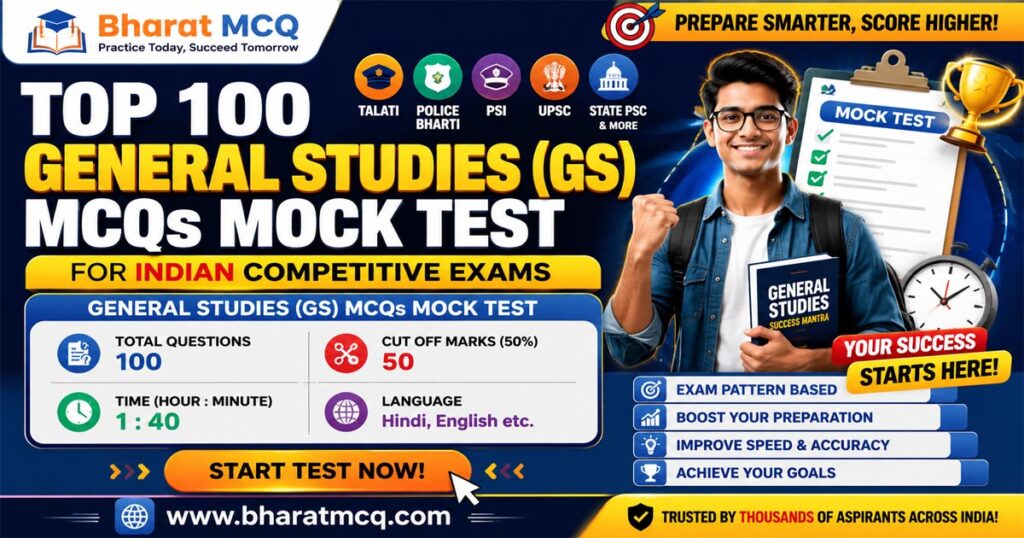
Master your upcoming Talati, Police Bharti, PSI, UPSC, & State PSC exams with this comprehensive, full-length 100-question General Studies mock test.
Table of Contents
Mastering General Studies: The Ultimate Strategy Guide and 100-Question Mock Test for Indian Competitive Exams
Achieving success in Indian competitive examinations requires a calculated approach to General Studies (GS). Whether you are targeting national-level examinations like the UPSC Civil Services, Staff Selection Commission (SSC), or state-specific recruitments such as the Police Bharti, Police Sub-Inspector (PSI), Talati, or administrative clerk positions, General Studies consistently forms the core component of the screening process.
Because the GS syllabus encompasses multiple disciplines—ranging from constitutional frameworks to global climate initiatives—aspirants frequently struggle to manage the volume of information. This comprehensive strategic guide explores the operational layout of General Studies in competitive exams, provides insights into question patterns, outlines effective preparation frameworks, and introduces our high-yield 100-question mock test designed to evaluate your exam readiness.
The Strategic Importance of General Studies in Competitive Exams
General Studies serves as a primary tool for sorting and selecting candidates in competitive examinations. Unlike technical or optional subjects that test deep, specialized knowledge, GS evaluates an applicant’s awareness of current affairs, operational understanding of state machinery, analytical perspective on social structures, and scientific awareness.
1. The Ultimate Merit Determinant
In exams like the UPSC Civil Services Prelims, your performance in GS Paper I is the single deciding factor for making the cut, provided you clear the qualifying threshold in the Civil Services Aptitude Test (CSAT). Similarly, in state-level recruitments like the PSI or Talati exams, a high score in the GS section establishes an insurmountable lead in the final merit rankings.
2. Analytical Thinking Over Rote Memorization
Modern examination bodies have steadily shifted away from testing pure memorization. Questions are now structured to assess whether an applicant can link a static concept (such as a constitutional provision) with a dynamic development (such as a recent Supreme Court judgment). This makes GS an ongoing evaluation of your cognitive agility.
Deconstructing the Anatomy of Exam Questions
An analysis of recent examination trends reveals that question setters design papers around three main categories. Recognizing these patterns helps you adjust your reading habits to focus on how information will be tested.
Conceptual Questions
These questions assess your understanding of foundational theories. For instance, in economics, instead of asking for the definition of inflation, a conceptual question will test how an increase in the repo rate by the Reserve Bank of India affects market liquidity and commercial borrowing.
Application-Based Questions
Particularly common in Science & Technology and Environment, these questions examine real-world use cases. You might encounter questions on how CRISPR-Cas9 works in gene editing, or the operational differences between PSLV and GSLV rocket engines.
Fact-Based Integration
Common in state-level exams like Clerk and Police Bharti recruitments, these items require accurate factual retention. This includes remembering specific constitutional articles, the geographical paths of major rivers, or the leadership of regional uprisings during the 1857 Revolt.
Tactical Preparation Framework for High-Yield Scores
To convert your study hours into high marks, avoid unstructured reading. Implement a disciplined, subject-specific strategy:
Polity and Governance
Focus on the working mechanics of the Indian Constitution. Prioritize Fundamental Rights (Articles 12-35), Directive Principles of State Policy, the structural powers of the President versus State Governors, and Landmark Judgments that have shaped the Basic Structure Doctrine. Use analytical tables to compare constitutional bodies like the Finance Commission with statutory bodies like the National Human Rights Commission.
Indian History and Culture
Divide your preparation into clear historical blocks:
- Ancient & Medieval: Focus on administrative structures, economic reforms (such as Alauddin Khalji’s market controls), and artistic achievements (Nagara versus Dravida temple architecture).
- Modern History: Concentrate on the phase between the 1857 Revolt and the 1947 Independence Act. Pay close attention to tribal and peasant uprisings, socio-religious reform societies, and internal policy developments within the Indian National Congress.
Geography and Environment
Develop map-based study habits. Track the tributaries of major Indian river systems, the distribution of black and alluvial soils, and the locations of Biosphere Reserves. For the environment component, focus on international frameworks like the Ramsar Convention, the Kyoto Protocol, and the Kigali Amendment.
Indian Economy
Develop a firm grasp of macroeconomic terms. Understand the components of the Balance of Payments, the differences between Consumer Price Index (WPI) and Wholesale Price Index (WPI), and the regulatory scope of bodies like SEBI and the RBI.
Critical Mistakes to Avoid During Your Preparation
Many dedicated aspirants miss the cut-off marks due to preventable strategic errors. Being aware of these pitfalls can save you months of misdirected effort:
- Collecting Excessive Study Materials: Relying on too many books leads to information fatigue. Choose one trusted standard textbook for each subject and revise it multiple times rather than skimming through multiple sources once.
- Ignoring the Syllabus Limits: Competitive exams test broad awareness rather than narrow academic specialization. Avoid spending weeks researching niche details that fall outside the scope of the official syllabus.
- Neglecting Current Affairs Integration: Treating static subjects and current affairs as isolated components is a major mistake. Always look for connections; if an interstate river water dispute is in the news, immediately review the static constitutional provisions governing water disputes.
Why Practicing Full-Length MCQ Mock Tests is Essential
Simulating the actual test environment is an indispensable part of exam preparation. Consistently practicing full-length mock exams provides several key benefits:
1. Refines Time Allocation Skills
Answering 100 questions within a strict 120-minute limit requires efficient pacing. Mock tests teach you how to quickly identify and skip overly complex questions during your first pass, ensuring you don’t run out of time before reaching simpler questions later in the booklet.
2. Builds Psychological Resilience
Experiencing the pressure of an official exam format helps reduce test anxiety. It conditions your brain to maintain focus and critical thinking across a long, multi-subject paper without losing stamina midway through.
3. Provides a Clear View of Weak Areas
Mock scores serve as an objective diagnostic tool. If you consistently miss questions on constitutional amendments or macroeconomic indices despite studying those topics, it indicates that your understanding of those specific areas needs deeper review.
General Studies (GS) Mock Test: Important Questions with Detailed Explanations
(1) Question: Which Fundamental Rights enshrined in the Constitution of India cannot be suspended even during a National Emergency declared under Article 352?
Answer: Article 20 and Article 21
Explanation: The 44th Amendment Act of 1978 mandated that the right to protection in respect of conviction for offenses (Article 20) and the right to life and personal liberty (Article 21) cannot be suspended even during a National Emergency.
(2) Question: Who was the prominent social reformer who founded the ‘Brahmo Samaj’ in Calcutta in the year 1828?
Answer: Raja Ram Mohan Roy
Explanation: Raja Ram Mohan Roy established the Brahmo Samaj to fight against rigid social evils like the Sati system, child marriage, and caste discrimination, while advocating for monotheism, women’s education, and rationalism.
(3) Question: The famous Dhuandhar Falls, known for its dramatic mist and marble rock gorges, is formed by which major Indian river near Jabalpur?
Answer: Narmada River
Explanation: The Narmada River plunges down a massive 30-meter drop creating the Dhuandhar Falls (Smoke Cascade) in Bhedaghat near Jabalpur, Madhya Pradesh, channeling through narrow world-famous marble rock formations.
(4) Question: What economic term is used to describe a unique market situation characterized by stagnant economic growth, high unemployment, and high inflation occurring simultaneously?
Answer: Stagflation
Explanation: Stagflation combines the words “stagnant” and “inflation.” It describes an unconventional and difficult economic dilemma where prices keep rising rapidly despite low economic output and high joblessness, complicating standard central bank interventions.
(5) Question: Which scientific instrument is universally utilized to measure atmospheric and barometric pressure variations?
Answer: Barometer
Explanation: Invented by Evangelista Torricelli, a barometer measures air pressure exerted by the atmosphere. Rapid drops in barometric readings typically indicate incoming low-pressure storm systems or rain.
(6) Question: The concept of the ‘Concurrent List’ (features of joint legislative power) in the Constitution of India was borrowed from the constitution of which country?
Answer: Australia
Explanation: While the structural blueprint of the Indian Constitution draws from many global laws, the framework of the Concurrent List (Seventh Schedule), where both Parliament and State Legislatures can make laws, was adopted from the Constitution of Australia.
(7) Question: In which historical year did the controversial Partition of Bengal take place under the administrative direction of Viceroy Lord Curzon?
Answer: 1905
Explanation: Lord Curzon issued the orders to partition the massive Bengal Presidency in 1905, officially claiming administrative convenience. However, it was a strategic move to divide the nationalist movement along communal lines, sparking the massive Swadeshi Movement.
(8) Question: Which unique Indian state is geographically situated such that it shares its international borders with three distinct foreign nations: Nepal, Bhutan, and China?
Answer: Sikkim
Explanation: Sikkim occupies a crucial geopolitical location in the eastern Himalayas. It is bounded by Nepal to the west, Bhutan to the east, and Tibet (China) to the north and northeast, making it a highly strategic frontier state.
(9) Question: Which expert committee recommended the formal establishment of the National Bank for Agriculture and Rural Development (NABARD) in India?
Answer: B. Sivaraman Committee
Explanation: Based on the crucial recommendations of the Committee to Review Arrangements For Institutional Credit for Agriculture and Rural Development (CRAFICARD) headed by B. Sivaraman, NABARD was set up through a parliamentary act in July 1982.
(10) Question: What is the formal chemical name of the common household cooking ingredient known as baking soda?
Answer: Sodium Bicarbonate ($NaHCO_3$)
Explanation: Baking soda is chemically classified as sodium bicarbonate. When it reacts with moisture and acidic ingredients in cooking, it releases carbon dioxide gas bubbles, causing batters and doughs to expand and rise.
(11) Question: By which specific Constitutional Amendment Act was the Right to Property officially removed from the list of Fundamental Rights in India?
Answer: 44th Constitutional Amendment Act, 1978
Explanation: The 44th Amendment stripped the Right to Property of its status as a Fundamental Right under Article 19(1)(f). Instead, it was reclassified as a regular legal or constitutional right under a newly inserted Article 300A.
(12) Question: Who was the ancient Greek diplomat and historian who authored the famous book ‘Indica’, providing invaluable descriptions of the Mauryan Empire under Chandragupta Maurya?
Answer: Megasthenes
Explanation: Megasthenes was sent as a Greek ambassador by Seleucus I Nicator to the royal court of Chandragupta Maurya in Pataliputra. His surviving records in ‘Indica’ give a detailed look into the military, city administration, and social castes of that era.
(13) Question: Which mountain peak holds the distinction of being the highest mountain summit located entirely and completely within the sovereign territory of India?
Answer: Nanda Devi
Explanation: While Kangchenjunga is higher, it is shared on the border between India and Nepal. Since K2 (Mount Godwin-Austen) lies in Pakistan-occupied Kashmir, Nanda Devi (7,816 meters) in Uttarakhand stands as the highest peak situated entirely within undisputed Indian territory.
(14) Question: What basic principle does ‘Gresham’s Law’ outline in economic monetary theory?
Answer: “Bad money drives out good money” from circulation.
Explanation: Gresham’s law states that if a market circulates two forms of commodity money with the same legal face value but different intrinsic value (e.g., old pure silver coins vs newer debased alloy coins), people will hoard the valuable “good” coins and spend the “bad” ones, driving good money out of active circulation.
(15) Question: A prolonged deficiency of Vitamin D in children’s nutritional intake leads to the development of which bone-weakening disease?
Answer: Rickets
Explanation: Vitamin D is crucial for helping the body absorb calcium and phosphorus from food. Without enough of it, children can develop rickets, a condition that causes progressive softening, weakening, and structural bowing of the skeletal bones.
(16) Question: The foundational concept of ‘Judicial Review’, which empowers courts to invalidate legislative acts, was adopted into the Indian Constitution from which nation’s legal tradition?
Answer: United States of America (USA)
Explanation: The power of the judiciary to review and nullify executive actions or laws that violate constitutional principles was adapted from the American constitutional system, where the precedent was famously established in the Marbury v. Madison case.
(17) Question: Who was appointed as the very first Governor-General of Bengal following the enactment of the historic Regulating Act of 1773?
Answer: Warren Hastings
Explanation: The Regulating Act of 1773 restructured British East India Company governance, elevating the Governor of Bengal, Warren Hastings, to the expanded administrative title of Governor-General of Bengal, subordinating Bombay and Madras presidencies under him.
(18) Question: What is the official name of the strategic border demarcation line that separates the northeastern frontier of India from China?
Answer: McMahon Line
Explanation: The McMahon Line is the effective boundary line agreed upon by British colonial administrator Sir Henry McMahon and Tibetan representatives at the Simla Accord in 1914. India recognizes it as the official legal border, though China contests its validity.
(19) Question: What are the two primary fiscal instruments utilized by the Government of India to formulate its annual ‘Fiscal Policy’?
Answer: Taxation (Revenue Generation) and Public Expenditure.
Explanation: Managed directly by the Ministry of Finance, Fiscal Policy regulates the nation’s economic momentum by adjusting tax structures to raise public revenues and managing budgetary spending across various developmental sectors.
(20) Question: Sound waves travel at their maximum velocity through which of the three fundamental states of matter (Solids, Liquids, or Gases)?
Answer: Solids
Explanation: Sound is a mechanical wave that requires a physical medium to travel. Because atoms in solids are packed tightly together with strong molecular bonds, the mechanical vibrations pass from particle to particle much faster than in liquids or gases.
Internal CTA: Evaluate Your Readiness with Our JavaScript Interactive Mock Test
To help you apply these principles, our team of assessment designers has built a production-ready, highly accurate 100-Question General Studies Interactive Mock Test at the top of this article.
This layout features clear, dynamic choice selection, zero conceptual repetition, and a balanced mix of historical, political, geographic, and scientific concepts designed to match the current standards of national and state-level testing agencies.
Scroll up, run through the full JavaScript-powered assessment system, track your accuracy metrics, identify your performance gaps, and refine your study strategy to secure your selection in your upcoming competitive exam.