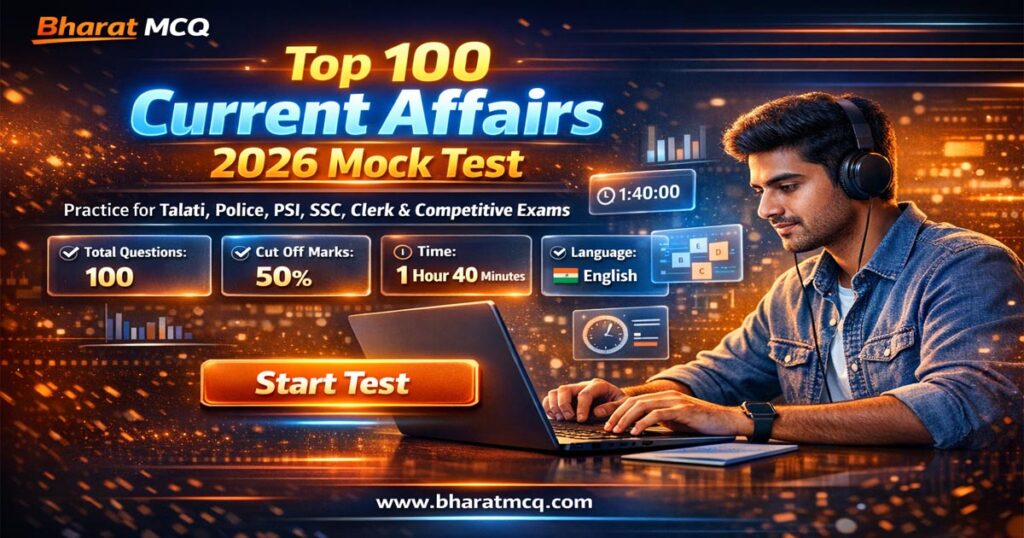
Practice the Top 100 Current Affairs 2026 mock test for Talati, Police, PSI, SSC, Clerk and state exams with updated, exam-focused MCQs.
Introduction
Current Affairs is one of the highest-scoring and fastest-changing sections in Indian competitive exams. Whether you are preparing for Talati, Police Bharti, PSI, Clerk, SSC, or other state-level and national-level recruitment exams, you cannot afford to treat current affairs as a last-minute topic. In real exams, this section is used to test not only your memory but also your awareness of government decisions, economy, international events, sports, science, awards, reports, and important observances.
The Top 100 Current Affairs 2026 Mock Test given above is designed in the style of a real competitive exam. It is not a random list of easy questions. The paper includes direct fact-based questions, number-based questions, institution-based questions, and statement-oriented questions. This makes it useful for aspirants who want proper exam-level practice instead of simple revision notes.
Importance of Current Affairs in Competitive Exams
Current Affairs plays a major role because it cuts across almost every exam pattern. In some exams, it appears as a separate General Knowledge or General Awareness section. In others, it is mixed with polity, economy, science, geography, and social issues. That is why students who prepare current affairs properly usually perform better across multiple subjects.
In 2026, the most important current affairs areas for exams include:
Government and Economy
Budget highlights, RBI policy decisions, census-related announcements, election updates, and major legislative reforms are highly relevant. Questions are often asked on figures, dates, official terms, and institutional decisions.
International Affairs
Summits, global reports, UN events, climate conferences, and global growth forecasts remain important because exams increasingly include international awareness.
Sports
Major tournaments, winners, venues, player awards, and performance records are among the most common exam questions. Sports is also one of the easiest areas to score in if revised properly.
Science and Technology
ISRO missions, space developments, defence production, strategic technology, and innovation-based announcements are regular features in competitive exams.
Awards, Reports and Observance Days
Award winners, themes of international days, and report highlights are frequently converted into one-line MCQs. These are easy marks only when revision is systematic.
Types of Questions Asked in Real Exams
Many students think current affairs means only headline memorization. Real exam papers are more demanding. The following question patterns are common:
1. Direct Factual Questions
These ask about winners, themes, venues, dates, and official names. Example patterns include:
- Who won a specific award?
- Where was an event held?
- What was the theme of a global observance?
2. Number-Based Questions
These are very common in budget, economy, reports, and sports. Students are asked about percentages, counts, allocations, or ranks. Such questions become difficult when revision is weak.
3. Statement-Based Questions
You may see questions asking which statement is correct or incorrect. These require proper understanding, not just memorization.
4. Match the Pair Type
Aspirants are tested on whether they can correctly link a report with an organisation, an event with a venue, or a day with its theme.
5. Application-Oriented MCQs
These combine current affairs with logic. For example, a question may ask you to identify the correct interpretation of a government announcement or a policy decision.
That is why solving a full-length mock test is better than reading only monthly PDFs.
Preparation Strategy for Current Affairs 2026
A good strategy is not to collect too many sources. Instead, use a limited number of reliable sources and revise them repeatedly.
Build Topic-Wise Notes
Do not make only date-wise notes. Divide your notes into categories such as:
- National affairs
- Economy and banking
- International events
- Sports
- Science and technology
- Environment
- Awards and appointments
- Important days and themes
This makes revision faster before the exam.
Focus on Official Keywords
In current affairs, one word can change the answer. Terms such as repo rate, fiscal deficit, theme, host city, report title, and award category must be revised exactly.
Revise Through MCQs
Reading current affairs once creates familiarity, but solving MCQs creates retention. When you attempt questions, your brain starts identifying gaps in names, dates, and figures.
Connect Current Affairs with Static GK
If you study Budget, revise fiscal terms. If you study RBI policy, revise monetary tools. If you study a UN event, revise the organisation and its role. This improves accuracy in mixed-question papers.
Use Weekly and Monthly Revision Cycles
A practical pattern is:
- Daily reading for 20 to 30 minutes
- Weekly short revision
- Monthly MCQ practice
- One full mock test before major exams
This method is far more effective than reading large current affairs compilations only before the exam.
Common Mistakes Students Make
Many aspirants lose marks in current affairs not because the section is hard, but because their method is weak.
Reading Without Revision
Students read news every day but do not revise. Current affairs is highly memory-dependent. Without repetition, most details are forgotten quickly.
Ignoring Numbers and Official Terms
Aspirants often remember the headline but forget the exact percentage, count, venue, or official title. This is where marks are lost.
Mixing Old and New Information
Some students revise older material without checking the latest update. In current affairs, the most recent verified development matters.
Avoiding Full-Length Practice
Solving 10 or 15 MCQs is not the same as attempting a 100-question mock. Full-length practice builds concentration, speed, and accuracy under exam conditions.
Depending Only on One-Liners
One-liners are useful for revision, but they are not enough for deeper or statement-based questions. A proper mock test exposes you to real exam framing.
Benefits of MCQ Practice
MCQ practice is one of the fastest ways to improve performance in current affairs.
Better Recall Speed
In competitive exams, you must identify the correct answer quickly. Repeated MCQ practice improves recall under pressure.
Stronger Elimination Skills
Even when you do not know the exact answer, good practice helps you eliminate wrong options. This increases overall score.
Easy Self-Assessment
A mock test tells you which areas are weak. You may find that you are strong in sports but weak in economy, or good in awards but weak in international organisations.
Improved Exam Temperament
A full-length paper develops timing sense and reduces panic during the actual exam.
Practice Test CTA
If you are preparing for Talati, Police Bharti, PSI, SSC, Clerk, or any state competitive exam, attempt the Top 100 Current Affairs 2026 Mock Test given above in one sitting. Do not check answers after every question. First complete the full paper, then review your mistakes category-wise.
After attempting the test:
- Note down wrong answers in a separate revision sheet.
- Mark repeated weak areas such as sports, economy, or international affairs.
- Reattempt the same test after a few days.
- Use your score trend to track improvement.
This is the most practical way to turn current affairs into a scoring section. A well-designed mock test does not just test memory; it builds exam readiness.