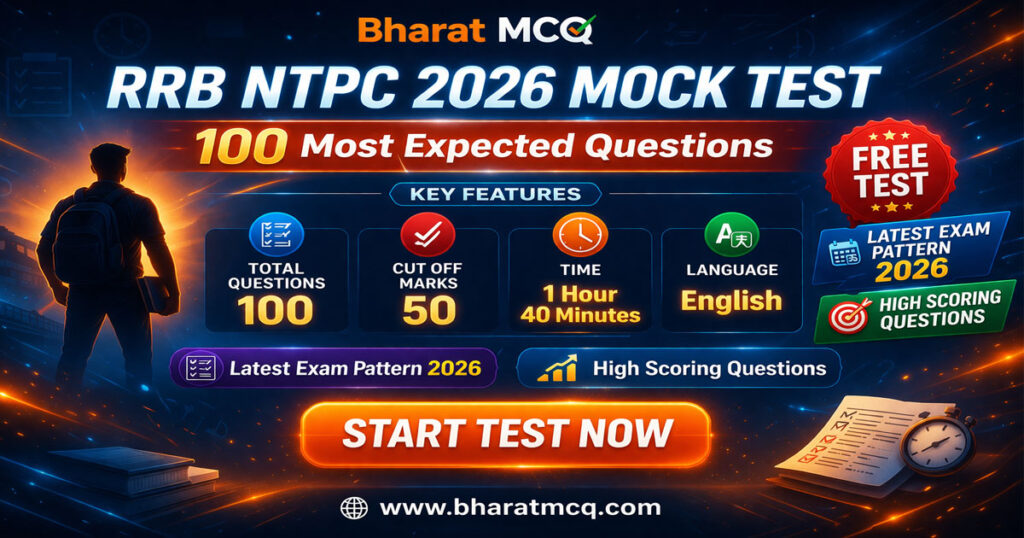
Prepare for RRB NTPC 2026 Mock Test with this full-length mock test. 100 high-yield MCQs covering GA, Maths, and Reasoning based on the latest 2026 exam pattern.
RRB NTPC 2026 Mock Test: Comprehensive Preparation Strategy and Practice Mock Test
The Railway Recruitment Board (RRB) Non-Technical Popular Categories (NTPC) exam remains one of the most prestigious and competitive recruitment drives in India. As we move through 2026, the level of competition has reached an all-time high, requiring aspirants to evolve their preparation methods beyond traditional rote learning. To succeed in the RRB NTPC 2026 exam, a candidate needs a blend of speed, accuracy, and deep conceptual clarity.
This article provides a deep dive into the exam’s core subjects, the shifting nature of questions, and a full-length mock test designed by experts to mirror the actual 2026 environment.
1. Understanding the RRB NTPC 2026 Landscape
The RRB NTPC exam usually consists of two stages of Computer Based Tests (CBT-1 and CBT-2), followed by a Typing Skill Test or Aptitude Test depending on the post. In 2026, the board has shifted towards more analytical and application-based questions. While static GK remains important, there is a marked increase in weightage for Science & Technology, Current Affairs of the last 18 months, and Logical Reasoning.
2. Importance of Core Subjects
General Awareness (GA)
This is the most significant section, carrying the highest weightage. In 2026, the GA section is no longer just about dates and names. It now encompasses:
- Current Affairs: Focus on 2025-26 Union Budget, International Summits (G20, BRICS), and India’s Space Missions.
- Science: Questions are increasingly focusing on Environmental Science and latest technological breakthroughs in AI and Green Energy.
- History & Geography: A shift toward socio-economic history and Indian river systems/resource distribution.
Mathematics (Quantitative Aptitude)
Maths is the “score booster.” The 2026 pattern emphasizes Arithmetic and Data Interpretation. Key topics include Time & Work, Profit & Loss, and Compound Interest. Advanced Math (Trigonometry/Geometry) questions are kept at a conceptual level but require quick calculation skills.
General Intelligence & Reasoning
Reasoning tests your mental agility. The current trend includes complex Puzzles, Syllogisms, and Statement-Assumption questions. These are designed to consume time; therefore, mastering shortcuts is essential.
3. Types of Questions Asked in Real Exams
In a real RRB NTPC paper, questions are categorized into three difficulty tiers:
- Factual (40%): Direct questions like “Who is the author of X?” or “What is the SI unit of Y?”
- Conceptual (35%): Requires understanding of the “Why” and “How,” especially in Physics and Economics.
- Application-based (25%): These are the tie-breakers. They involve multi-step math problems or logical deductions in reasoning.
4. Practical Preparation Strategy
- Master the Syllabus: Don’t just read; analyze the sub-topics. If you are studying ‘Polity,’ focus on the latest Constitutional Amendments made in 2024 and 2025.
- Time Management: During CBT, you have 90 minutes for 100-120 questions. You cannot afford to spend more than 40 seconds on a math problem.
- The 18-Month Rule: For Current Affairs, do not stop at 6 months. Review the major events of the past 18 months to stay ahead of the curve.
- Reverse Engineering: Solve previous year papers to understand the “language” of the examiner.
5. Common Mistakes Students Make
- Ignoring Negative Marking: RRB NTPC has a 1/3rd negative marking rule. Guesswork is the number one reason for failure among otherwise well-prepared candidates.
- Over-reliance on One Subject: Many students master Maths but ignore GA. Remember, GA is 40% of the paper and takes the least time to solve if you know the answers.
- Skipping Mock Tests: Reading books is passive learning. Solving a mock test is active learning.
6. Benefits of Regular MCQ Practice
Practicing MCQs in a timed environment simulates the pressure of the exam hall. It helps in:
- Improving Peripheral Vision: Identifying keywords in a question quickly.
- Elimination Technique: Learning how to rule out two out of four options increases your success probability to 50% even when unsure.
- Memory Retrieval: Testing yourself reinforces neural pathways better than just reading.
7. Take the Practice Test
To help you gauge your current preparation level, we have provided a full-length 100-question mock test in the section above. This test includes the most expected questions for 2026, covering everything from the latest appointments to complex reasoning patterns.