
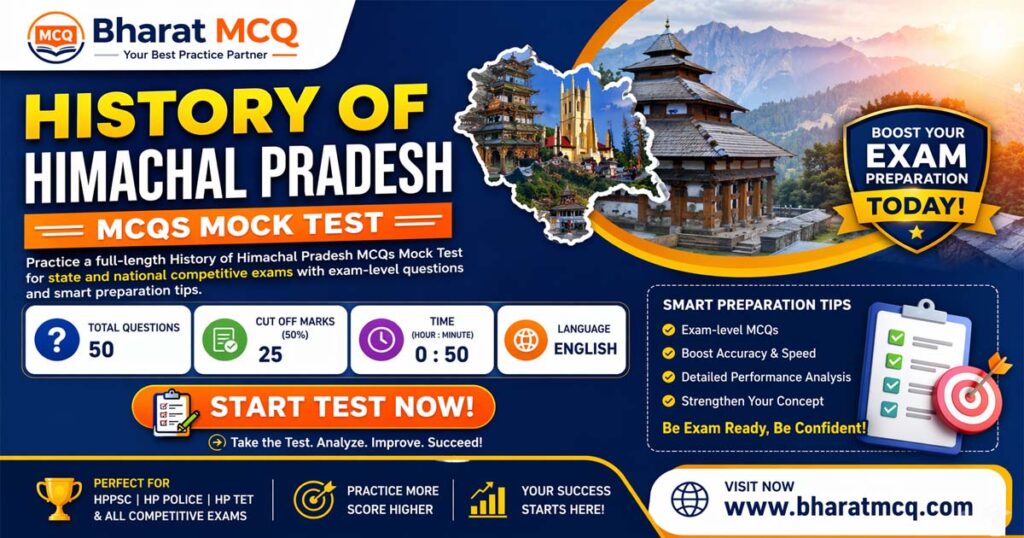
Practice a full-length History of Himachal Pradesh MCQs Mock Test for state and national competitive exams with exam-level questions and smart preparation tips.
Table of Contents
History of Himachal Pradesh MCQ Test for Competitive Exams
The history of Himachal Pradesh is a high-value topic for candidates preparing for state-level and national-level competitive exams. Whether you are appearing for Talati-type clerical exams, Police Bharti, Clerk, SSC, state services, or other recruitment tests, questions from Himachal Pradesh history can appear in direct GK, state GK, static awareness, and mixed current-static sections. This is why serious aspirants should not treat the subject as a small add-on. A strong command over the history of Himachal Pradesh improves accuracy, saves time in the exam, and creates an advantage in section-wise scoring.
The topic is not limited to remembering a few rulers or dates. Real exam papers now mix factual questions with chronology, matching, state formation, political movements, cultural history, and applied MCQ logic. A student who understands the flow of history performs much better than a student who only memorizes isolated facts. That is exactly why a structured History of Himachal Pradesh MCQ practice set is useful.
Importance of History of Himachal Pradesh in Competitive Exams
In many competitive exams, state history is used to test more than memory. Examiners want to check whether a candidate can connect ancient regional identities, princely states, colonial developments, and post-independence political integration. Himachal Pradesh offers a rich historical canvas for this style of questioning.
The ancient names of regions such as Trigarta and Kuluta are frequently asked. Medieval hill states such as Chamba, Mandi, Bushahr, Bilaspur, Sirmaur, Nurpur, and Kangra remain very important. Then comes a major transition zone: Gurkha expansion, British influence, hill-state politics, Praja Mandal activity, and the gradual formation of modern Himachal Pradesh. If you study these as one connected historical sequence, your recall becomes stronger and your elimination ability improves.
For state-level exams, the probability of direct questions is high. For all-India exams, the topic may appear in broader Indian history, art and culture, or regional polity-linked GK sections. That makes preparation highly practical.
Types of Questions Asked in Real Exams
Real competitive exam papers on Himachal Pradesh history usually contain four major patterns.
1. Direct factual questions
These are the easiest to identify. They ask about founders, capitals, dynasties, treaties, dates, fairs, monuments, and state reorganization milestones. Examples include questions on Sahil Varman, Ajbar Sen, Raja Jagat Singh, Kangra Fort, Bharmour, Bilaspur merger, and full statehood.
2. Chronology-based questions
These questions check whether you know the order of events. A common example is the sequence from the 1948 formation of Himachal Pradesh, the 1954 merger of Bilaspur, the 1956 Union Territory phase, the 1966 territorial expansion, and the 1971 grant of full statehood. Students who revise through timelines handle these questions comfortably.
3. Matching and pair-based questions
These are common in objective exams. You may be asked to match Kahlur with Bilaspur, Dhameri with Nurpur, Guler with painting tradition, or Shipki La with trans-Himalayan trade. Such questions are easy only when your revision is organized.
4. Conceptual and application-based questions
These are slightly harder and closer to real competitive exam design. For example, a question may ask what broader historical process is indicated by the Shobha Ram movement, Dhami firing, and Praja Mandal activity. Another may ask why modern Himachal Pradesh did not emerge in one step. These questions require understanding, not just recall.
Preparation Strategy for History of Himachal Pradesh
A practical approach works best. Do not study this subject like a long descriptive chapter. Study it like an exam unit.
Build one master timeline
Write a one-page timeline from ancient to modern. Start with Trigarta, Kuluta, and the Audumbaras. Then move to medieval hill states, Kangra rulers, Chamba, Mandi, Bushahr, and Sirmaur. After that, add colonial developments, Gurkha expansion, British intervention, Praja Mandal movement, and the final administrative evolution of Himachal Pradesh. This method reduces confusion.
Study by historical blocks
Divide your revision into five blocks: ancient, medieval hill states, colonial phase, political movements, and post-independence formation. This makes retention easier and helps during mock-test revision.
Link rulers with places and events
Do not memorize names separately. Link each ruler or state with one clear identifying point. Sahil Varman with Chamba, Ajbar Sen with Mandi, Jagat Singh with Kullu Dussehra, Sansar Chand with Kangra painting, and Y. S. Parmar with modern Himachal Pradesh. This is a highly effective memory strategy for MCQ exams.
Use map-based mental revision
Even though history is the focus, location memory matters. If you know where Chamba, Kangra, Kullu, Mandi, Bilaspur, Bushahr, and Lahaul-Spiti fit in the larger regional picture, matching and elimination become easier.
Practice MCQs repeatedly
After every study session, solve 20 to 30 MCQs. Then review mistakes immediately. This is the fastest way to identify weak areas such as chronology, state formation, or confusion between princely states.
Common Mistakes Students Make
The first mistake is preparing only from short notes and skipping structured revision. This creates weak retention. The second mistake is memorizing dates without understanding the sequence of events. The third mistake is ignoring political movements in hill states and focusing only on kings and capitals. The fourth mistake is mixing cultural facts with geography and answering too quickly without reading options carefully.
Another major error is not revising state formation properly. Many students remember 1971 but forget 1948, 1954, 1956, and 1966. In competitive exams, this gap leads to avoidable mistakes. A final mistake is practicing only easy MCQs. Real exam papers usually include a combination of direct, moderate, and application-based questions. Your preparation should reflect that pattern.
Benefits of MCQ Practice
Regular MCQ practice turns passive reading into active recall. It helps you remember dates, identify weak concepts, improve speed, and sharpen elimination skills. It also trains you to distinguish between similar-sounding options such as Kahlur and Bilaspur, Guler and Kangra, or Praja Mandal activity and other political movements.
A full-length History of Himachal Pradesh MCQ test is especially useful because it simulates actual exam pressure. When you solve a 50-question set in one sitting, you learn pacing, attention control, and question selection. This is far more effective than reading theory alone.
Practice Test
Use the full-length test given above as a serious practice session, not as a casual quiz. Attempt all 50 questions in one go, avoid checking answers in between, and mark the areas where you hesitated. After finishing, review your errors under three labels: factual mistake, confusion mistake, and conceptual mistake. That review process is where real improvement happens.
If you are preparing for Police, Clerk, SSC, state-level recruitment, or any exam where regional history matters, this practice test is a strong revision tool. Reattempt it after a few days and compare your score. Consistent repetition with proper review is the most reliable way to improve performance in Himachal Pradesh history questions.