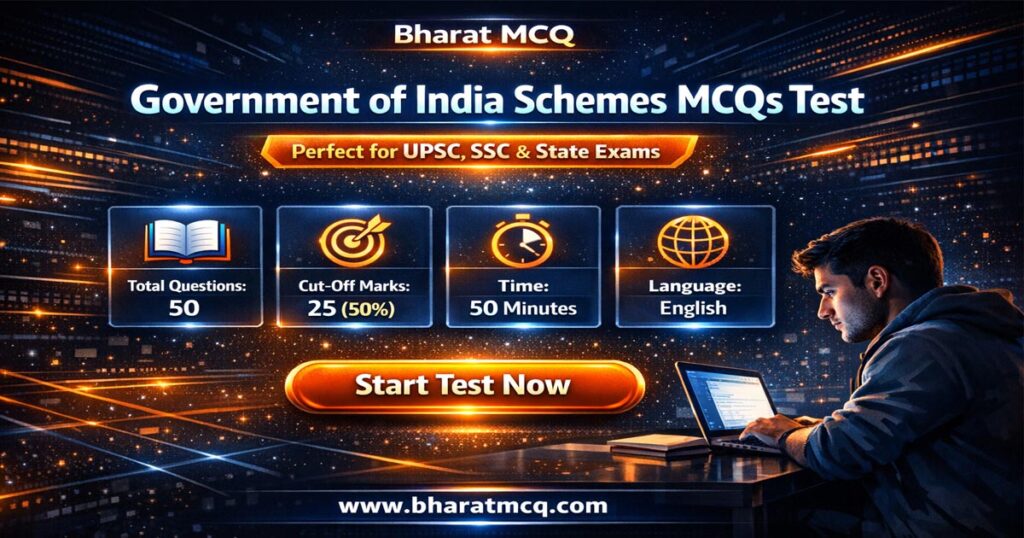
Master Government of India Schemes MCQs Test with this full-length practice test. Expert-curated MCQs on PM-Kisan, PM-JAY, and more for UPSC, SSC, and State Exams.
Master Government of India Schemes MCQs Test for Competitive Exams: A Comprehensive Guide
In the landscape of Indian competitive examinations, the “General Studies” and “Current Affairs” sections hold the key to success. Whether you are appearing for the UPSC Civil Services, SSC CGL, State PSCs, or Bank PO, there is one topic that consistently commands high weightage: Government of India Schemes (Sarkari Yojana).
With the government shifting focus towards “Viksit Bharat 2047,” new schemes like PM-Surya Ghar, Lakhpati Didi, and PM-Vishwakarma have become focal points for paper setters. This article explores why these schemes matter and how you can master them to secure your selection.
Importance of Government Schemes in Competitive Exams
Government schemes are not just facts; they represent the socio-economic policy direction of the country. For a competitive exam aspirant, these schemes serve two purposes:
- Direct Questions: Many exams (SSC, Talati, Clerk, Police Bharti) ask direct questions about the launch year, ministry, and financial outlays.
- Mains & Descriptive Writing: For UPSC and State-level Mains, schemes provide the data and examples needed to write impactful answers regarding social justice, agriculture, and infrastructure.
Types of Questions Asked in Real Exams
Based on the analysis of the last 15 years of exam papers, questions on schemes generally fall into three categories:
- Fact-Based: Target beneficiaries, age limits, and insurance premiums (e.g., PMJJBY premium or APY age criteria).
- Ministry-Specific: Identifying which ministry implements a particular mission (e.g., Jal Jeevan Mission falls under the Ministry of Jal Shakti).
- Conceptual/Application-Based: Statement-based questions commonly seen in UPSC/PSI exams where you must identify the correct objectives or pillars of a scheme (e.g., PM Gati Shakti pillars).
Preparation Strategy: How to Remember 100+ Schemes
The sheer number of schemes can be overwhelming. Follow this professional strategy to streamline your learning:
- Categorize by Sector: Instead of chronological learning, group schemes by sector—Agriculture (PM-Kisan, PM-FBY), Health (Ayushman Bharat, Mission Indradhanush), and Social Security (PM-SYM, Atal Pension Yojana).
- Focus on the ‘Five Ws’: For every scheme, note down Who (Beneficiaries), What (Benefits), When (Launch Year), Where (Ministry/Nodal Agency), and Why (Objective).
- Track the Budget Updates: Every year, the Union Budget revises targets. For instance, the increase in the ‘Lakhpati Didi’ target from 2 crore to 3 crore is a high-probability question for 2025-26 exams.
- Keyword Mapping: Connect schemes with specific keywords. Example: “Svamitva” = “Drones” + “Rural Land Mapping.”
Common Mistakes Students Make
- Studying Outdated Data: Many students use old PDFs. Schemes like PM-Awas or SBM often enter their 2.0 or 3.0 phases with different guidelines.
- Confusing Similar Names: PM-KUSUM (Solar pumps) is often confused with PM-Kisan (Income support). Careful reading of the full name is vital.
- Ignoring Nodal Ministries: Students often assume the ministry based on the name, which can be tricky. For example, PM-SVANidhi is under the Ministry of Housing and Urban Affairs, not Finance.
Benefits of MCQ Practice
Reading about a scheme is only half the battle. Testing your knowledge through full-length online tests helps in:
- Improving Retention: Active recall through MCQs strengthens memory more than passive reading.
- Time Management: Online tests simulate the real exam environment, teaching you to eliminate wrong options quickly.
- Identifying Weak Areas: If you consistently get health-sector schemes wrong, you know exactly where to focus your revision.
Conclusion
Government schemes are the bridge between the government’s vision and the citizen’s reality. As a future civil servant or government employee, understanding these initiatives is fundamental. Use the comprehensive practice test provided below to evaluate your current preparation level and bridge the gaps.
Ready to test your knowledge? Scroll up and take our 50-question full-length mock test on Government of India Schemes 2026. Bookmark this page for regular updates on new policy launches!