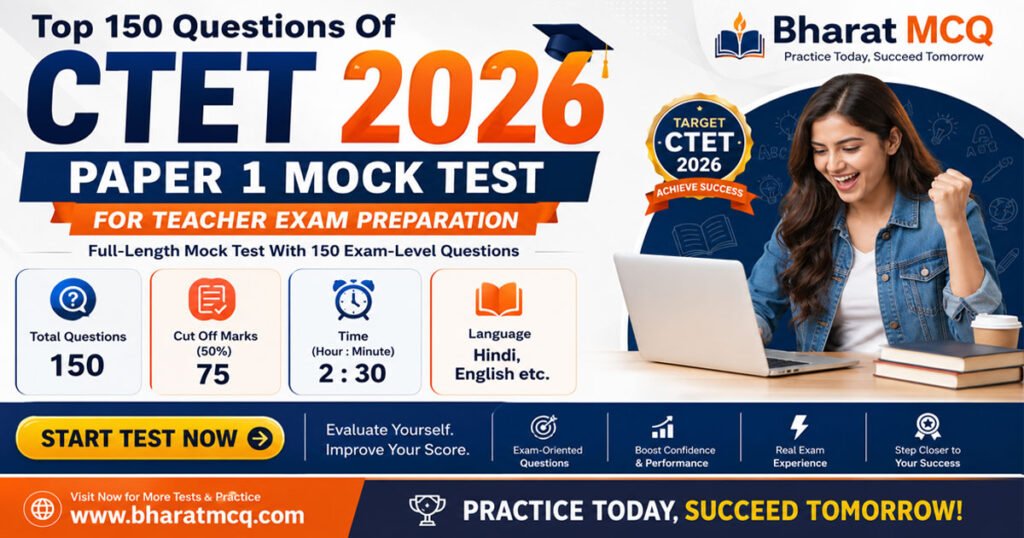
Attempt this full-length CTET 2026 Paper 1 mock test with 150 exam-level questions covering CDP, Mathematics, EVS, Language I and Language II.
Table of Contents
CTET 2026 Paper 1 Full-Length Mock Test
The CTET 2026 Paper 1 examination tests whether a candidate can understand children, select suitable teaching methods, interpret classroom evidence and apply subject knowledge in primary-stage situations. It is not merely a memory test. Strong performance requires clear concepts, careful reading and the ability to choose the most educationally appropriate option when several choices appear partly correct.
This mock test follows the official Paper 1 structure: Child Development and Pedagogy, Mathematics, Environmental Studies, Language I and Language II, with 30 questions in each section. The official CTET September 2026 bulletin specifies 150 multiple-choice questions for 150 marks, a duration of two-and-a-half hours and no negative marking. It also states that Paper 1 content is based on NCERT topics for Classes I to V, although the difficulty level and linkages may extend to the secondary stage.
Importance of the Five CTET Paper 1 Sections
Child Development and Pedagogy evaluates how well candidates understand development, learning, inclusion, assessment and classroom interaction. A high score depends on applying theories rather than recalling theorists’ names. Questions commonly present a classroom incident and ask which response is child-centred, inclusive, diagnostic or constructivist.
Mathematics combines primary-level content with pedagogy. Candidates must solve accurately, but they must also recognise misconceptions, evaluate strategies and select teaching activities that build conceptual understanding. The official syllabus gives equal weight to mathematical content and pedagogical issues, so preparation limited to calculations is incomplete.
Environmental Studies connects natural, social and cultural surroundings. Content questions cover family, food, shelter, water, travel, plants, animals and work. Pedagogy questions examine observation, field visits, discussion, local knowledge, experiments, assessment and integrated learning. The best answer usually connects a concept with evidence, experience and children’s immediate environment.
Language I focuses on proficiency related to the medium of instruction, while Language II focuses on language, communication and comprehension abilities. Both require comprehension as well as language pedagogy. Candidates should be able to infer meaning, identify grammatical relationships and judge methods for developing listening, speaking, reading and writing. The official syllabus allocates 15 questions to comprehension and 15 to pedagogy in each language section.
Types of Questions Asked in CTET
A realistic CTET paper contains several question forms. Classroom-situation questions ask what a teacher should do after observing an error, participation problem or learning difficulty. Theory-application questions connect a situation with Piaget, Vygotsky, Kohlberg, constructivism, motivation or assessment. Subject questions test mathematical reasoning and EVS concepts through practical contexts rather than isolated definitions.
Pedagogy questions often require candidates to distinguish between superficially attractive options. For example, extra practice is not automatically remedial teaching. Effective remediation begins with diagnosis. Similarly, group work is not necessarily cooperative learning unless the task includes shared responsibility and individual accountability.
Language questions include literal comprehension, inference, vocabulary in context, grammar and discourse relationships. Pedagogy items test whether language is treated as a tool for communication instead of a list of rules. Multilingualism, supportive feedback, meaningful exposure, reading strategies and integrated skill development are recurring areas.
Practical Preparation Strategy
Begin with the official syllabus and divide every section into content and pedagogy. Prepare a topic tracker instead of studying from an unstructured question bank. For Child Development and Pedagogy, create comparison charts for major ideas: maturation and learning, assessment for and of learning, fixed and growth orientations, integration and inclusion, and teacher-centred versus child-centred practice.
For Mathematics, practise one concept in three ways: solve it, explain it and teach it. After finding an answer, ask what misconception a wrong option represents. Use diagrams, number lines, paper folding, place-value materials and real-life data while revising because CTET frequently tests the transition from concrete experience to symbolic understanding.
For EVS, connect textbook themes with everyday observation. Study water use, food sources, occupations, transport, shelter, plants and animals through cause-and-effect relationships. Also revise how field visits, surveys, experiments, maps, portfolios and discussions should be planned and assessed.
For both language sections, read short passages daily and answer literal, inferential and vocabulary questions. Review grammar through actual sentences rather than isolated labels. Practise deciding which classroom activity develops a particular skill. Listening requires purposeful listening tasks; speaking requires interaction; reading requires meaning-making; and writing requires planning, drafting, feedback and revision.
Attempt this mock in one sitting of 150 minutes. Mark uncertain questions but do not spend excessive time on one item. Since the official scheme has no negative marking, every question should be attempted after eliminating clearly unsuitable options.
Common Mistakes Candidates Make
A frequent mistake is choosing a strict or uniform option because it appears disciplined. CTET generally rewards responses that maintain high expectations while recognising learner diversity. Another error is confusing activity with learning. An activity is educational only when it has a clear purpose, produces evidence of thinking and is followed by reflection.
Candidates also overuse memorised keywords. Not every group activity is constructivist, and not every test is assessment for learning. Read the complete situation and identify the function of the teacher’s action. In Mathematics and EVS, careless unit conversion and failure to identify the exact relationship asked can cause avoidable errors. In language sections, candidates often select an option based on one familiar word instead of the meaning of the whole sentence.
Benefits of Full-Length MCQ Practice
A full-length mock develops pacing, concentration and decision-making under realistic conditions. It reveals whether weakness lies in content, pedagogy, reading speed or option analysis. After completing the test, classify every incorrect response as a concept gap, calculation error, misreading, confusion between two pedagogical principles or unsupported guessing.
Do not merely record the correct option. Write one sentence explaining why it is correct and why the strongest distractor is wrong. This turns MCQ practice into conceptual revision and reduces repeated mistakes. Reattempt only the incorrectly answered and doubtful items after a gap, then take a fresh full-length paper to measure improvement.
20 Sample Questions with Detailed Explanations
1. A teacher observes that a child can solve a puzzle only when given hints, but later solves a similar puzzle independently. This progression is best explained by:
Correct Answer: A — Zone of proximal development
Explanation: Vygotsky’s zone of proximal development refers to the gap between what a learner can complete independently and what the learner can achieve with guidance. Hints, prompts or collaboration provide temporary support. Once the child internalises the strategy, the support is no longer necessary, and the child can perform a similar task independently.
2. A child says that a taller, thinner glass contains more water than a shorter, wider glass, although both hold the same quantity. The child has not yet acquired:
Correct Answer: C — Conservation
Explanation: Conservation is the understanding that quantity remains unchanged even when its appearance or arrangement changes. The child focuses on the height of the water and ignores the width of the container. This response is commonly associated with the preoperational stage in Piaget’s theory.
3. Which assessment practice is an example of assessment for learning?
Correct Answer: A — Using exit slips to modify the next lesson
Explanation: Assessment for learning is formative. The teacher collects evidence during the learning process and uses it to decide what should be taught next. Exit slips reveal learners’ understanding, confusion and misconceptions. Final grades and board examinations mainly summarise achievement rather than guide immediate instruction.
4. Inclusive education means that:
Correct Answer: D — All learners participate together with appropriate support and reasonable accommodation
Explanation: Inclusion is not simply placing every learner in the same room. It requires meaningful participation, accessible teaching, suitable support and reasonable accommodation. Learners may need different materials, assistive devices, extra time or alternative ways of responding while working toward meaningful educational goals.
5. A child with dyslexia is most likely to need support in:
Correct Answer: D — Decoding and fluent word recognition
Explanation: Dyslexia commonly affects accurate or fluent word recognition, decoding and spelling. It is not caused by low intelligence, poor hearing or weak gross motor ability. Effective support may include explicit phonological instruction, structured decoding practice, multisensory teaching and accessible reading material.
6. From a constructivist perspective, children’s errors are important because they:
Correct Answer: D — Reveal current thinking and guide further instruction
Explanation: Constructivist teaching treats errors as evidence of how learners are currently organising knowledge. An error may reveal a partially formed rule or misconception. Teachers can analyse that reasoning, design a suitable task and help the learner reconstruct understanding instead of merely marking the response wrong.
7. Which feedback is most effective for learning?
Correct Answer: B — Your explanation identifies the pattern; now check whether it works for the final case
Explanation: Effective feedback is specific, linked to the task and provides a clear next step. This response acknowledges what the learner has done successfully and directs attention to an aspect requiring verification. General comments such as “Good” or personal praise do not explain how the work can be improved.
8. A school has 84 red beads and 126 blue beads. They are to be packed into identical packets with no bead left over and the greatest possible number of packets. How many packets can be made?
Correct Answer: B — 42
Explanation: The greatest possible number of identical packets is the highest common factor of 84 and 126. The prime factorisations are 84 = 2² × 3 × 7 and 126 = 2 × 3² × 7. Their HCF is 2 × 3 × 7 = 42.
9. The angle between the hands of a clock at 3:30 is:
Correct Answer: D — 75°
Explanation: At 3:30, the minute hand is at 180°. The hour hand has moved halfway between 3 and 4. Its position is 3 × 30° + 30 × 0.5° = 105°. Therefore, the smaller angle is 180° − 105° = 75°.
10. A tank is 3/5 full. After 24 litres are added, it becomes 9/10 full. What is the tank’s capacity?
Correct Answer: B — 80 litres
Explanation: The increase in the filled portion is 9/10 − 3/5. Converting 3/5 to tenths gives 6/10, so the increase is 3/10. If 3/10 of the tank equals 24 litres, the complete capacity is 24 × 10/3 = 80 litres.
11. A child writes 402 as 42. This error most directly indicates difficulty with:
Correct Answer: B — Place value and the role of zero
Explanation: The zero in 402 is a placeholder showing that there are no tens. Writing 42 suggests that the learner has not understood how the position of each digit determines its value. Place-value blocks, expanded notation and comparison of numbers such as 402, 420 and 42 can address this misconception.
12. A child says that 1/8 is greater than 1/6 because 8 is greater than 6. The best instructional response is to:
Correct Answer: D — Use equal wholes to compare the sizes of the parts
Explanation: The learner is applying whole-number reasoning incorrectly to fractions. When the whole is divided into more equal parts, each part becomes smaller. Using two equal paper strips or circles divided into sixths and eighths allows the learner to observe directly that 1/6 is larger than 1/8.
13. Which adaptation most directly helps a camel conserve water in a desert?
Correct Answer: A — Producing highly concentrated urine
Explanation: Concentrated urine allows the camel to remove waste while losing comparatively little water. Camels also have several other desert adaptations, but webbed feet and gills are unrelated. A “thin layer of fur only” does not accurately explain their water-conservation mechanism.
14. A food chain is: grass → grasshopper → frog → snake. If the grasshopper population declines sharply, the most immediate likely effect is:
Correct Answer: C — Frogs may have less food
Explanation: In this food chain, frogs depend directly on grasshoppers as a food source. A sharp reduction in grasshoppers therefore reduces food availability for frogs. Other effects may occur later in the ecosystem, but reduced food for frogs is the most immediate relationship shown by the chain.
15. The central purpose of teaching EVS at the primary stage is to:
Correct Answer: B — Help children understand their natural and social environment through integrated experiences
Explanation: EVS brings together ideas from science, social science, health, culture and everyday life. It should help children observe, question and interpret their surroundings. Teaching isolated scientific facts or replacing local knowledge with textbook definitions would undermine the integrated and experience-based nature of EVS.
16. The most appropriate way to address a child’s belief that all insects are harmful is to:
Correct Answer: B — Explore examples of pollinators, decomposers and pests through evidence
Explanation: The child’s statement is an overgeneralisation. The teacher should help the learner examine different roles played by insects. Some damage crops, while others pollinate plants, decompose organic matter or form part of food chains. Evidence-based comparison supports conceptual change better than ridicule or memorisation.
17. Read: “The old library was quiet, yet it did not feel empty; every shelf seemed to hold a conversation waiting to begin.” The description suggests that books:
Correct Answer: A — Create a sense of intellectual companionship
Explanation: The “conversation” is figurative. It suggests that books contain voices, experiences and ideas with which readers can engage. The library is physically quiet but intellectually alive. The passage does not imply noise, poor arrangement or that the books should remain unopened.
18. Which word contains a prefix meaning “again”?
Correct Answer: B — Rewrite
Explanation: The prefix “re-” commonly means “again” or “back.” Therefore, “rewrite” means to write again or produce a revised version. In “preview,” the prefix “pre-” means before; “sub-” means under; and “trans-” generally means across or through.
19. In a multilingual classroom, the teacher should:
Correct Answer: C — Use learners’ languages as resources while building proficiency in the target language
Explanation: Learners’ home languages carry knowledge, identity and prior understanding. Strategic comparison, translation, discussion and multilingual resources can help learners access new ideas while developing the target language. Completely prohibiting home languages may restrict participation and disconnect school learning from children’s existing linguistic knowledge.
20. The “silent period” in second-language acquisition refers to a phase when some learners:
Correct Answer: B — Are building comprehension before producing much speech
Explanation: Some second-language learners initially listen, observe and develop receptive understanding before speaking extensively. This does not indicate hearing loss or absence of learning. Teachers should provide meaningful input, gestures, visual support, low-pressure interaction and adequate wait time rather than forcing immediate public speech.
Practice Test
Complete all 150 questions before checking the answer indices. Use the result to prepare a section-wise error log, revise weak concepts and repeat the test under timed conditions after targeted study.