
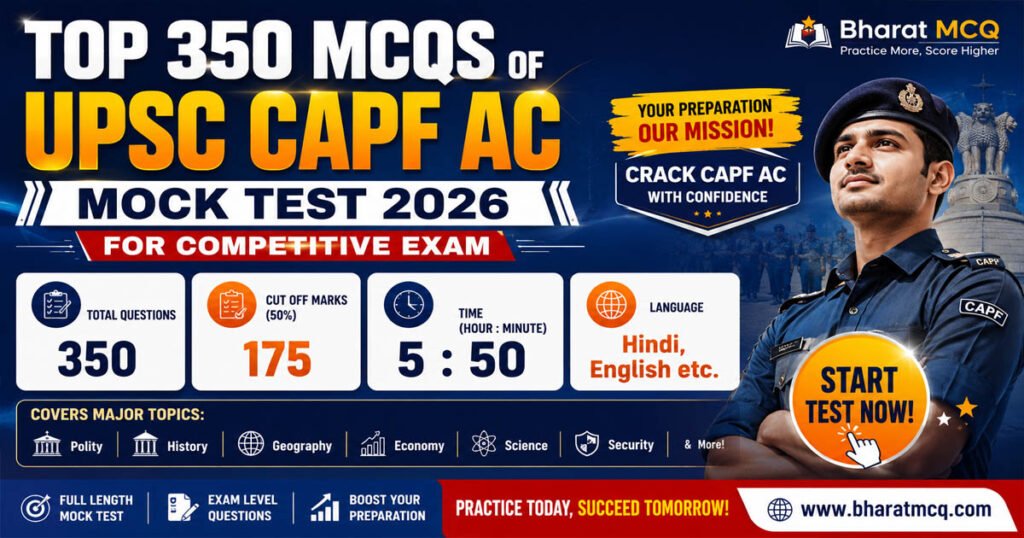
Practice a full-length UPSC CAPF AC mock test with 350 exam-level MCQs covering polity, history, geography, economy, science and security.
Table of Contents
UPSC CAPF AC Mock Test: Complete Practice for Assistant Commandant Exam
The UPSC CAPF Assistant Commandant examination is one of the most serious competitive exams for candidates who want to join the Central Armed Police Forces as officers. The exam demands more than ordinary factual knowledge. It checks awareness, reasoning ability, decision-making, analytical thinking and understanding of national issues. A full-length mock test is useful because it gives candidates a real exam-like experience before they appear in the actual paper.
This UPSC CAPF AC mock test is designed for aspirants who want structured practice in English. The questions cover important areas such as Indian Polity, History, Geography, Economy, General Science, Environment, International Relations, Security Issues, Reasoning and English comprehension. These areas are regularly important in CAPF AC Paper I and also support preparation for Paper II.
Importance of These Subjects in Competitive Exams
For UPSC CAPF AC, General Ability and Intelligence is not limited to simple General Knowledge. Indian Polity helps candidates understand the Constitution, Parliament, Fundamental Rights, emergency provisions, local governance and constitutional bodies. These topics are important because CAPF officers work within a democratic and legal framework.
History is equally important because the freedom movement, social reform movements and ancient and medieval developments are often used to test conceptual understanding. Questions are not always direct. They may ask about causes, consequences, reforms, personalities or institutional changes.
Geography is important for understanding India’s physical features, climate, agriculture, resources, disaster-prone areas and strategic location. For an Assistant Commandant, knowledge of borders, terrain, rivers, passes, climate and natural resources has practical relevance.
Economy questions test basic concepts such as inflation, fiscal deficit, monetary policy, GDP, banking, taxation, poverty, unemployment and inclusive growth. These concepts are important because internal security and economic development are closely linked.
General Science and Environment are also significant. Science questions usually test everyday application, while environment questions focus on biodiversity, pollution, climate change, conservation laws and ecological balance. These topics are common in UPSC-style objective papers.
Security and international relations are especially relevant for CAPF aspirants. Questions related to border management, internal security, disaster response, counter-insurgency, cyber security and regional organizations help candidates connect static knowledge with real administrative responsibilities.
Types of Questions Asked in Real Exams
In real competitive exams, questions are generally of three types. The first type is factual, where candidates must remember exact information such as Articles, years, institutions, locations and definitions. Examples include questions on Article 21, the establishment of the RBI or the Battle of Plassey.
The second type is conceptual. These questions require understanding rather than memorization. For example, a question may ask about judicial review, fiscal deficit, ecological succession or demographic dividend. Such questions test whether the candidate understands the idea behind the term.
The third type is application-based. These are very important for CAPF AC. A question may describe a security situation, crisis communication problem, resource allocation issue or crowd-control scenario. The candidate must choose the most appropriate response based on legality, proportionality, discipline and administrative wisdom.
Reasoning questions test series, coding-decoding, direction sense, blood relations, syllogism, arithmetic logic and decision-making. English questions test grammar, vocabulary, sentence correction, passive voice, direct-indirect speech, idioms and comprehension-based inference.
Preparation Strategy for UPSC CAPF AC
A practical preparation plan should begin with the syllabus and previous year papers. Candidates should not study randomly. Divide preparation into fixed areas: Polity, History, Geography, Economy, Science, Environment, Security and Current Affairs. After completing each topic, solve MCQs immediately.
For Polity, focus on the Constitution, Fundamental Rights, Directive Principles, Parliament, President, Prime Minister, Supreme Court, emergency provisions, constitutional bodies and local governance. Use short notes for Articles and amendments.
For History, give priority to the freedom movement from 1857 to 1947. Ancient and medieval history should be prepared through important sources, dynasties, administrative systems, religion, art and architecture.
For Geography, prepare maps along with theory. Rivers, passes, mountains, climate, soils, agriculture, minerals, industries and neighboring countries should be revised repeatedly. Map-based thinking helps in both objective and descriptive papers.
For Economy, understand basic terms clearly. Do not memorize without meaning. Concepts like inflation, GDP, fiscal deficit, repo rate, current account deficit and unemployment should be revised through examples.
For Science, focus on daily-life application, human body, diseases, physics principles, chemistry basics, energy and space science. Environment should be prepared through ecology, biodiversity, pollution, conservation projects and major conventions.
For security topics, prepare internal security challenges, border management, role of CAPFs, disaster management, cyber threats and human rights in security operations. These topics also help in essay and report writing.
Common Mistakes Students Make
One common mistake is treating the CAPF exam like a simple GK test. The exam requires understanding, not only memory. Many students remember facts but fail in application-based questions.
Another mistake is ignoring English and reasoning. These sections can improve the overall score if practiced consistently. A candidate who studies only General Studies may lose easy marks in grammar, vocabulary, arithmetic and logic.
Some aspirants avoid mock tests until the end of preparation. This is not advisable. Mock tests should be used throughout preparation because they reveal weak areas early.
Many candidates also fail to revise. Competitive exam preparation requires repeated revision. Without revision, even well-studied topics become weak during the exam.
Another serious mistake is not analyzing wrong answers. Solving questions is useful only when the candidate checks why an answer was wrong. Analysis improves accuracy and reduces repeated mistakes.
Benefits of MCQ Practice
MCQ practice improves speed, accuracy and decision-making. In a full-length test, candidates learn how to manage time across different subjects. They also understand which topics are strong and which require more revision.
Regular practice helps candidates identify patterns. For example, polity questions often revolve around Articles, bodies and constitutional principles. Economy questions often test definitions and application. Environment questions usually focus on concepts and conservation.
MCQs also improve elimination skills. In UPSC-style questions, two options may appear close. A trained candidate can remove wrong options by checking keywords, extreme statements and conceptual errors.
Full-length mock tests are especially useful because they create exam pressure. Candidates learn to maintain concentration for a long duration. This is important because mental stamina is a major factor in competitive exams.
Practice Test
Candidates preparing for UPSC CAPF AC should attempt this 200-question mock test in a timed manner. Treat it like the actual exam. Avoid checking answers while solving. After completing the test, calculate your score and mark weak sections separately.
Revise every wrong question. Make a short note of the concept involved. Repeat the same process with more mock tests and previous year questions. With disciplined practice, candidates can improve both confidence and performance in the UPSC CAPF Assistant Commandant examination.