
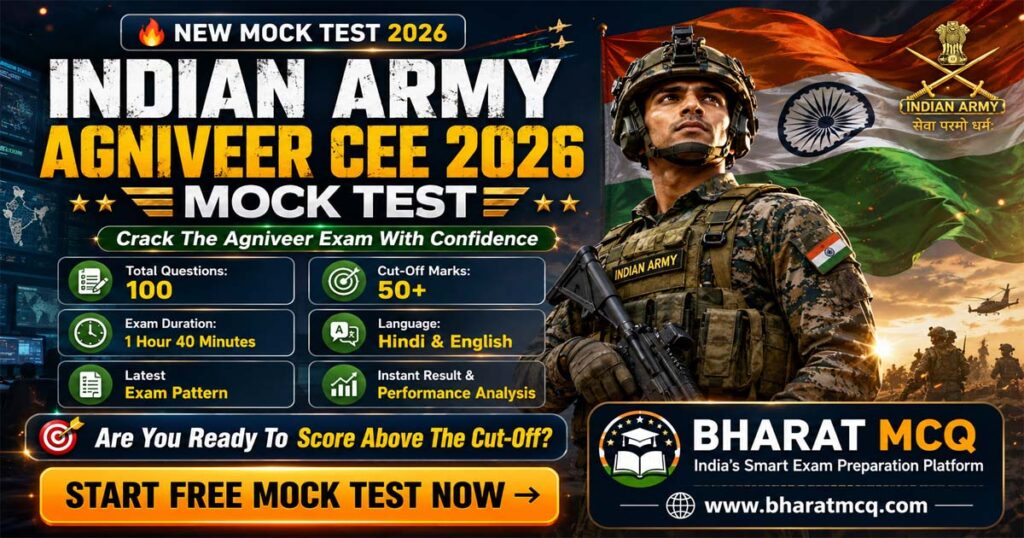
Practice a full Indian Army Agniveer CEE mock test with 100 MCQs covering GK, science, maths, reasoning and English for exam preparation.
Table of Contents
Indian Army Agniveer CEE Mock Test: Complete Preparation Guide
The Indian Army Agniveer Common Entrance Examination, commonly called Agniveer CEE, is one of the most important first-stage tests for candidates who want to join the Indian Army under the Agnipath recruitment process. The official Join Indian Army resources describe Agniveers as candidates inducted under the Agnipath scheme, and recruitment notifications refer to the online Common Entrance Examination as a major part of the selection process.
A good Agniveer CEE mock test should not feel like a random set of questions. It must reflect the actual exam requirement: speed, accuracy, factual clarity, basic conceptual understanding and disciplined time management. This 100-question practice paper is designed for aspirants who want to revise General Knowledge, General Science, Mathematics, Logical Reasoning and English in one sitting.
Importance of These Subjects in Competitive Exams
The Agniveer CEE checks whether a candidate has the mental sharpness, academic foundation and decision-making ability required for defence recruitment. General Knowledge helps test awareness of Indian history, polity, geography, defence structure and national institutions. These questions are often direct, but wrong preparation can lead to confusion between similar facts.
General Science is equally important because it tests practical understanding of physics, chemistry and biology. Questions may involve electricity, human body systems, lenses, acids and bases, vitamins, sound, force, motion and environmental science. In a defence-oriented exam, science questions are usually application-based rather than purely theoretical.
Mathematics plays a scoring role. Arithmetic topics such as percentage, profit and loss, simple interest, compound interest, time and work, ratio, average and mensuration are commonly useful in competitive exams. Candidates who practise calculations regularly can save valuable time.
Logical Reasoning tests the ability to identify patterns, relationships and conclusions. Series, coding-decoding, direction sense, blood relation, syllogism and ranking questions help assess mental alertness. English tests grammar, vocabulary, sentence correction, voice, narration and comprehension-related skills.
Types of Questions Asked in Real Exams
In real competitive exams, questions are generally compact and time-bound. The examiner does not usually ask very long theoretical questions. Instead, the question is framed to check whether the candidate can identify the correct concept quickly.
In General Knowledge, questions may ask about constitutional articles, national movements, military operations, awards, rivers, soil, crops and important historical events. In General Science, candidates may see questions on Ohm’s law, vitamins, blood groups, lens usage, chemical reactions, pH values, human organs and energy.
Mathematics questions are usually calculation-based. A question may look easy but may consume time if the candidate does not know the shortcut. For example, questions on average, ratio and percentage can be solved quickly with basic formulas. Time and work, pipes and cisterns, trains and mensuration need regular practice.
Reasoning questions are designed to test accuracy under pressure. A small mistake in direction, position or coding pattern can lead to a wrong answer. English questions focus on standard grammar usage, correct prepositions, subject-verb agreement, active-passive voice, direct-indirect speech and vocabulary.
Preparation Strategy for Agniveer CEE
Build a Subject-Wise Study Plan
Do not prepare all subjects randomly. Divide your study time into five blocks: GK, Science, Maths, Reasoning and English. Give more time to weak areas but revise strong areas regularly. A balanced paper rewards candidates who can perform across subjects, not only in one topic.
Practise with a Timer
The Agniveer CEE is not only about knowing the answer. It is also about answering within limited time. While practising MCQs, use a timer and try to reduce average solving time. For mathematics and reasoning, first solve with full steps, then learn faster methods.
Revise Static GK Regularly
Avoid depending only on current affairs. Static GK forms the backbone of many defence and state-level exams. Prepare Indian Constitution basics, freedom movement events, important wars, geography of India, national symbols, awards and defence-related facts.
Strengthen Science Concepts
Science should not be memorised blindly. Understand why a fuse wire melts, why a convex lens corrects hypermetropia, how blood groups work and why bile helps digestion. Conceptual understanding helps when the question is framed differently.
Maintain an Error Notebook
After every mock test, write down the questions you got wrong. Divide mistakes into four types: factual error, calculation error, concept error and time-pressure error. This method helps you improve faster than simply attempting more tests without analysis.
Common Mistakes Students Make
One major mistake is attempting mock tests without reviewing them. A mock test is useful only when the candidate studies the wrong answers carefully. Another mistake is spending too much time on one mathematics or reasoning question. In competitive exams, time management is part of scoring.
Many students ignore English because they think it is easy. However, grammar questions can be tricky. Prepositions, subject-verb agreement and sentence correction require regular practice. Similarly, some candidates study only GK and neglect science or maths, which reduces overall score potential.
Another common mistake is learning facts from unreliable sources. For Agniveer preparation, candidates should follow the official recruitment website for notifications and use standard books or verified study material for subject preparation. The official Join Indian Army portal remains the key source for recruitment-related updates.
Benefits of MCQ Practice
MCQ practice improves speed, accuracy and exam temperament. It helps candidates understand how options are designed. In many questions, two options may look close, but only one is fully correct. Regular MCQ practice trains the mind to eliminate wrong options quickly.
Mock tests also improve confidence because they create exam-like pressure. When candidates attempt 100 questions in one sitting, they learn how to maintain concentration. This is important for defence exams where physical preparation and written preparation both matter.
Another benefit is revision. A well-designed MCQ paper covers many topics in less time. Instead of reading long chapters again and again, candidates can revise formulas, facts and concepts through targeted questions.
Internal CTA: Practice Test
Use the 100-question Indian Army Agniveer CEE mock test above as a complete practice session. Attempt it without checking answers first. After finishing, calculate your score, mark weak subjects and revise those topics before taking the next test. Regular practice with quality MCQs is one of the most practical ways to improve your Agniveer CEE preparation.