
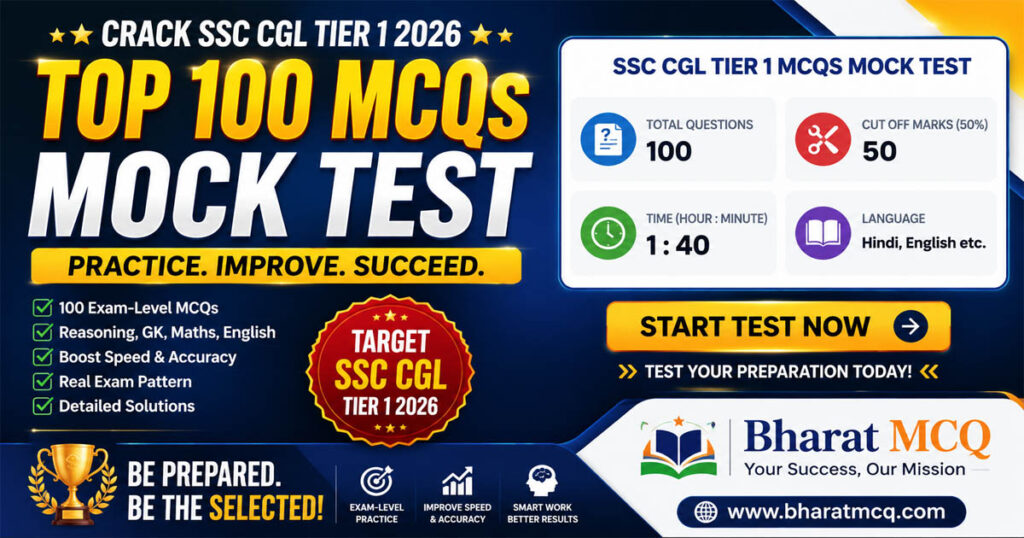
Practice SSC CGL Tier 1 Mock Test 2026 with 100 exam-level MCQs covering reasoning, GK, maths, and English to improve speed and accuracy online.
Table of Contents
SSC CGL Tier 1 Mock Test: Complete Practice Guide for Aspirants
Introduction
SSC CGL Tier 1 is one of the most competitive screening stages for graduate-level government jobs in India. A serious aspirant cannot treat it as a casual objective test because the paper checks speed, accuracy, subject balance, and exam temperament at the same time. The Tier-I structure generally covers General Intelligence and Reasoning, General Awareness, Quantitative Aptitude, and English Comprehension with 25 questions from each section, so preparation must be equally balanced rather than dependent on only one strong subject.
A full-length mock test is useful because it creates the pressure of a real exam. When you attempt 100 questions in one sitting, you understand how much time you spend on calculations, how often you make silly mistakes, and which subjects need revision. This mock test is designed for candidates who want exam-level practice instead of school-level questions.
Importance of These Subjects in SSC CGL Tier 1
General Intelligence and Reasoning
Reasoning is a scoring section when concepts are clear. It includes series, analogy, coding-decoding, blood relation, direction sense, syllogism, order and ranking, arrangement, and logical conclusions. These questions test how quickly you can identify patterns and eliminate wrong options. In the actual exam environment, reasoning should not consume too much time because most questions can be solved through structured observation.
General Awareness
General Awareness is important because it saves time. A factual question can be answered within seconds if you know the concept. This section usually includes Indian Polity, History, Geography, Economy, Science, Culture, important institutions, and static GK. Candidates often ignore this subject because the syllabus looks wide, but regular revision of high-yield topics can improve the score significantly.
Quantitative Aptitude
Quantitative Aptitude checks numerical ability and application of formulas. Important areas include percentage, ratio, profit and loss, simple and compound interest, time and work, speed and distance, algebra, geometry, mensuration, trigonometry, and data interpretation. A strong candidate does not only know formulas but also knows which shortcut or method is suitable for a particular question.
English Comprehension
English tests grammar, vocabulary, sentence correction, idioms, one-word substitution, voice, narration, and comprehension. This section rewards consistency. Reading alone is not enough; candidates must practise exam-style questions to understand how SSC frames errors and options.
Types of Questions Asked in Real Exams
SSC-style questions are usually direct but not always simple. In reasoning, a question may combine arrangement with conditions, or a code may involve more than one letter shift. In quantitative aptitude, the calculation may look lengthy, but the correct approach can reduce the solution to a few steps. In English, options are often close, especially in grammar and sentence improvement.
General Awareness questions are a mix of static and concept-based facts. For example, the exam may ask about constitutional amendments, river systems, classical dances, scientific principles, economic terms, or important organizations. The purpose is not to test deep academic theory but to check whether the candidate has a reliable command over commonly asked exam facts.
Practical Preparation Strategy
Start with a diagnostic mock test. Do not worry about the score in the first attempt. Use it to identify weak areas. After that, divide preparation into four daily blocks: reasoning practice, quantitative practice, English revision, and general awareness study. Even 45 to 60 minutes per subject can bring improvement if the study is regular.
For reasoning, maintain a notebook of patterns. Write down common series logic, coding rules, syllogism conclusions, and arrangement mistakes. For quantitative aptitude, revise formulas but focus more on question selection. A candidate should know when to solve, when to approximate, and when to skip. For English, revise grammar rules with examples and practise vocabulary through repeated exposure. For General Awareness, use short notes and revise them multiple times instead of reading too many random sources.
While attempting mock tests, keep a fixed order of sections. Many candidates prefer reasoning or English first because these sections can build confidence. Others attempt their strongest section first. The best order is the one that gives you maximum accuracy with minimum stress.
Common Mistakes Students Make
The first common mistake is spending too much time on one difficult question. In a competitive exam, every question carries opportunity cost. If a question is not moving forward within a reasonable time, mark it for review and proceed.
The second mistake is ignoring General Awareness until the last month. This section cannot be mastered overnight because it requires repeated revision. The third mistake is solving quantitative questions without checking calculation accuracy. A small arithmetic error can convert a correct method into a wrong answer.
Another frequent mistake is attempting too many mocks without analysis. Mock tests are useful only when you review them properly. After every test, classify errors into concept errors, calculation errors, reading errors, and time-management errors. This classification tells you exactly what to improve.
Benefits of MCQ Practice
MCQ practice improves decision-making. In SSC CGL Tier 1, candidates do not write long answers; they select the most suitable option under time pressure. Regular MCQ practice trains the mind to compare options, identify traps, and apply elimination techniques.
It also improves speed. When you solve similar patterns repeatedly, your brain recognizes the structure faster. This is especially useful in topics like number series, syllogism, percentage, profit and loss, sentence correction, and vocabulary. Another benefit is confidence. A candidate who has practised full-length tests enters the exam hall with a better understanding of timing and difficulty level.
Internal CTA: Practice Test
Use the full-length SSC CGL Tier 1 mock test given above as a serious practice paper. Attempt it in one sitting, avoid checking answers during the test, and record your time. After completion, review every wrong answer and every guessed answer. Repeat this process with multiple mock tests to build accuracy, speed, and exam discipline.
Consistent practice is more valuable than random study. A well-planned mock test routine helps you understand your preparation level and improves your ability to perform under exam pressure. Treat every mock as a rehearsal for the real examination.