
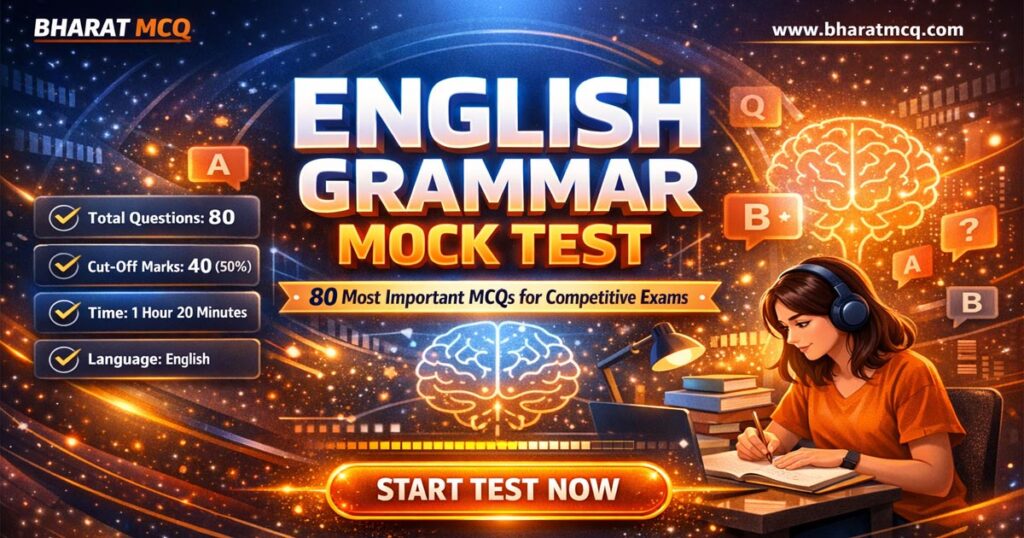
Practice a full-length English Grammar Mock Test 80 MCQs designed for SSC, Clerk, Police, PSI, and state-level competitive exam preparation.
Table of Contents
English Grammar Mock Test for Competitive Exams: Full-Length Practice Guide
English grammar remains one of the most scoring yet most misunderstood sections in Indian competitive exams. Whether you are preparing for Talati, Police Bharti, PSI, Clerk, SSC, or other state-level and national-level recruitment exams, grammar-based questions appear regularly and often decide the final merit position. A candidate may know the rules in theory, but exam performance depends on speed, accuracy, and the ability to identify subtle errors under pressure.
A full-length English Grammar mock test is therefore not just a practice resource. It is a performance-checking tool. It helps you measure how well you can handle grammar questions in an exam-like setting, how consistently you apply rules, and where your errors are happening. This mock test with 80 questions is designed to reflect the level and structure commonly seen in real competitive examinations.
Why English Grammar Matters in Competitive Exams
In most competitive exams, English grammar is included because it tests more than language knowledge. It checks attention to detail, logical understanding, sentence control, and error detection. Government recruitment exams often rely on objective questions, and grammar is ideal for that format because it can be tested through sentence correction, fill-in-the-blanks, error spotting, narration, voice, tenses, prepositions, agreement, and transformation.
For aspirants, grammar offers one major advantage: it is highly rule-based. Unlike reading comprehension, which depends more on interpretation, grammar can be improved through repeated targeted practice. If you have a clear command over core areas such as subject-verb agreement, articles, modifiers, conditionals, and reported speech, your accuracy rate can improve quickly.
In exams where even one mark affects ranking, grammar becomes a high-value section. Candidates who prepare it seriously usually gain a dependable scoring edge.
Types of Grammar Questions Asked in Real Exams
The grammar section in competitive exams is rarely limited to very basic school-level questions. Most papers combine direct rule-based questions with application-oriented sentence-level problems. That is why candidates who only memorise definitions often struggle.
1. Fill in the blanks
These questions test your understanding of tense, preposition, article, conjunction, or verb form. One missing word changes the entire sentence, so context is important.
2. Error identification
These are common in SSC, clerk, and police recruitment exams. You may be asked to spot errors in agreement, pronoun use, sentence structure, comparison, or modifier placement.
3. Sentence improvement
In this format, a part of the sentence may be underlined or implied, and you have to choose the best correction. These questions require both grammar knowledge and sentence sense.
4. Active and passive voice
Competitive exams often test whether you can accurately transform a sentence while preserving its meaning.
5. Direct and indirect speech
Reported speech remains a standard grammar area, especially in objective English sections.
6. Conditionals and transformation
Advanced mock tests include inverted conditionals, subjunctive forms, emphatic structures, and formal sentence transformations.
7. Punctuation and parallelism
Though fewer in number, such questions appear in quality mock tests and in actual papers to test precision.
A serious grammar mock test should include all of these areas in balanced form, with gradual progression from straightforward rule-based items to higher-level application questions.
Practical Strategy to Prepare English Grammar Effectively
Aspirants often prepare grammar in a random way. They solve a few questions from one topic, then move to another without checking whether the underlying rule is clear. That approach rarely works in competitive exams.
Build topic-wise clarity first
Start with high-frequency topics: articles, tenses, subject-verb agreement, pronouns, prepositions, voice, narration, conditional sentences, modifiers, and conjunctions. Do not move ahead until you can identify the rule behind a correct answer.
Maintain a grammar error notebook
Whenever you get a question wrong, note the sentence, the correct form, and the exact rule involved. Over time, this notebook becomes more useful than any theory book because it reflects your personal weak areas.
Solve mixed-topic MCQs regularly
Once topic-wise preparation is done, switch to full-length mixed practice. Real exams do not group questions chapter-wise. You must learn to shift quickly from tense to preposition to reported speech without losing accuracy.
Practise with time control
Do not solve all grammar questions in a relaxed way. Fix a time limit. For example, attempt 20 grammar questions in 12 to 15 minutes. This builds exam temperament and improves answer selection speed.
Review answer patterns
After every mock test, do not simply count marks. Analyse which category caused maximum mistakes. If you repeatedly lose marks in modifiers or conditionals, that is where your revision should go.
Common Mistakes Students Make in Grammar Preparation
Many candidates put in effort but still fail to improve because of recurring preparation mistakes.
Memorising without application
Reading rules alone is not enough. Grammar improves only when rules are repeatedly applied in questions.
Ignoring sentence context
Candidates often choose an option because it looks familiar, not because it fits the sentence logically and grammatically.
Overlooking subject-verb agreement traps
Words like “along with,” “as well as,” “either…or,” and “neither…nor” create confusion. These are standard exam traps.
Confusing formal and spoken English
Some forms are common in speech but not acceptable in competitive exam grammar. Objective papers test standard written usage.
Not revising previous mistakes
If you do not revisit wrong answers, you will continue making the same errors across mock tests.
Practising only easy questions
A good exam paper includes moderate and advanced items. Limiting yourself to basic questions gives false confidence.
Why MCQ Practice is Essential
MCQ-based grammar practice is the most exam-relevant method because it trains both accuracy and discrimination. In multiple-choice questions, all four options are designed to look possible at first glance. The skill lies in identifying the one option that is grammatically precise.
Regular MCQ practice improves:
- rule recall under time pressure
- elimination ability
- attention to small differences in usage
- familiarity with common exam traps
- confidence in mixed-topic grammar sections
A full-length grammar mock test also helps you understand stamina. Solving 80 questions demands concentration, pattern recognition, and consistency. That is exactly why mock practice matters before the final exam.
Use This Mock Test as a Structured Practice Tool
Do not attempt this mock test casually. Use it in proper exam mode. Sit with a timer, avoid interruptions, and complete all 80 questions in one sitting if possible. After finishing, review every incorrect answer and classify it topic-wise. That review process is where real improvement happens.
Suggested method
- Attempt the full test seriously.
- Check your score and accuracy.
- Mark weak grammar areas.
- Revise rules from those topics.
- Re-attempt similar mixed questions within a few days.
This method turns one mock test into a full revision cycle.
English Grammar Mock Test: Important Questions with Detailed Explanations
(1) Question: Neither the teacher nor the students ______ present in the meeting yesterday.
Answer: were
Explanation: When two subjects are joined by ‘neither… nor’, the verb must agree with the closer subject. Since “students” is plural and closer to the blank, the plural past tense verb “were” is correct.
(2) Question: She has been living in this city ______ ten years.
Answer: for
Explanation: “For” is used to denote a specific duration or period of time (ten years), whereas “since” is used to refer to a specific starting point in time.
(3) Question: Change the following sentence into passive voice: “The chef prepared a delicious meal.”
Answer: A delicious meal was prepared by the chef.
Explanation: To convert a sentence from active to passive voice, the object (a delicious meal) becomes the new subject. Since the original sentence is in the simple past tense, the passive structure requires “was/were + past participle (prepared)”.
(4) Question: Identify the grammatical error in the following sentence: “One of my friends are planning a trip to Goa next month.”
Answer: The plural verb ‘are’ should be replaced with the singular verb ‘is’.
Explanation: The true subject of the sentence is the pronoun “One”, which is singular. The phrase “of my friends” is a prepositional phrase modifying the subject. Therefore, a singular verb (“is”) is required.
(5) Question: Select the correct word to fill in the blank: The economic crisis had a severe ______ on the small business owners.
Answer: effect
Explanation: “Effect” is a noun that means the result or outcome of an action. “Affect” is typically a verb meaning to influence or make a difference to something.
(6) Question: Complete the conditional sentence: If it rains tomorrow, we ______ the football match.
Answer: will cancel
Explanation: This is a first conditional sentence, which expresses a real possibility in the future. The structure requires the simple present tense (“rains”) in the if-clause and “will + base form of the verb” (“will cancel”) in the main clause.
(7) Question: Change the sentence to indirect speech: Rohan said, “I am writing a letter now.”
Answer: Rohan said that he was writing a letter then.
Explanation: In indirect speech, the present continuous tense (“am writing”) changes to the past continuous tense (“was writing”). Additionally, the personal pronoun “I” changes to “he” to match the speaker, and the time adverb “now” changes to “then”.
(8) Question: Fill in the blank with the appropriate article: Copper is ______ useful metal.
Answer: a
Explanation: Although the word “useful” begins with the vowel letter ‘u’, it starts with a consonant sound (/juː/ or ‘yoo’). The choice between ‘a’ and ‘an’ depends on the sound, not the spelling, making “a” the correct choice.
(9) Question: Choose the correct word to complete the phrase: He is too weak ______ walk without support.
Answer: to
Explanation: The adverbial structure “too + adjective + to + verb” is used to indicate a negative consequence, meaning he is so weak that he cannot walk.
(10) Question: Identify the correct collective noun: A ______ of wolves chased the deer through the forest.
Answer: pack
Explanation: “Pack” is the specific collective noun designated for a group of wolves or hounds working together.
(11) Question: Fill in the blank with the correct conjunction: Although he worked extremely hard, ______ he could not pass the examination.
Answer: yet
Explanation: The subordinating conjunction “Although” is traditionally paired with “yet” or a comma to join the contrasting main clause. Using “but” alongside “although” in the same sentence is a grammatical redundancy error.
(12) Question: Choose the correct word to complete the sentence: The dynamic entrepreneur is known for his ______ business strategies.
Answer: ingenious
Explanation: “Ingenious” means clever, original, and inventive, which fits the context of successful business strategies. “Ingenuous”, on the other hand, means innocent, naive, or unsuspecting.
(13) Question: Spot the error in the sentence: “Hardly had I arrived at the station than the train left.”
Answer: The word ‘than’ should be replaced with ‘when’ (or ‘before’).
Explanation: The correlative expressions “Hardly… when” and “Scarcely… when” are fixed idioms in English grammar. The word “than” is strictly reserved for the expression “No sooner… than”.
(14) Question: Fill in the blank with the correct pronoun form: Between you and ______, this secret should not be shared with anyone.
Answer: me
Explanation: The word “between” is a Instead of subjective case (“I”), all prepositions must be followed by pronouns in the objective case (“me”).
(15) Question: Fill in the blank with the correct tense: By the time the police arrived, the thief ______ away.
Answer: had run
Explanation: When two actions occurred at different times in the past, the earlier action is expressed using the past perfect tense (“had run”) and the subsequent action is expressed in the simple past tense (“arrived”).
– (16) Question: What is the antonym of the word ‘Transient’?
Answer: Permanent
Explanation: “Transient” refers to something that lasts for only a short time or is temporary. Therefore, its exact opposite is “permanent” or “enduring”.
(17) Question: Complete the sentence with the correct question tag: You haven’t finished your assignment yet, ______?
Answer: have you
Explanation: The rule for question tags states that if the statement is negative (“haven’t finished”), the corresponding question tag must be positive (“have you”), utilizing the same auxiliary verb and pronoun.
(18) Question: What is the meaning of the idiom ‘To burn the midnight oil’?
Answer: To work or study late into the night.
Explanation: This idiomatic expression historically refers to utilizing an oil lamp to continue working or studying long after regular daylight hours have passed.
(19) Question: Identify the part of speech of the bold word: The elderly man walked slowly down the street.
Answer: Adverb
Explanation: The word “slowly” modifies the verb “walked” by describing the manner in which the action was performed, which categorizes it as an adverb of manner.
(20) Question: Fill in the blank with the correct modal verb: You ______ drive fast; the speed limit here is strictly 40 km/h.
Answer: must not
Explanation: “Must not” (or mustn’t) is used to express a strict prohibition or legal obligation where an action is completely against rules and regulations.
Practice Test CTA
If you are preparing for SSC, Clerk, Police Bharti, PSI, Talati, or any other competitive exam, use this English Grammar mock test as part of your regular weekly practice. Attempt the complete 80-question set, track your score, and repeat the process with strict review. Consistent mock-based grammar preparation is one of the fastest ways to improve marks in the English section and strengthen your overall exam performance.