
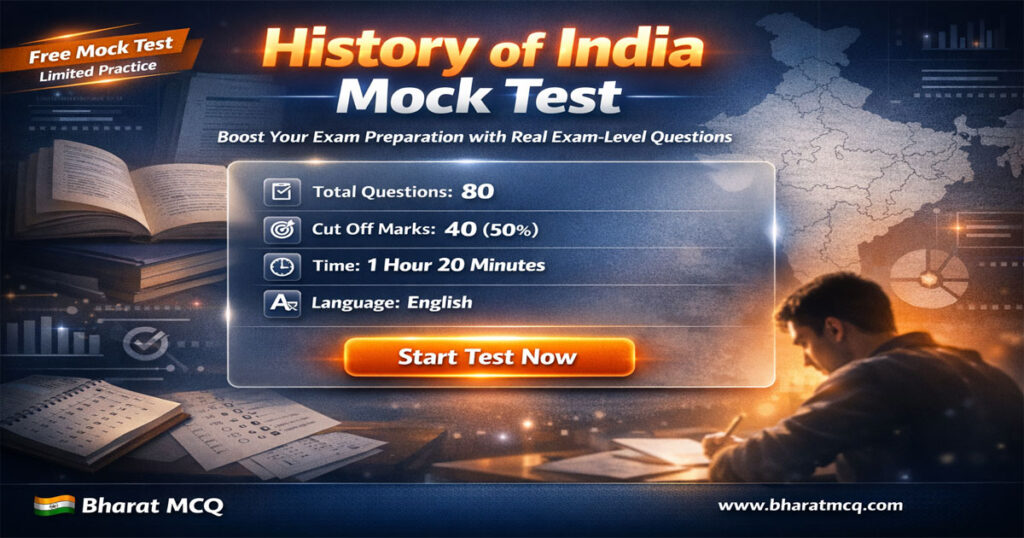
Practice 80 high-quality MCQs on Indian History for UPSC, SSC, and state exams. Boost your preparation with exam-level questions.
Introduction : History of India Mock Test
Indian History is one of the most crucial subjects in almost every competitive examination in India, including UPSC, SSC, State PSC, Police Bharti, Talati, and Clerk exams. A strong command over history not only helps in scoring high marks but also enhances overall awareness of India’s socio-political and cultural evolution. This mock test of 80 MCQs is designed to simulate real exam conditions and improve accuracy, speed, and conceptual clarity.
India’s history, spanning over 5,000 years, began with the Indus Valley Civilization (c. 2500–1900 BCE), followed by the Vedic period, which shaped Hinduism. Major ancient empires included the Maurya and Gupta, known for art, science, and Buddhism. Medieval India saw the Delhi Sultanate and Mughal rule, while modern history was marked by British colonial rule, the 1947 independence/partition, and growth as a major democracy.
Importance of Indian History in Competitive Exams
Indian History plays a significant role in both preliminary and mains examinations. Questions are frequently asked from Ancient, Medieval, and Modern India, with a strong emphasis on conceptual understanding rather than rote learning.
- In UPSC and State PSC exams, history contributes a major portion of General Studies.
- In SSC and Railway exams, history questions are direct but require factual accuracy.
- Police and clerical exams focus on key events, timelines, and personalities.
Understanding history helps candidates connect events, analyze patterns, and answer application-based questions efficiently.
Types of Questions Asked in Real Exams
Competitive exams test candidates through a variety of question formats:
1. Factual Questions
These are direct questions based on dates, events, and personalities.
Example: Who founded the Mauryan Empire?
2. Conceptual Questions
These require understanding of systems like administration, economy, and culture.
Example: Features of the Iqta system.
3. Chronological Order
Candidates may be asked to arrange events in sequence.
4. Assertion-Reason Questions
Mostly seen in higher-level exams like UPSC.
5. Match the Following
These test depth of knowledge across multiple topics.
The mock test above includes a balanced mix of all these types to reflect actual exam patterns.
Preparation Strategy
A smart preparation strategy is essential to master Indian History:
1. Divide the Syllabus
Break history into three parts:
- Ancient India
- Medieval India
- Modern India
2. Focus on NCERTs
Start with NCERT textbooks (Class 6–12) to build a strong foundation.
3. Make Short Notes
Prepare concise notes for quick revision, especially for:
- Important dates
- Dynasties
- Acts and movements
4. Practice MCQs Regularly
Daily MCQ practice helps in:
- Identifying weak areas
- Improving time management
- Enhancing retention
5. Revise Frequently
Revision is key. Without revision, retention drops significantly.
Common Mistakes Students Make
Many aspirants struggle with history due to avoidable mistakes:
- Rote Learning: Memorizing without understanding concepts
- Ignoring Ancient & Medieval: Over-focusing on Modern India
- Lack of Revision: Not revisiting topics regularly
- Skipping MCQ Practice: Theory alone is not sufficient
- Poor Time Management: Spending too much time on one section
Avoiding these mistakes can significantly improve performance.
Benefits of MCQ Practice
Practicing MCQs is one of the most effective ways to prepare for competitive exams:
- Improves accuracy and speed
- Helps in understanding exam patterns
- Strengthens conceptual clarity
- Identifies weak topics quickly
- Builds confidence for real exams
The provided 80-question mock test is structured to gradually increase difficulty, ensuring a real exam-like experience.
Practice Test (Internal CTA)
If you are serious about cracking competitive exams, consistent practice is non-negotiable. Attempt this full-length mock test and analyze your performance carefully.
- Try to complete the test within a fixed time
- Avoid guessing blindly
- Review incorrect answers
- Revise weak areas immediately
Regular practice with such high-quality mock tests will significantly boost your chances of success in exams like UPSC, SSC, Talati, and Police Bharti.
Start practicing now and take your preparation to the next level.