
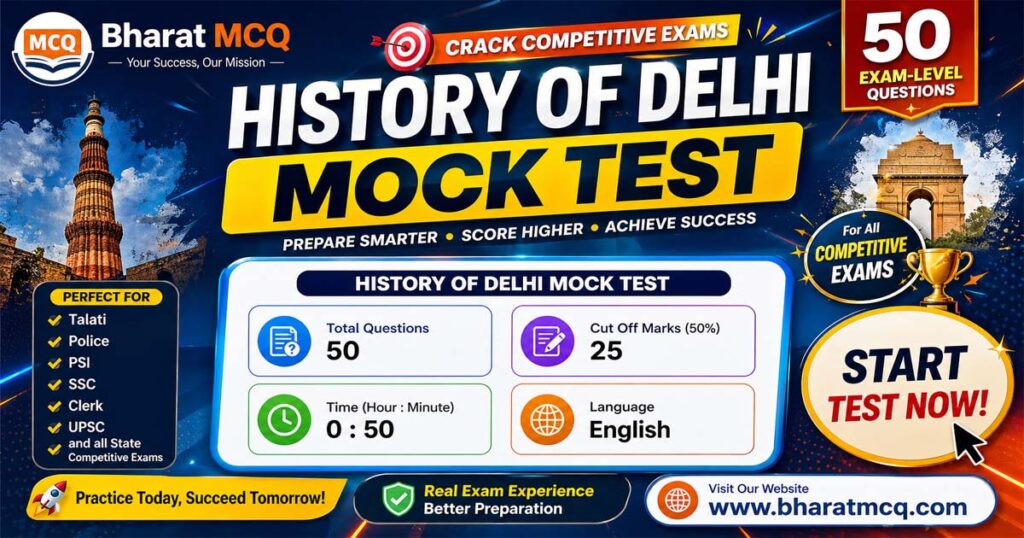
Practice 50 exam-level History of Delhi MCQ Test for Talati, Police, PSI, SSC, Clerk, UPSC and state competitive exam preparation.
Table of Contents
History of Delhi MCQ Test for Competitive Exams
History of Delhi is one of the most important historical regions for Indian competitive exams. Its history covers ancient traditions, Rajput rule, the Delhi Sultanate, Mughal urban development, colonial planning, the Revolt of 1857, Partition, and post-independence India. Because of this long and layered past, questions from the history of Delhi regularly appear in exams such as SSC, UPSC, State PSC, Police Bharti, PSI, Clerk, Talati and other state-level recruitment tests.
This History of Delhi MCQ test is designed for aspirants who want exam-oriented practice rather than simple textbook revision. The questions focus on political developments, monuments, rulers, urban centres, historical events, administrative changes and cultural importance. A strong command over Delhi’s history helps students answer both direct factual questions and analytical questions based on chronology, cause and effect, and historical significance.
Importance of Delhi History in Competitive Exams
Delhi has been a major centre of power for several centuries. It was connected with ancient Indraprastha traditions, the Tomara and Chauhan rulers, the Turkish conquest, the Delhi Sultanate, the Mughal Empire and the British colonial state. After independence, it became the capital of the Republic of India. This makes Delhi a high-value topic for General Knowledge and History sections.
In competitive exams, Delhi is not asked only as a local history topic. It is linked with medieval Indian polity, architecture, administration, urbanisation, colonial history and national movement. For example, a question about Qutub Minar may test knowledge of early Sultanate architecture. A question on Shahjahanabad may test Mughal urban planning. A question on the 1911 Delhi Durbar may test British administrative history. Therefore, preparing Delhi history helps aspirants revise multiple periods of Indian history together.
For state-level exams, Delhi-based questions are often asked to test awareness of important capitals, dynasties, monuments and events. For national-level exams, the topic may appear in a more analytical way, where candidates must identify correct pairs, chronological order, historical significance or the broader impact of a ruler’s policy.
Types of Questions Asked in Real Exams
Real competitive exams usually ask different types of questions from the history of Delhi. The most common type is the ruler-monument question. Examples include Qutub Minar, Alai Darwaza, Tughlaqabad Fort, Firoz Shah Kotla, Humayun’s Tomb, Red Fort and Jama Masjid. These questions require accurate matching of monuments with rulers or dynasties.
Another common type is chronology-based questions. Candidates may be asked to arrange Lal Kot, Siri, Tughlaqabad, Shahjahanabad and New Delhi in correct order. Such questions are important because Delhi developed through several urban centres over time. Students should not study these names separately; they should understand the sequence of Delhi’s political and urban growth.
Policy-based questions are also frequent. Alauddin Khalji’s market control policy, Muhammad bin Tughlaq’s capital transfer, Balban’s theory of kingship and Firoz Shah Tughlaq’s construction activities are examples. These questions test not only facts but also the purpose behind a policy.
Colonial Delhi is another important area. The Revolt of 1857, Bahadur Shah Zafar, the British capture of Delhi, the 1911 Delhi Durbar, the transfer of capital from Calcutta to Delhi and the inauguration of New Delhi in 1931 are all exam-relevant points. Questions from this section often connect Delhi with modern Indian history.
Preparation Strategy for History of Delhi
Aspirants should prepare Delhi history through a timeline-based method. Start with ancient references and early settlements, then move to Tomara and Chauhan rule, the foundation of the Delhi Sultanate, the Khalji and Tughlaq phases, the Mughal period, colonial Delhi and post-independence developments. This method helps avoid confusion between rulers, monuments and cities.
Prepare a separate list of Delhi’s major cities and their founders. For example, Lal Kot is linked with the Tomaras, Qila Rai Pithora with Prithviraj Chauhan, Siri with Alauddin Khalji, Tughlaqabad with Ghiyasuddin Tughlaq, Firozabad with Firoz Shah Tughlaq, Shahjahanabad with Shah Jahan and New Delhi with British colonial planning. This list is extremely useful for quick revision.
Monuments should be revised with three details: builder, dynasty and historical importance. Do not simply memorize names. Understand why a monument matters. Humayun’s Tomb is important as an early major garden tomb. Red Fort represents Mughal imperial architecture. Rashtrapati Bhavan was originally the Viceroy’s House. Such details help in application-based questions.
For medieval Delhi, focus on administrative and military aspects. The Sultanate rulers used Delhi as a centre of authority, revenue control, military expansion and defence against invasions. For Mughal Delhi, focus on urban planning, imperial culture and Shahjahanabad. For British Delhi, focus on administrative transfer, New Delhi’s design and the symbolic use of architecture.
Common Mistakes Students Make
One common mistake is confusing the dynasties of the Delhi Sultanate. Many students mix up Khalji, Tughlaq, Sayyid and Lodi rulers. To avoid this, prepare a short dynasty chart with important rulers and their contributions.
Another mistake is memorizing monuments without location and context. For example, students may remember Alai Darwaza but forget that it is in the Qutub complex and belongs to the Khalji period. Similarly, Firoz Shah Kotla should be linked with Firoz Shah Tughlaq and the Ashokan pillar installed there.
Students also confuse the Revolt of 1857 with later nationalist events. In Delhi, 1857 is especially important because Bahadur Shah Zafar became the symbolic leader of the rebels and the suppression of the revolt ended Mughal political authority. This point is repeatedly useful in exams.
Many aspirants ignore colonial urban history. New Delhi was not just another city; it was planned as a capital to display imperial authority. Questions on Lutyens, Herbert Baker, Viceroy’s House, Central Vista and the 1911 Delhi Durbar can appear in both history and general awareness sections.
Benefits of MCQ Practice
MCQ practice is essential because competitive exams test speed, accuracy and concept clarity. Reading history once is not enough. Candidates must be able to identify correct options under time pressure. A well-designed MCQ test helps students revise facts, detect weak areas and improve decision-making.
Practicing Delhi history MCQs also improves elimination skills. In many questions, two options may look similar. If the candidate knows chronology, dynasty sequence and monument-builder relationships, the wrong options can be removed quickly. This is especially useful in SSC, Police, Clerk and State PSC exams.
Regular MCQ practice also helps in retaining factual details. Dates such as 1192, 1398, 1526, 1739, 1803, 1857, 1911 and 1931 are easier to remember when used repeatedly in questions. Similarly, names like Iltutmish, Alauddin Khalji, Firoz Shah Tughlaq, Shah Jahan, Bahadur Shah Zafar, Edwin Lutyens and Herbert Baker become clearer through practice.
Practice Test
To prepare effectively, attempt the full History of Delhi MCQ test given above in exam mode. First, solve all 50 questions without checking answers. Then review your incorrect responses and classify mistakes into categories such as chronology, monuments, rulers, policies or colonial history. This method gives a clear picture of your preparation level.
For best results, revise the topic once, take the MCQ test, analyze your score and repeat the test after a few days. This approach is useful for Talati, Police Bharti, PSI, SSC, Clerk, UPSC foundation preparation and other competitive exams where Indian history and general knowledge play an important role.