
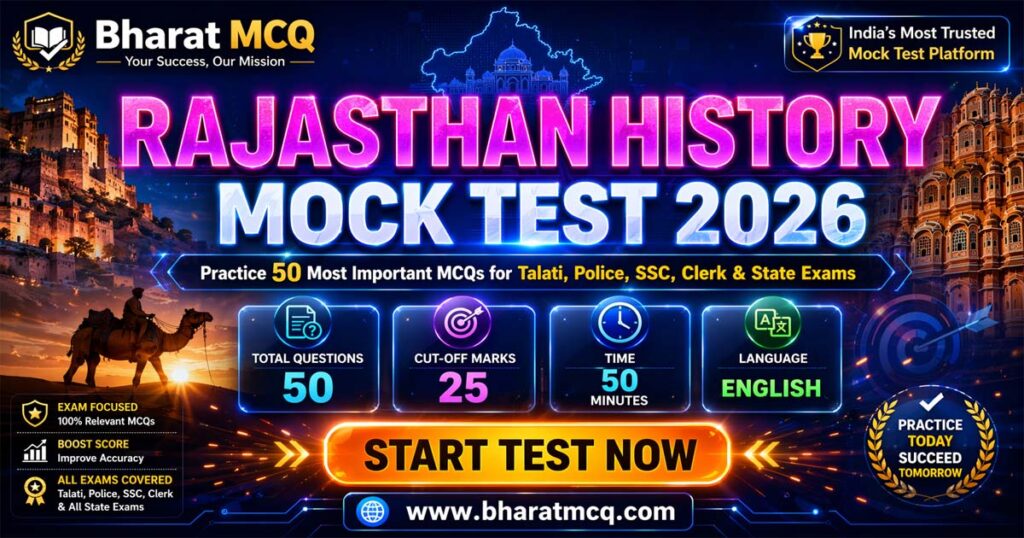
Take this Rajasthan History mock test with 50 high-quality MCQs for Talati, Police, SSC, Clerk and state exams. Improve accuracy with exam-style practice.
Table of Contents
Rajasthan History Practice Test for Competitive Exams
Rajasthan history is an important scoring area in many competitive exams because it combines factual knowledge, chronology, political developments, regional culture, and modern state formation in one subject. Whether you are preparing for Talati-type local administration exams, Police Bharti, PSI, Clerk, SSC, or any state-level competitive test, questions from Rajasthan history are often framed in a direct but tricky way. Examiners usually do not ask only school-level facts. They test whether a candidate can connect dynasties, battles, inscriptions, popular movements, forts, princely states, and post-Independence integration in a structured manner.
A well-designed Rajasthan History mock test helps students move beyond passive reading. It forces recall, improves elimination skills, and shows whether the candidate actually understands the subject in exam language. That is why practice through objective questions remains one of the most practical methods for preparation.
Why History of Rajasthan Matters in Competitive Exams
Rajasthan history has a wide range. It starts from prehistoric and protohistoric cultures such as Kalibangan, Ahar, and Ganeshwar, moves through the period of Mahajanapadas and early medieval powers, and then becomes especially important in the Rajput, Mughal, colonial, and integration phases. This variety makes it ideal for exam setters because questions can be asked from multiple levels.
In real exams, Rajasthan history is useful for three reasons. First, it has high factual density. Names of rulers, forts, battles, inscriptions, and reformers can all be converted into MCQs. Second, it supports analytical questions. A paper setter can ask not only “who founded Jaipur” but also why Jaipur is historically important as a planned city. Third, it overlaps with general studies. Topics such as the Prajamandal movements, tribal resistance, and Rajasthan’s integration after Independence are connected with modern Indian history and polity.
For aspirants, this means Rajasthan history is not a side topic. It is a scoring topic when revised properly and a damaging topic when left for last-minute memorisation.
Types of Questions Asked in Real Exams
1. Ancient and Archaeological Questions
These questions usually come from sites, excavations, material culture, and early settlements. Examiners may ask about Kalibangan, Ahar-Banas culture, Ganeshwar-Jodhpura culture, Viratnagar, or early historical centres like Bhinmal. The pattern is often simple on the surface but can become confusing because options are closely related.
Examples of common areas:
- archaeological significance of a site
- association of a site with a district or region
- inscription-based history
- notable scholars linked with places
2. Medieval Dynasties, Forts, and Battles
This is the most frequently tested segment. The examiner may ask about the Chahamanas, Sisodias, Rathores, Kachwahas, Hadas, Bhatis, or the interaction of Rajasthan states with the Delhi Sultanate and the Mughals. Forts such as Chittorgarh, Kumbhalgarh, Mehrangarh, Jaisalmer, and Ranthambore are common sources of questions.
Typical question patterns include:
- founder of a city or fort
- battle and year
- ruler and dynasty matching
- victory monuments and inscriptions
- political significance of an event such as Khanwa, Haldighati, or Dewair
3. Modern Rajasthan and Political Movements
This part is extremely important because many students focus only on Rajput history and neglect the modern phase. Competitive exams frequently ask about Bijolia movement, Govind Guru, Motilal Tejawat, Prajamandal activities, princely states, Matsya Union, and the formation of Greater Rajasthan.
These questions are often more scoring because facts are direct if revised from good notes.
Practical Preparation Strategy for Rajasthan History
Build a Timeline First
Do not prepare Rajasthan history as isolated facts. Start with a timeline. Divide the subject into ancient, early medieval, Rajput states, Mughal interactions, colonial developments, popular movements, and integration after Independence. A timeline reduces confusion between similar names and events.
Study Theme-Wise, Not Only Chapter-Wise
Instead of reading one book straight from beginning to end, make topic clusters:
- archaeological sites
- dynasties and capitals
- forts and architecture
- major battles
- reform and resistance movements
- Rajasthan integration
This method matches the way questions are framed in exams.
Use Short Notes for High-Retention Topics
Prepare one-page notes for:
- important rulers and their achievements
- important battles with year and outcome
- inscriptions and monuments
- tribal and peasant movements
- post-Independence political integration
The purpose of short notes is quick revision before mock tests.
Practice Elimination Through MCQs
In competitive exams, you may not know every answer directly. Many questions can still be solved through elimination. If you know that Ganga Singh belongs to Bikaner, you can eliminate wrong state pairings. If you know Haldighati is later than Khanwa, chronology questions become easier.
That is why repeated MCQ practice is not optional. It trains the mind to identify the most probable correct answer under time pressure.
Common Mistakes Students Make
One common mistake is over-focusing on famous names only. Many candidates read only Maharana Pratap, Rana Sanga, and Jaipur, but neglect inscriptions, movements, and integration stages. This creates gaps that exam setters exploit.
Another mistake is learning facts without context. If you memorise that Kumbhalgarh was built by Rana Kumbha but do not understand its defensive significance, you may fail in conceptual questions.
A third mistake is ignoring chronology. Rajasthan history has many similar names, especially among rulers. Without timeline revision, candidates confuse Jai Singh I with Jai Singh II, or mix medieval and modern developments.
The final mistake is poor revision discipline. Students read once, feel familiar with the subject, and stop testing themselves. Familiarity is not the same as exam readiness.
Why MCQ Practice Improves Scores
MCQ practice improves performance in several measurable ways. It increases recall speed, helps identify weak sections, improves accuracy under time pressure, and teaches option analysis. It also shows which facts are secure and which are only partially remembered.
A full-length practice set is even more useful because it simulates the mental movement of a real paper. You may start with archaeology, shift to Rajput states, move into Mughal relations, and finish with modern political developments. This transition is exactly what happens in competitive exams, and it tests concentration as much as memory.
Regular practice also helps you build a revision loop. After each test, mark questions by topic. If you lose marks in inscriptions, movements, or chronology, revise that section the same day.
Chalo, image_258048.jpg na topic (Rajasthan History Mock Test) pramane 20 important questions ready chhe.
Aama પણ badha j Question tags ne bold kari didha chhe ane vachche --- dividers sathe double line spacing raakhi chhe, jethi WordPress block editor ma direct copy-paste karti vakhte automatic alag blocks bani jay.
Rajasthan History Mock Test: Important Questions with Detailed Explanations
(1) Question: In which year was the historic Battle of Haldighati fought between Maharana Pratap and the Mughal army led by Raja Man Singh?
Answer: 1576
Explanation: The Battle of Haldighati was fought on June 18, 1576. It was a fierce clash between the forces of Maharana Pratap, the ruler of Mewar, and the imperial Mughal army of Emperor Akbar, commanded by Raja Man Singh I of Amber.
(2) Question: Which Kachwaha Rajput ruler founded the planned city of Jaipur in the year 1727?
Answer: Maharaja Sawai Jai Singh II
Explanation: Jaipur was founded on November 18, 1727, by Maharaja Sawai Jai Singh II. The city was meticulously planned and designed by the famous architect Vidyadhar Bhattacharya based on principles of Vastu Shastra and Shilpa Shastra.
(3) Question: The famous Vijay Stambha (Tower of Victory) at Chittorgarh Fort was constructed by Rana Kumbha to commemorate his victory over which ruler?
Answer: Mahmud Khilji of Malwa
Explanation: Rana Kumbha constructed the magnificent 9-story Vijay Stambha between 1440 and 1448 to celebrate his historic victory over the combined armies of Malwa and Gujarat led by Sultan Mahmud Khilji in the Battle of Sarangpur.
(4) Question: Who is traditionally regarded as the real founder of the Guhila (Guhilot) dynasty of Mewar, who captured Chittor from the Mori Rajputs in the 8th century?
Answer: Bappa Rawal
Explanation: Bappa Rawal (born Kalbhoj) is considered the true founder and consolidator of the Mewar Kingdom. In 734 CE, he captured the strategic Chittorgarh Fort from the Mori Rajput ruler Man Mori and established Nagda as his capital.
(5) Question: The historic First Battle of Tarain (1191 CE) was fought between Chahamana king Prithviraj Chauhan III and which invader?
Answer: Muhammad Ghori
Explanation: The Battles of Tarain were fought near Karnal (modern Haryana). In the First Battle (1191), Prithviraj Chauhan decisively defeated Muhammad Ghori. However, in the Second Battle of Tarain (1192), Ghori returned with a strategic plan and defeated Chauhan, opening the gates for Muslim rule in North India.
(6) Question: The modern state of Rajasthan was formed through a process of political integration that took place in how many distinct stages?
Answer: 7 stages
Explanation: The integration of 19 princely states and 3 chiefships into the single state of Rajasthan was completed in 7 stages. The process started with the formation of the Matsya Union on March 17, 1948, and culminated in its final shape on November 1, 1956.
(7) Question: Which Rathore ruler laid the foundation stone of the majestic Mehrangarh Fort in Jodhpur in the year 1459?
Answer: Rao Jodha
Explanation: Rao Jodha, the ruler of Marwar, founded the city of Jodhpur and began the construction of the massive Mehrangarh Fort on an isolated rocky cliff known as Bhakurcheeria in 1459 to establish a more secure capital than Mandore.
(8) Question: Which movement in Rajasthan holds the record for being the longest continuous, fully non-violent peasant movement in Indian history?
Answer: Bijolia Peasant Movement
Explanation: The Bijolia movement started in 1897 and lasted for 44 years until 1941. It was a mass protest by farmers against excessive land revenue, forced labor (Begar), and 84 different types of unjust taxes imposed by the feudal lords (Jagirdars). It was famously led by Vijay Singh Pathik.
(9) Question: The historic first ‘Saka’ (mass self-immolation/Jauhar and battle to the death) of Chittorgarh took place in 1303 CE when which Delhi Sultan attacked the fort?
Answer: Alauddin Khilji
Explanation: In 1303, Sultan Alauddin Khilji besieged Chittorgarh Fort to expand his empire (and driven by legends surrounding Queen Padmini). Facing defeat, Rawal Ratan Singh and his soldiers performed ‘Shaka’, and Rani Padmini along with thousands of women committed ‘Jauhar’.
(10) Question: The architectural heritage site ‘Kirti Stambha’ (Tower of Fame) at Chittorgarh is dedicated to which spiritual figure?
Answer: Adinath (Rishabhanatha), the first Jain Tirthankara
Explanation: Kirti Stambha is a 12th-century tower built by a wealthy Jain merchant named Jijabhai Rathod. It stands at 22 meters tall and is adorned with intricate carvings dedicated specifically to Adinath, the first Jain Tirthankara.
(11) Question: The crucial Battle of Khanwa (1527 CE) was fought between the Mughal Emperor Babur and which Rajput monarch?
Answer: Rana Sanga (Maharana Sangram Singh)
Explanation: Fought on March 16, 1527, near Khanwa village (Bharatpur district), the Battle of Khanwa was a major turning point. Babur utilized artillery and advanced military tactics to defeat the vast confederacy of Rajput rulers led by Rana Sanga of Mewar.
(12) Question: Which prominent freedom fighter and social reformer is popularly known as the “Gandhi of Rajasthan”?
Answer: Gokulbhai Bhatt
Explanation: Gokulbhai Bhatt was an eminent freedom fighter, social activist, and a close associate of Mahatma Gandhi. He hailed from Sirohi and played a major role in the Prajamandal movement and the integration of Sirohi into Rajasthan.
(13) Question: Who is considered the pioneer or founder prince of the Rathore dynasty in the Marwar region of Rajasthan?
Answer: Rao Siha
Explanation: In the early 13th century, Rao Siha, a descendant of the Gahadavala dynasty of Kannauj, migrated to western Rajasthan. He established a small principality near Pali, laying the ultimate foundational root of the Rathore kingdom of Marwar.
(14) Question: Which legendary ruler of Mewar is credited with constructing 32 of the 84 major defensive forts in the region, including the formidable Kumbhalgarh Fort?
Answer: Rana Kumbha (Maharana Kumbhakaran)
Explanation: Rana Kumbha was not only a formidable warrior but also a prolific builder and patron of the arts. His architectural masterpiece is Kumbhalgarh Fort, which features the second-longest continuous wall in the world after the Great Wall of China.
(15) Question: Which historic city was designated as the capital of the ‘Matsya Union’, the very first stage of the integration of Rajasthan in 1948?
Answer: Alwar
Explanation: Formed on March 17, 1948, the Matsya Union comprised the four princely states of Alwar, Bharatpur, Dholpur, and Karauli. Alwar was chosen as the administrative capital of this initial union, and Shobha Ram Kumawat was made its Prime Minister.
(16) Question: Maharaja Sawai Jai Singh II built scientific astronomical observatories called ‘Jantar Mantar’ across five cities in India. Which of these is a UNESCO World Heritage Site?
Answer: Jantar Mantar of Jaipur
Explanation: Out of the five observatories built by Sawai Jai Singh II (Jaipur, Delhi, Ujjain, Varanasi, and Mathura), the Jantar Mantar in Jaipur is the largest, best-preserved, features the world’s largest stone sundial, and was inscribed as a UNESCO World Heritage site in 2010.
(17) Question: The Battle of Giri Sumel (1544 CE) was a close and desperate conflict fought between Sher Shah Suri and the forces of which Marwar ruler?
Answer: Rao Maldeo
Explanation: In the Battle of Giri Sumel (near Jaitaran), Sher Shah Suri faced extreme resistance from Maldeo’s brilliant generals Jaita and Kumpa. After winning with great difficulty due to deception, Sher Shah famously uttered: “For a handful of bajra, I would have lost the empire of Hindustan.”
(18) Question: Under which Maharana did the state of Mewar sign a subsidiary alliance treaty with the British East India Company in January 1818?
Answer: Maharana Bhim Singh
Explanation: Facing extreme financial ruin and devastating plunder from Maratha and Pindari raids, Maharana Bhim Singh of Mewar formally signed the treaty of protective alliance with British representative Charles Metcalfe in 1818.
(19) Question: The first ‘Prajamandal’ (People’s Council) in Rajasthan was established in Jaipur in 1931 under whose initial leadership?
Answer: Kapoori Chand Patni
Explanation: The Jaipur Prajamandal was the first political organization of its kind in Rajasthan, founded in 1931 by Kapoori Chand Patni to fight for civil liberties and democratic governance under the aegis of the Maharaja. It was later reorganized in 1936 by Jamnalal Bajaj.
(20) Question: Which historical place served as the very first capital of the Kachwaha Rajput clan before they shifted to Amber?
Answer: Dausa
Explanation: The Kachwaha dynasty initially established its base in eastern Rajasthan by conquering Dausa from the Badgujar Rajputs in the 10th century under Dulah Rai. Dausa served as their first capital before they moved to Ramgarh, Khoh, and eventually Amber.
Practice Test: Attempt This 50-Question Rajasthan History Set
Use the 50-question Rajasthan History practice test on this page as a timed exercise, not just a reading activity. Attempt all questions in one sitting, avoid checking answers during the test, and review mistakes topic-wise after submission. This method will give you a realistic picture of your preparation level.
For best results, attempt the test once in exam mode, then revise the weak areas, and attempt a similar set again after two or three days. Students who practise in this pattern usually improve both speed and retention.
If you are preparing seriously for competitive exams, make Rajasthan history a revision-based subject rather than a memory burden. Read with structure, revise through timelines, and test yourself through quality MCQs. Consistent exam-style practice is what turns knowledge into marks.